 Emergency:
  WhatsApp

Subscribe to our
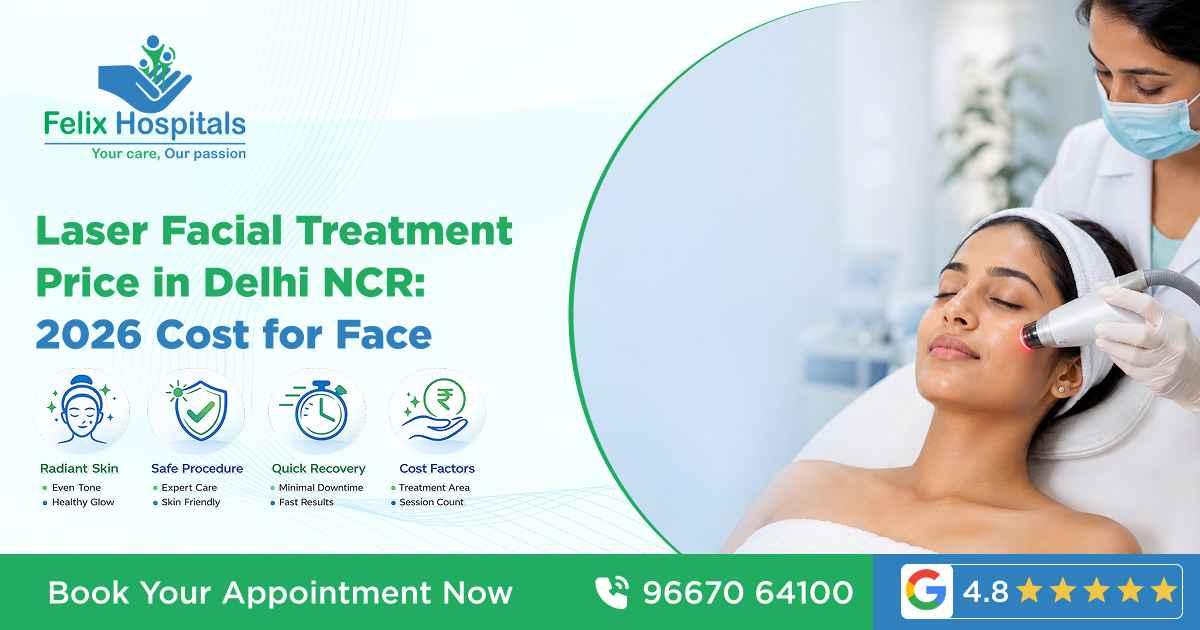
Walk into any dermatology clinic in Delhi NCR today and laser treatment comes up in almost every skin consultation. Acne scars, uneven texture, pigmentation, fine lines, dullness that nothing topical has shifted the answer increasingly involves a laser. And for good reason. The results are documented, the technology has matured significantly, and India now has access to the same clinical-grade equipment used in London and Seoul.
A laser facial treatment costs ₹4,000 at one place and ₹30,000 at another. Both call it the same thing. Neither explains what's actually different. And somewhere between those two numbers is a decision that affects your face which is not somewhere you want to be guessing.
At Felix Hospital's dermatology department, laser treatments are among the most frequently discussed procedures at consultation. What patients want most before the procedure, before the pricing is a straight answer about what they're actually paying for and what results are realistic.
Most skincare products work on the epidermis, the outermost skin layer. Serums, creams, even most chemical peels stay in this zone. Results are real but limited by how deep the product reaches.
Laser treatment reaches the dermis, the structural layer beneath. This is where collagen and elastin live, where scars are anchored, where the architecture of the skin either holds up or doesn't.
The laser creates controlled, precise injury in this layer. The body responds by activating its wound healing process producing new collagen, remodelling existing fibres, generating fresh skin cells. The result isn't just surface brightness. It's structural improvement in the skin itself.
This is why laser treatment produces results that creams genuinely cannot not because the creams are bad, but because they don't reach where the problem lives.
Understanding this distinction saves a lot of confusion when comparing treatment options and prices.
Ablative lasers remove the outermost skin layer while heating the dermis beneath: The surface is physically cleared and the deeper layer is stimulated simultaneously. Results are more dramatic but downtime is longer, three to seven days of redness, swelling, and skin peeling. CO2 and Erbium YAG are the main ablative lasers.
Non-ablative lasers leave the surface intact and work entirely below it: No visible injury, no peeling, minimal downtime often zero. Results per session are more modest than ablative treatment but accumulate significantly over a course of sessions. Q-switched Nd: YAG, pulsed dye laser, and IPL fall broadly into this category.
Neither is universally better: Deep acne scars and surgical scars respond better to ablative treatment. Pigmentation, tanning, and mild texture concerns often respond well to non-ablative approaches with no downtime at all. A dermatologist should recommend the right laser for your specific concern, not the most expensive option or the one the clinic happens to have.
By Laser Type Per Session
Laser Technology | Average Cost Per Session (India) | Best For | Downtime |
Fractional CO2 Laser | ₹8,500 – ₹18,000 | Deep acne scars, surgical scars, resurfacing | 5 – 7 days |
Erbium YAG Laser | ₹7,000 – ₹15,000 | Fine lines, surface texture, mild scars | 3 – 5 days |
MNRF (Microneedling RF / Morpheus8) | ₹12,000 – ₹25,000 | Skin tightening, deep scars, pores | 2 – 3 days |
Q-Switched Nd:YAG | ₹5,000 – ₹10,000 | Pigmentation, tanning, laser toning | Zero |
IPL / Photofacial | ₹4,000 – ₹8,000 | Sun damage, redness, mild uneven tone | Zero |
Pulsed Dye Laser | ₹8,000 – ₹20,000 | Redness, vascular concerns, fresh scars | Minimal |
Combination Protocol | ₹15,000 – ₹35,000 | Complex or multiple concerns | Varies |
By Skin Concern Per Session
Skin Concern | Minimum Per Session | Maximum Per Session |
Fine lines | ₹7,000 | ₹25,000 |
Wrinkles | ₹10,000 | ₹40,000 |
Acne scars | ₹5,000 | ₹35,000 |
Dark spots / pigmentation | ₹5,000 | ₹18,000 |
Sun damage / tanning | ₹4,000 | ₹12,000 |
Uneven skin texture | ₹6,000 | ₹20,000 |
Skin tightening | ₹12,000 | ₹35,000 |
Full face rejuvenation | ₹15,000 | ₹40,000 |
The wide ranges within each concern reflect laser type, clinic setting, and individual skin complexity, not arbitrary pricing decisions.
Area | Fractional CO2 | Q-Switched Laser | Full Face Rejuvenation | MNRF |
Noida / Greater Noida | ₹8,000 – ₹15,000 | ₹5,000 – ₹10,000 | ₹12,000 – ₹25,000 | ₹12,000 – ₹22,000 |
South Delhi (Saket, GK) | ₹10,000 – ₹20,000 | ₹6,000 – ₹12,000 | ₹15,000 – ₹30,000 | ₹15,000 – ₹28,000 |
Gurgaon (Cyber Hub area) | ₹12,000 – ₹22,000 | ₹7,000 – ₹15,000 | ₹18,000 – ₹35,000 | ₹18,000 – ₹35,000 |
West / North Delhi | ₹7,000 – ₹15,000 | ₹5,000 – ₹10,000 | ₹10,000 – ₹22,000 | ₹10,000 – ₹20,000 |
Ghaziabad | ₹6,000 – ₹12,000 | ₹4,000 – ₹8,000 | ₹8,000 – ₹18,000 | ₹9,000 – ₹18,000 |
Faridabad | ₹6,000 – ₹13,000 | ₹4,000 – ₹9,000 | ₹8,000 – ₹20,000 | ₹9,000 – ₹18,000 |
Noida offers genuinely competitive pricing relative to the rest of NCR; the technology available at reputable hospital-based dermatology departments in Noida is the same clinical-grade equipment used in South Delhi and Gurgaon. The cost difference is largely overhead and postcode, not capability.
At Felix Hospital, laser treatments are performed under dermatologist supervision using clinical-grade technology. Call +91 9667064100 for current 2026 pricing and package availability.
This is the question that matters most when comparing quotes. A ₹4,000 session and a ₹18,000 session are not the same procedure wearing different price tags. Here's what's actually different.
Medical-grade FDA-approved laser systems Lumenis, Alma, Candela, Fotona cost significantly more to acquire and maintain than unbranded alternatives. The difference in precision is significant. Clinical-grade systems deliver controlled energy at exact wavelengths with integrated cooling that protects the epidermis while treating the dermis. Non-branded machines common at budget salons and some standalone skin clinics create inconsistent energy delivery that causes hot spots, burns, and post-inflammatory hyperpigmentation.
The equipment cost shows up in the session price. A clinic offering fractional CO2 for ₹2,500 either doesn't have a genuine fractional CO2 machine or is cutting corners elsewhere. Neither is safe.
A laser is a medical device. The wavelength, fluence, pulse duration, and spot size all need to be calibrated to your specific skin type, concern, and Fitzpatrick classification. For Indian skin predominantly Fitzpatrick III to V this calibration is particularly important because darker skin has more epidermal melanin that can absorb laser energy and cause burns or hyperpigmentation if settings aren't adjusted correctly.
A board-certified dermatologist makes these calibrations based on clinical assessment. A technician follows a preset protocol. The outcome difference is not subtle.
A hospital-based dermatology department maintains sterile protocols, clinical-grade cooling and post-procedure management, and the ability to handle complications on-site. Complications are rare with properly administered laser treatment but when they occur, having a qualified clinical team immediately available is the difference between a managed outcome and a problem.
Many skin concerns respond better to combination approaches fractional CO2 followed by PRP for accelerated healing, or alternating Q-switched and fractional sessions for complex pigmentation. Combination protocols cost more per session but often produce better results in fewer total sessions, making them more cost-effective over a full treatment course.
A focused treatment for forehead lines costs less than a full face resurfacing session. Neck and décolletage added to a face treatment increases total cost. The quoted price should always specify the treatment area clearly.
This is where a lot of clinics over-promise. Here's the honest clinical picture.
Mild pigmentation, tanning, general glow improvement: Two to four Q-switched or IPL sessions typically produces significant improvement. These are zero-downtime treatments that can be done monthly.
Surface texture, fine lines, early skin ageing: Three to four fractional or Erbium sessions spaced four to six weeks apart produces meaningful collagen remodelling and texture improvement.
Moderate acne scars: Four to six fractional CO2 sessions is the clinical standard for 50 to 70 percent improvement. Results continue improving for three to six months after the final session as collagen remodelling completes.
Deep, pitted, or icepick acne scars: Six or more sessions, often with combination protocols including subcision, PRP, or dermal filler for specific scar types. Complete elimination is not realistic.
Skin tightening (MNRF/Morpheus8): Three to four sessions spaced six to eight weeks apart for visible tightening.
Maintenance annually: Any dermatologist quoting a specific session count without examining your skin in person is giving you a number, not a clinical recommendation. The consultation is where this gets determined honestly.
Indian skin predominantly falls in Fitzpatrick types III to V. The higher melanin content in darker skin means there's more competition for the laser's energy; the epidermal melanin absorbs some of the same wavelengths intended to target deeper structures. If laser parameters aren't adjusted for this, the result is post-inflammatory hyperpigmentation darkening of the treated area which is more cosmetically problematic than the original concern.
This is not a reason to avoid laser treatment. It's a reason to choose an operator who treats Indian skin regularly and knows how to calibrate correctly. Specific techniques, longer pulse durations, lower fluence, appropriate cooling, skin type-specific wavelength selection make laser treatment safe and effective for Fitzpatrick III to V patients. These are standard practice at experienced dermatology departments.
At Felix Hospital, our dermatology team regularly treats South Asian skin types and applies appropriate protocols for each Fitzpatrick classification. The consultation includes skin type assessment before any laser parameters are recommended.
After session one: Improved surface glow, slightly smoother texture, reduced surface pigmentation for Q-switched treatments. For ablative treatments, initial results are visible after healing around day seven to ten.
After sessions two to three: Noticeable reduction in acne scars, visible flattening, reduced depth, improved colour match with surrounding skin. Significant pigmentation reduction. Skin visibly firmer from collagen response.
After sessions four to six: Comprehensive improvement. Deep scars levelled significantly. Pigmentation largely resolved. Skin texture and tone substantially closer to undamaged skin. Fine lines are noticeably reduced.
Three to six months after final session: Collagen remodelling continues after the course ends. Many patients see their best results at this point not immediately after treatment.
What laser cannot do: stop ongoing aging, prevent new sun damage from forming, or completely erase very deep scars. The goal is significant, lasting improvement not perfection.
How you prepare and care for your skin after laser treatment directly affects how many sessions you need. Better-prepared skin heals faster, responds more efficiently, and requires fewer total sessions to reach the target outcome.
Before treatment: Avoid sun exposure to the treatment area for two weeks. Stop retinoids, AHAs, and vitamin C serums three to five days before the session. Stay well hydrated water intake matters for healing speed. Inform the dermatologist of all medications, particularly any that increase photosensitivity.
After treatment: Keep the area moisturised with a gentle, fragrance-free product. Do not pick, scratch, or attempt to peel healing skin this causes scarring. Avoid direct sun exposure for two weeks. SPF 50 every morning without exception laser-treated skin is more vulnerable to UV damage and new pigmentation. Avoid heat hot showers, saunas, steam rooms for 48 to 72 hours post-session. No active skincare ingredients for one week after ablative treatment.
The post-care period is where results are protected or lost. Patients who follow the protocol consistently require fewer corrective sessions.
Treatment | Effectiveness | Downtime | Cost Range (NCR) | Reaches Dermis |
Regular facial / cleanup | Low | None | ₹500 – ₹3,000 | No |
Chemical peel (superficial) | Mild to moderate | 3 – 5 days | ₹2,000 – ₹8,000 | Partially |
Microneedling | Moderate | 2 – 3 days | ₹5,000 – ₹15,000 | Yes |
HydraFacial | Moderate (surface) | None | ₹3,000 – ₹8,000 | No |
Q-Switched Laser | Good for pigmentation | None | ₹5,000 – ₹12,000 | Yes |
Fractional CO2 Laser | High | 5 – 7 days | ₹8,000 – ₹20,000 | Yes |
MNRF / Morpheus8 | High for tightening | 2 – 3 days | ₹12,000 – ₹25,000 | Yes |
PRP combined with laser | Very high | 3 – 5 days | ₹15,000 – ₹35,000 | Yes |
Laser sits at the higher end of both cost and effectiveness and is often the most cost-efficient choice over a full treatment course because it produces more improvement per session than alternatives requiring more sessions to achieve similar results.
Confirm the laser equipment brand Ask specifically which laser system is being used, brand name, model. Lumenis, Alma, Candela, Fotona, Cynosure are reputable manufacturers with documented clinical performance. If the clinic can't or won't name the equipment, that tells you something.
Confirm a dermatologist is performing the treatment Not supervising performing: The calibration of laser parameters to your skin type should be done by the qualified clinician, not delegated to a technician after a brief consult.
Expect a proper skin assessment before any quote: A treatment plan and session count given without examining your skin is marketing, not medicine. The consultation should include skin type assessment, concern evaluation, and a realistic discussion of expected outcomes before any pricing conversation.
Ask what the quoted price includes: Does it include numbing cream? Post-procedure cooling treatment? Follow-up review? SPF or post-care kit? Get this in writing before agreeing to treatment.
Look for a hospital-based or clinical setting: A hospital dermatology department maintains standard sterilisation protocols, emergency capability, qualified staff that standalone beauty clinics and medi-spas often don't. For a procedure with genuine medical complexity, this infrastructure is meaningful.
For treatments requiring multiple sessions, which is most of them, package pricing produces better value than paying per session.
Sessions | Approximate Package Saving |
3 sessions | 15 – 20% below individual session rate |
6 sessions | 20 – 30% below individual session rate |
Laser facial treatment in India in 2026 is accessible, effective, and when done correctly one of the most reliable ways to address skin concerns that nothing topical has resolved. The technology is mature. The clinical evidence is consistent. The outcomes, for patients who go through a proper course with appropriate post-care, are real and lasting.
The price variation across Delhi NCR is not noise. It reflects genuine differences in equipment quality, operator expertise, clinical protocols, and safety infrastructure. The gap between a ₹3,000 laser session and a ₹15,000 one isn't a gap between expensive and affordable. It's a gap between different procedures with different outcomes and different risk profiles.
At Felix Hospital,, laser facial treatments are performed by our dermatologist using clinical-grade technology with a proper skin assessment before any treatment recommendation, transparent pricing, and protocols specifically calibrated for South Asian skin. Whether you're addressing acne scars, pigmentation, uneven texture, or early skin ageing, the consultation starts with an honest picture of what your skin needs and what results are achievable.
Call +91 9667064100 to book a laser consultation or enquire about current 2026 pricing and package options.
Per session costs range from ₹4,000 for basic IPL/photofacial to ₹35,000 for combination protocols. Fractional CO2, the most commonly used for acne scars, ranges from ₹8,500 to ₹18,000 per session nationally. In Noida, prices range from ₹8,000 to ₹15,000 for the same treatment.
Moderate acne scars typically require four to six fractional CO2 sessions for 50 to 70 percent improvement. Deep or pitted scars may need six or more sessions, often combined with PRP or subcision. Results continue improving for three to six months after the final session.
Yes, when performed by a dermatologist experienced with South Asian skin types using appropriately calibrated parameters. Incorrect settings on darker skin can cause post-inflammatory hyperpigmentation which is why operator experience with Fitzpatrick III to V skin is essential, not optional.
Q-switched Nd:YAG laser is the most widely used for pigmentation and tanning in Indian skin. Zero downtime, safe for darker skin types, and produces consistent results over three to six sessions.
Ablative lasers remove the outermost skin layer and treat deeper, more dramatic results, more downtime. Non-ablative lasers work beneath the surface without removing it, less downtime, more sessions needed. The right choice depends on your concern and how much downtime you can accommodate.
Laser-stimulated collagen remodelling is structural and lasting; it's not a surface treatment that fades. Scars that are reduced after a course of treatment stay reduced. However lasers cannot prevent new acne from causing new scarring, and annual maintenance helps preserve results against ongoing skin ageing.
Zero downtime for Q-switched and IPL treatments. Two to three days for MNRF. Three to five days for Erbium YAG. Five to seven days for fractional CO2. Planning treatment before a weekend or break period is advisable for ablative treatments.
Yes and often should be. PRP combined with a fractional laser accelerates healing and enhances collagen response. Microneedling alternated with laser sessions suits patients who can't take the downtime of full laser courses. Your dermatologist should recommend the combination based on your specific concern.
The cost difference reflects clinical-grade equipment, qualified dermatologist involvement, sterile protocols, and the infrastructure to manage complications. For a medical procedure with genuine complexity and real risks when done incorrectly, these aren't luxuries they're what make the treatment safe and effective.
Ask for the equipment brand and model. Confirm a dermatologist will perform not just supervise the treatment. Expect a proper skin assessment before any quote. Avoid significantly underpriced sessions. And choose a clinical or hospital setting over a beauty studio for any laser procedure involving the face.
Dr. Tarun Gupta is an experienced Dermatologist with 17+ years of expertise in treating skin, hair, and nail conditions, along with advanced cosmetic dermatology procedures.
Facial Bone Fractures: Types, Diagnosis, and Treatment Options" provides a comprehensive overview of facial bone injuries, including common types such as nasal, jaw, and cheekbone fractures.

Know the HydraFacial treatment cost, inclusions, and benefits in this quick price guide.

Find the updated list of ECHS empanelled hospitals in Meerut for ex-servicemen and their dependents. Explore cashless treatment facilities, referral processes, and trusted healthcare providers in 2026.

DGEHS empanelled hospitals in Delhi 2026 provide cashless treatment for eligible government employees and pensioners under the Delhi Government health scheme.


Subscribe to our
© Copyright 2026. All Rights Reserved by Felix Healthcare Private Limited
Design and development by :


 +(91)9667064100
 Emergency : +(91)9667064100