 WhatsApp
 Emergency:
Subscribe to our
Felix Hospital runs a 24/7 emergency ambulance service across Noida. Call +91 9667064100 and a fully equipped ambulance with trained medical staff is on its way.
Our emergency department handles cardiac arrests, strokes, trauma, obstetric emergencies, paediatric cases, and ICU transfers — following international acute care protocols.
Our ambulances range from Basic Life Support to fully equipped ICU Critical Care units, staffed by ACLS-trained paramedics and critical care physicians. Cashless services are available under PM-JAY and major insurance partners.
Felix Hospital ambulances carry trained paramedics and emergency physicians who initiate treatment during transit — not after arrival.
All vehicles carry
Cardiac Arrest and Heart Attack Chest pain. Arm or jaw pain. Breathlessness. Sweating. Do not drive. Call immediately.
Road Accident and Trauma Unconscious. Heavy bleeding. Cannot move. Do not shift the patient. Call now — spine boards and paramedics on board.
Stroke Face drooping. Arm weakness. Slurred speech. Call while symptoms develop. Every minute matters.
Pregnancy Emergency Heavy bleeding. Premature labour. Reduced fetal movement after 28 weeks. The obstetrics team notified during transit. Level III NICU ready on arrival.
Paediatric Emergency Seizures. Difficulty breathing. Toxic ingestion. Unconscious child. Paediatric kit on board. Team pre-notified before arrival.
Felix Hospital dispatches the closest available GPS-tracked ambulance to your location
Area | Landmarks | Est.arrival time |
Noida Extension — Gaur City | Gaur City Mall, Crossings Republik | 20–25 mins |
Central Noida — Sector 18, 50–76 | Noida City Centre, Atta Market, Sector 18 Market | 15–20 mins |
Noida Expressway — Sector 100–137 | Advant Navis Business Park, Sector 137 Metro | 20–25 mins |
Dadri, Surajpur, Gautam Buddha Nagar | Dadri Bus Stand, Surajpur Chowk | 25–35 mins |
Call +91 9667064100 — dispatch team locates nearest vehicle to your exact location in real time.
Step 1: Call +91 9667064100 24-hour trained dispatch. Give your location or nearest landmark.
Step 2: Stay on the line Dispatch officer determines ambulance type and guides you while the vehicle moves.
Step 3: Ambulance dispatched, ER notified Vehicle dispatched during the call. Felix ER briefed simultaneously. Callback with confirmation follows immediately.
100% Cashless Ambulance for PM-JAY and Major Insurance Partners
Felix Hospital ambulance services are covered by major health insurers and Ayushman Bharat PM-JAY. Emergency transport costs covered for listed conditions. For emergencies — get in the ambulance, documentation is sorted after stabilisation. Call +91 9667064100 to verify cashless eligibility for your policy.
When a family member collapses or a patient deteriorates in transit, the ambulance that arrives determines what happens next. Felix Hospital's emergency ambulance service is built around one standard: the same level of care that begins on your call continues without interruption until the receiving team takes over.
Every vehicle carries a trained paramedic. ICU and critical transfers carry a critical care physician. The Felix ER is briefed before the ambulance arrives. GPS dispatch covers Noida, Noida Extension, the Expressway corridor, and surrounding areas — with real arrival times, not estimates.
For emergencies, inter-facility transfers, or if you simply want to verify insurance coverage before you ever need us:
Felix Hospital Emergency: +91 9667064100 — 24 hours, 7 days, 365 days.
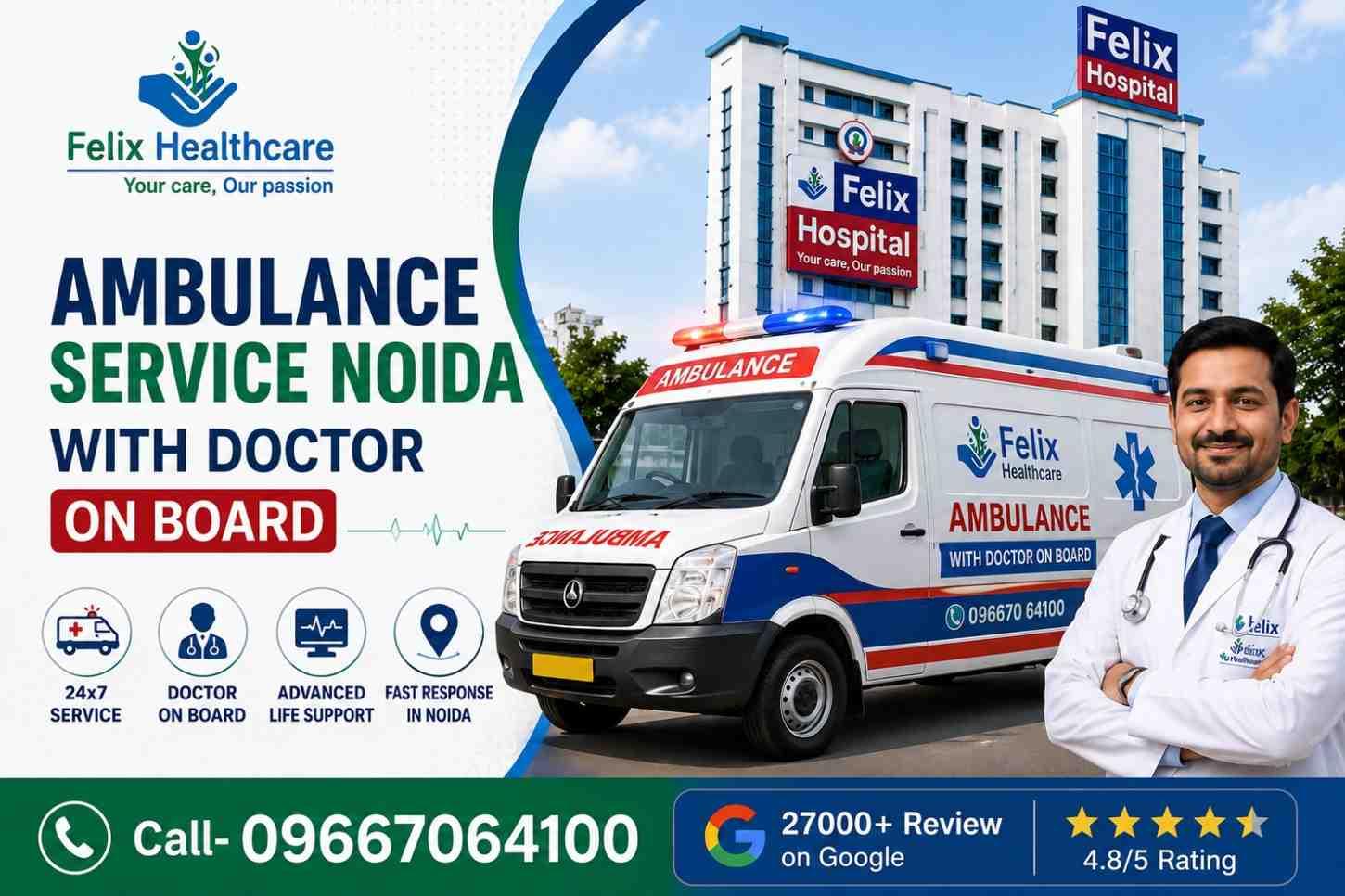

Every Felix ambulance has a trained, certified paramedic on board — without exception. BLS ambulances carry one ACLS-certified paramedic qualified to manage airways, administer emergency drugs, and perform CPR and defibrillation. ALS ambulances carry a paramedic with advanced cardiac life support certification and hands-on experience managing deteriorating patients in transit. ICU Critical Care ambulances carry both a paramedic and a critical care physician — a doctor, not a technician — who actively manages the patient from your location to the receiving unit.
This matters because most ambulance deaths in India occur not from lack of equipment but from untrained staff who cannot use it. Felix does not dispatch drivers with a stretcher. Every crew member on board has a defined clinical role.
Costs are tiered by ambulance type and distance:
BLS (Basic Life Support) — most affordable. Paramedic, oxygen, vitals monitor, stretcher.
ALS (Advanced Life Support) — mid-tier. ACLS paramedic, cardiac monitor, defibrillator, emergency drugs, infusion pumps.
ICU Critical Care — highest tier. Critical care physician, transport ventilator, invasive monitoring, full mobile ICU setup.
For PM-JAY beneficiaries and major insurance holders — Star Health, Niva Bupa, HDFC Ergo, Care Health, New India Assurance — emergency transport is cashless for listed conditions. Get in the ambulance. Documentation is handled after the patient is stabilised.
For self-pay: call +91 9667064100 and we will quote you before the vehicle moves. No hidden charges, no billing surprises at the end of a crisis.
The ambulance is dispatched during your call — the vehicle moves while you are still on the line, not after you hang up. This is a deliberate protocol difference from hospital-affiliated services where dispatch is initiated after the call is logged and triaged.
Typical arrival times from the nearest GPS-tracked vehicle:
Central Noida — sectors 18 to 76: 15–20 minutes Noida Expressway corridor — sectors 100 to 137: 20–25 minutes Noida Extension and Gaur City: 20–25 minutes Dadri, Surajpur, Gautam Buddha Nagar: 25–35 minutes
Once dispatched, you receive a callback with your crew's name and a live vehicle tracking link. You are not waiting on a verbal estimate — you can watch the ambulance move toward you in real time.
In cardiac arrest, brain tissue dies at close to 1.9 million neurons per minute without CPR. In stroke, every 60-second delay in reperfusion costs roughly 1.9 million neurons. Dispatch speed is not a convenience metric — it is a survival variable.
Yes — and this is one of the most clinically significant differences between a well-run ambulance service and a vehicle with equipment.
Every Felix dispatch simultaneously triggers ER pre-notification. Before the ambulance reaches you, the Felix emergency team knows: the patient's presenting condition and vital signs, the ambulance type and crew en route, any interventions already performed in the field, and the estimated arrival time.
When the ambulance bay doors open, the team is not receiving information — they already have it. Resuscitation bays are prepared. Specialist teams are on standby for cardiac, stroke, trauma, and obstetric cases. There is no handover delay because handover has already happened in transit.
This protocol follows international emergency medicine standards and is the same pre-notification model used by Level I trauma centres globally.
Yes. The ICU Critical Care ambulance is specifically configured for ventilated and hemodynamically unstable patients. Equipment on board: transport ventilator with full mode capability, invasive arterial and central venous pressure monitoring, syringe pumps for vasoactive infusions, defibrillator, and a critical care physician managing the patient throughout.
Ventilation is never interrupted during the transfer — not for patient loading, not for vehicle-to-hospital transition, not for power source changeover. The receiving ICU is briefed before departure so their team is set up for immediate takeover without a gap in care.
Families are often told by referring hospitals that "the patient is too sick to move." In most cases, the limiting factor is not the patient's condition — it is the ambulance's capability. An ICU-level patient requires an ICU-level vehicle. Felix's ICU ambulance is that vehicle.
For all ICU Critical Care transfers — yes. A critical care physician travels with the patient from origin to receiving unit, managing active interventions throughout.
For ALS emergency dispatches, the decision is made during the call based on reported condition and clinical severity. Chest pain with haemodynamic instability, altered consciousness, active seizures, obstetric emergencies beyond 28 weeks, and paediatric respiratory compromise typically warrant physician accompaniment from dispatch. The dispatch officer makes this assessment in real time — describes the symptoms clearly and completely, and the right crew is sent.
On every Felix ambulance, continuously from the moment the crew reaches the patient:
Cardiac monitoring: 12-lead ECG capability, continuous rhythm monitoring, pulse oximetry, end-tidal CO₂ on ALS and ICU vehicles.
Haemodynamic monitoring: non-invasive BP on BLS and ALS; invasive arterial line monitoring on ICU ambulances.
Airway: bag-valve mask, suction unit, laryngoscope, supraglottic airway devices, surgical airway kit for failed airway scenarios.
Vascular access: IV cannulation, intraosseous access for cases where IV access fails.
Drugs: adrenaline, atropine, amiodarone, morphine, midazolam, dextrose, salbutamol, and a full critical care drug kit on ALS and ICU vehicles.
Power: all monitoring and ventilation equipment runs on independent battery backup. There is no interruption when the vehicle engine is off, during loading, or during hospital entry.
You do not need to know — the dispatch officer determines this during your call. But here is what each carries so you understand what is being sent:
BLS (Basic Life Support) is for patients who are stable and need supervised transport — post-discharge, planned admissions, non-critical inter-hospital moves. Risk of deterioration in transit is low.
ALS (Advanced Life Support) is for patients whose condition may worsen during transport — chest pain, stroke symptoms, trauma, respiratory distress, diabetic emergencies. The ALS crew can intervene aggressively if the patient deteriorates.
ICU Critical Care is a mobile intensive care unit. It is for patients who are already unstable, ventilated, or require active critical care management during transit. Sending a BLS ambulance for an ICU-level patient is one of the most common causes of preventable deterioration during transfer in India.
When in doubt, describe the symptoms. The dispatch officer will ask the right questions and send the right vehicle.
Yes. Inter-facility transfer is a core service, not an exception. Felix handles ICU-to-ICU transfers, post-operative transfers where the referring hospital lacks transport capability, emergency pickups when the on-site ambulance is not equipped for the patient's acuity, and step-down transfers for patients moving to lower-dependency care.
When you call for an inter-facility transfer, give the dispatch officer the patient's current location, primary diagnosis, whether the patient is ventilated or on vasoactive drugs, and current monitoring status. This determines the ambulance tier dispatched. Sending the wrong tier wastes critical time — the more clinical detail you provide, the better matched the response.
Call +91 9667064100.
Felix Hospital dispatches GPS-tracked ambulances across the full Noida and Greater Noida region:
Central Noida — sectors 18, 19, 27, 29, 44, 50, 62, 63, 76 and surrounding: 15–20 minutes Noida Expressway corridor — sectors 100, 110, 120, 128, 132, 135, 137: 20–25 minutes Noida Extension — Gaur City, Crossings Republik, Raj Nagar Extension: 20–25 minutes Outer zones — Dadri, Surajpur, Bisrakh, Rabupura, Gautam Buddha Nagar district: 25–35 minutes
Arrival times are calculated from the nearest available vehicle, not from Felix Hospital. GPS dispatch means the vehicle closest to you is sent — not the vehicle that happens to be at base.
For locations not listed, call +91 9667064100. The dispatch officer confirms coverage and arrival estimate in under 60 seconds.
Felix Hospital ambulance services are empanelled under Ayushman Bharat PM-JAY and major private health insurers. Commonly covered insurers include Star Health and Allied Insurance, Niva Bupa, HDFC Ergo Health, Care Health Insurance, and New India Assurance.
Coverage applies to emergency transport for listed conditions under your policy. Not all plans cover ambulance transport — the specific benefit depends on your policy tier and insurer.
Call +91 9667064100 before an emergency to verify cashless eligibility for your policy. This takes under two minutes and removes the billing uncertainty from the worst possible moment.
24 hours a day, 7 days a week, 365 days a year. This includes all public holidays, national holidays, Diwali, Holi, Eid, and election days when road conditions and hospital staffing often change. Night operations run the same staffed, equipped ambulances as daytime. There is no skeleton crew at 3am. Medical emergencies do not observe calendars, and neither does Felix dispatch.
Yes. All Felix ambulances are fully climate-controlled. In Delhi NCR summers where ambient temperatures exceed 45°C — and vehicle cabin temperatures without AC can reach 55–60°C — heat compounds almost every medical emergency. In cardiac patients, hyperthermia increases myocardial oxygen demand and extends ischaemic damage. In stroke patients, fever worsens neurological outcomes measurably. In paediatric and obstetric cases, thermoregulation is compromised by the emergency itself.
Climate control in a medical vehicle is not a passenger comfort feature. It is active clinical management of a modifiable variable. Every Felix ambulance maintains it.
Stay on the line. The dispatch officer remains with you until the crew arrives and provides real-time instruction based on what is happening in front of you. General guidance by situation:
Cardiac arrest: if trained, begin CPR immediately on instruction — 30 compressions to 2 breaths, hard and fast. If an AED is nearby, use it. Do not stop for any reason until the crew takes over.
Trauma: do not move the patient unless there is immediate life-threatening danger such as fire. Control active bleeding with direct firm pressure using the cleanest material available. Note the time of injury.
Stroke: keep the patient still and lying down. Do not give food, water, or medication by mouth — swallowing reflex may be compromised. Note the exact time symptoms started. This determines treatment eligibility on arrival.
Pregnancy emergency: keep the patient lying on her left side to reduce vena cava compression. Note contraction timing and frequency. Do not attempt to delay or manage labour.
Paediatric emergency: keep the child calm and still. Do not restrain forcefully during seizure — clear the area, protect the head, time the seizure. For breathing difficulty, keep the child in whatever position they find most comfortable — do not force them to lie down.
The single most useful thing you can do in every scenario: stay on the line and describe exactly what you see.


Subscribe to our
© Copyright 2026. All Rights Reserved by Felix Healthcare Private Limited
Design and development by :


 +(91)9667064100
 Emergency : +(91)9667064100