 Emergency:
  WhatsApp

Subscribe to our
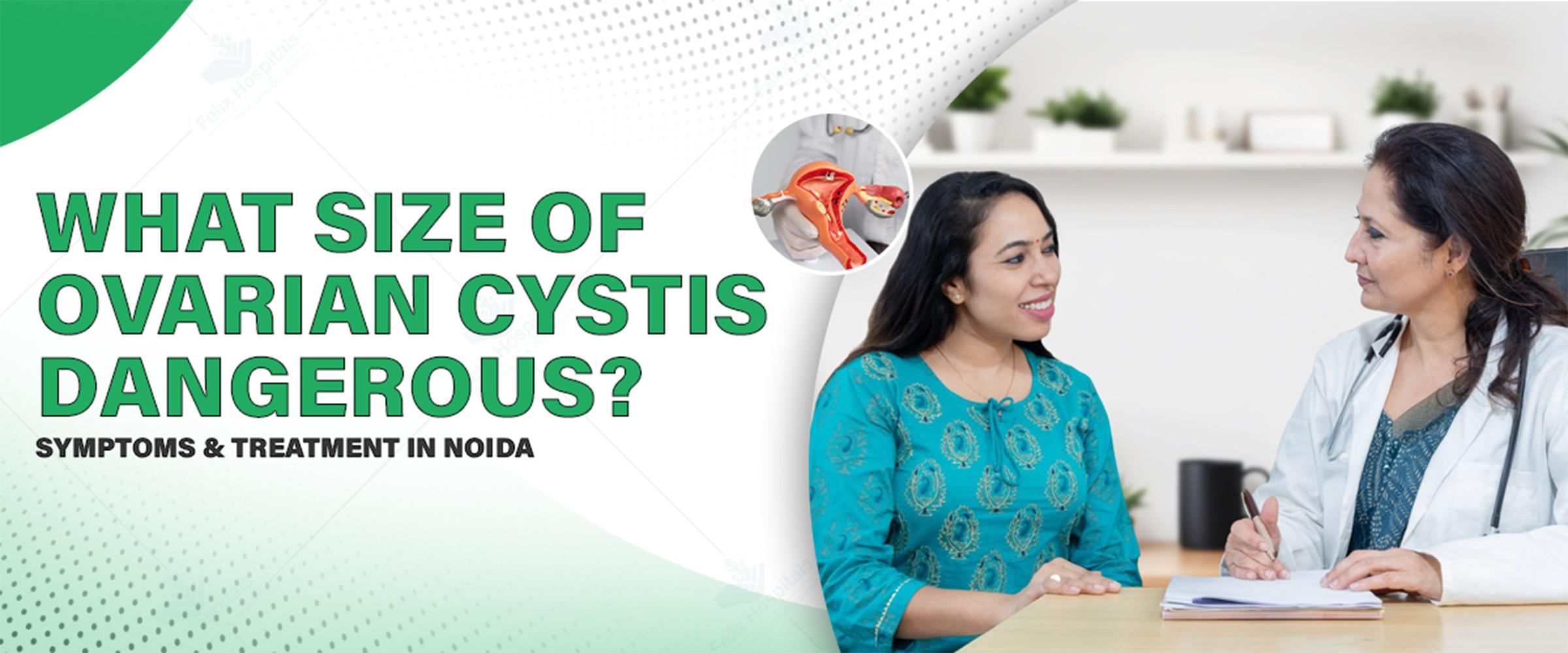
Ovarian cysts are hollow, fluid-filled sacs found on or within ovaries. Though most are benign and spontaneously resolved by themselves, some become large enough to develop issues for which medical attention or even surgical intervention is needed. Knowing about the risk threshold for size in an ovarian cyst if you are in Noida and you are worried about one is critical for you since it is key in determining when you should seek medical intervention.
This blog will walk you step by step through size guidelines for ovarian cysts, risks in large cysts, and what is Ovarian Cyst Treatment In Noida. We will also cover how you should prepare for ovarian cyst surgery and why selecting a proper hospital such as Felix Hospital is so very important for safe and effective care.
Control your ovarian health. Call now at +91 9667064100 for a specialist appointment in Noida.
Ovarian cysts are a common occurrence in women at any age but mostly in reproductive age women. Cysts are a component of a normal menstruating cycle and resolve spontaneously without intervention. Nonetheless, a few cysts can become large in size, painful, or result in severe complications.
Follicular Cysts: These are those in which a follicle does not release an egg but continues.
Corpus Luteum Cysts: These are formed if an egg is expelled but the follicle does not disintegrate.
These are typically benign and resolve in several months.
Dermoid Cysts: These are made up of hair, skin, or teeth.
Cystadenomas: Cysts that are filled with a low-viscosity fluid.
Endometriomas: Grow because of endometriosis and are filled with.
These cysts may require medical intervention if they are large or if they are symptomatic.
The risk level for an ovarian cyst is mostly based on its size. Here is how size divides up cysts:
Risk Level: Low.
Characteristics: Most tiny cysts are harmless and symptom-free.
Management: There is no treatment typically necessary. Timely ultrasounds are recommended for tracking progress.
Risk Level: Moderate.
Characteristics: Can cause mild cramping or irregular periods.
Follow-up ultrasounds is recommended for tracking progress.
Risk Level: High.
Management: Surgery may be needed if the cyst is painful or have chances of becoming cancerous.
These can cause pain, break, or twist (torsion) the ovary.

Whereas most ovarian cysts are symptom-free, larger or more complex cysts can produce obvious signs.
Sharp or a dull lower abdominal pain, particularly if it is sharp or abrupt.
Bloating not alleviated by dietary adjustment.
Heavy periods, spotting at intervals between periods, or spotting postmen.
Pain or unpleasant sensation during sex.
Common Symptoms: Frequent Urination: A large cyst can push upon the bladder.
Abdominal Mass: Most frequently found in an ectopic pregnancy patient.
Large ovarian cysts can result in serious problems such as:
What Occurs: Twisting around its support ligaments, which results in cutting off blood flow.
Symptoms: Sudden onset pelvic pain, nausea, vomiting.
Risk: Most prevalent with 5 cm or larger cysts.
Treatment: Emergency surgery is needed to untwist the ovary and normalize blood flow.
What occurs: A ruptured cyst releases its material into the pelvic cavity.
Symptoms: Severe temporary pain, internal hemorrhaging, and risk for infection.
Risk: Increased in cysts over 5 cm in size.
Treatment: Prompt medical care for controlling pain and for preventing infection.
What occurs: More common women during or after menopause.
Symptoms: Rapid growth, solid areas within the cyst, or elevated tumor markers in blood tests.
Risk: Increased for cysts greater than 10 cm in diameter or with an irregular shape.
Treatment: Surgical excision and biopsy for cancer rule-out.
Size and type of cyst determine which treatment is appropriate. Here is what you should know about treatment for symptoms for ovarian cyst based on size:
| Cyst Size | Symptoms | Treatment Options |
| Under 4 cm | Usually none | Watchful waiting, follow-up ultrasounds |
| 4–6 cm | Mild discomfort, irregular periods | Monitoring, hormonal therapy (birth control pills) |
| Over 6 cm | Pelvic pain, bloating, pressure | Surgical removal (laparoscopy or laparotomy) |
| Suspected Malignancy | Rapid growth, abnormal bleeding | Surgery, biopsy, oncology referral |
Once you are diagnosed with an ovarian cyst in Noida, you are treated based on size, type, and symptom.
Birth Control Pills: Regulation of menstrual cycles.
Pain Relief: Self-medication with over-the-counter painkiller for minor pains.
Ideal for: Large cysts (more than 6 cm), symptomatic cysts, or cancer suspicion.
Laparotomy: Open surgery to deal with large or complex cysts.
Laparoscopy: Less invasive process to create small cuts and use a camera. Ideal for small cysts and rapid recovery.
If you should decide on surgery, proper prepping ensures an uncomplicated operation and recovery. Here's what you can expect:
Blood Tests: Screen for anemia or infection.
Imaging: MRI or ultrasound for identification of location and size of tumor.
ECG or X-Ray of Chest: Prepare patient for anesthesia.
Fast: Do not consume food or fluids for 6–8 hours preoperatively.
Medication Changes: Avoid blood thinners or specific supplements as directed.
Arrange Accommodation: Arrange for a driver to pick you up after surgery.
Rest for 1–2 weeks from work or strenuous activity.
Improvement from pain with medication as directed by your physician.
Visits for regular check-ups for progress monitoring.
Ovarian cysts are prevalent, but symptomatic or enlarged cysts should be treated at once to avoid complications. Knowing the level of risk for ovarian cyst size, being attuned to warning signs, and being aware of choices are key to keeping your health intact.
Suffering from pelvic pain or bloating? Get a gynecologist in Noida for the detection of ovarian cyst. Call at +91 9667064100 now for a specialist consultation.
Find the links below:
Check the links below:
Explore the top diagnostic centers near you:
Q1: Does an ovarian cyst cause infertility?
Ans: Most are not a concern for fertility but large or endometrioma cysts can impede ovulation or need treatment beforehand before a pregnancy is established.
Q2: Are ovarian cysts preventable?
Ans: Although not all cysts are preventable, risk for functional cysts can be decreased when a woman uses hormonal birth control. Routine gynecologic screenings are also essential.
Q3: Is laparoscopic surgery safe for ovarian cysts?
Ans: Yes, it is an effective and safe therapy for most ovarian cysts with less scarring and rapid recovery.
Q4: What should I do if my ovarian cyst bursts?
Ans: Get prompt medical help. Numbness or tingling in a limb is the most common symptom of a choking episode.
Q5: Why should you consider ovarian cyst surgery at Noida's Felix Hospital?
Ans: At Felix Hospital, specialist gynecologists, state-of-the-art surgical units, and confidential care are made available for best-in-class results for patients.
Can ovarian cancer be cured? Early detection plays a critical role. This article explores the chances of cure, available treatment options, survival rates, and the importance of regular screenings for timely diagnosis and improved outcomes.
Explore the causes, symptoms, and best treatment options for ovarian cysts after pregnancy. Find expert care in Greater Noida.


Subscribe to our
© Copyright 2026. All Rights Reserved by Felix Healthcare Private Limited
Design and development by :


 +(91)9667064100
 Emergency : +(91)9667064100