 Emergency:
  WhatsApp


Subscribe to our
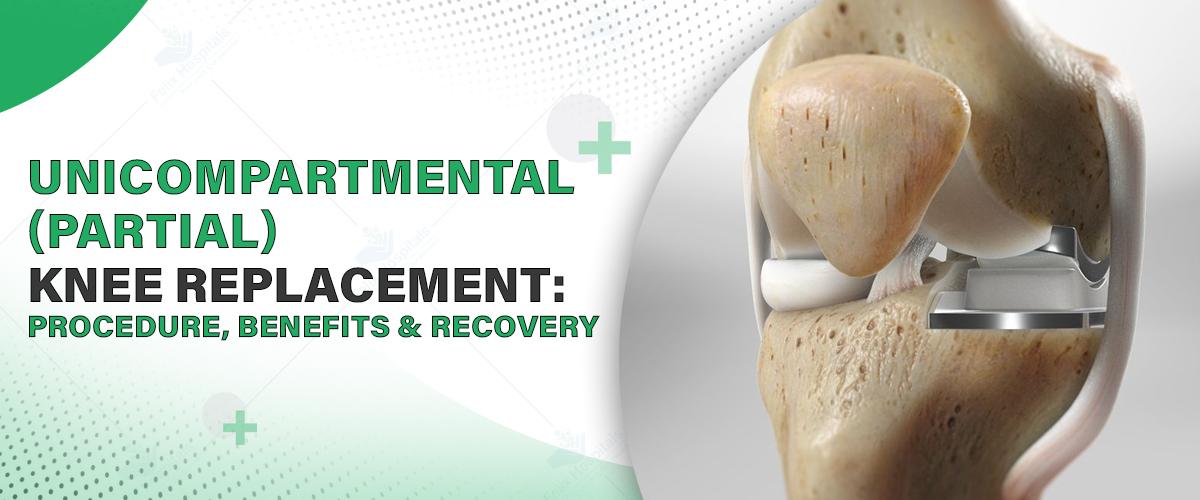
Knee discomfort from osteoarthritis makes it hard to move around and lowers the quality of life. Sometimes surgery is needed if non-surgical treatments like drugs, physiotherapy, or injections don't work. Some patients may be able to have unicompartmental (partial) knee surgery instead of total knee replacement.
In this blog post, we'll talk about unicompartmental knee replacement, how the surgery works, the benefits, and what you may expect throughout the recuperation period. We'll also talk about how much a partial knee replacement costs in Noida and how to find the best orthopedic facility in Noida for this procedure.
Thinking about getting a partial knee replacement? To discuss your options with our orthopedic specialists, schedule a consultation right now at +91 9667064100.
There are three parts to the knee joint:
The inside of the knee, or the medial compartment
The lateral compartment is the outside of the knee.
The patellofemoral compartment is the space between the kneecap and the thighbone.
Osteoarthritis tends to break down the cartilage that covers these bones, which makes them stiff and painful. A unicompartmental or partial knee replacement is a great option when arthritis only affects one component of the knee.
Partial knee replacement just replaces the damaged compartment with metal and plastic parts. The healthy bone, cartilage, and ligaments in the other compartments are not changed. This is different from total knee replacement, which resurfaces the whole knee. There are many benefits to this less invasive process.
Not everyone with osteoarthritis in the knee can get a unicompartmental knee replacement. The greatest prospects are individuals whose arthritis only affects one area of the knee and who have:
Stability of the ligaments is good.
A good range of motion
No serious knee deformity or stiffness
No arthritis that causes inflammation or damage to ligaments
Your orthopedic doctor will undertake a full evaluation, which will include a physical exam and imaging tests like X-rays or MRIs, to see if a partial knee replacement is right for you.
Getting Ready for Surgery
Before the surgery, you will talk with your orthopedic surgeon and anesthesiologist. You can choose between general anesthesia (which puts you to sleep), spinal anesthesia (which numbs you from the waist down), or peripheral nerve blocks (which numb specific areas).
Steps in Surgery
The treatment normally lasts one to two hours and includes the following:
Cutting and Looking: A tiny cut is made in the front of the knee. The doctor looks at all three compartments to make sure that the arthritis is localized in one place.
Bone Preparation: Using specific tools, the injured compartment's bad cartilage and a small piece of bone are cut out.
Implant Placement: The surgeon puts the implants on the well-prepared bone surfaces, usually with bone cement. In some circumstances, the implants are designed to fit tightly so that natural bone can grow onto them.
Putting in the Spacer: A plastic spacer is put between the metal pieces so they can move freely.
Closure: The cut is sewn or stapled shut.
After surgery, you are sent to the recovery room for observation. Depending on your condition, you may be sent home the same day or after one night in the hospital. Partial knee replacement has several benefits over total knee replacement. Most patients recognize the many benefits of partial knee replacement, such as:
Less harm to the tissue and a smaller cut: The surgery is less invasive than a full knee replacement.
Faster recovery: Patients feel less pain and swelling and get better faster.
Keeping healthy bones and ligaments: This makes the knee feel more natural and gives it better range of motion.
Lower risk of complications: There is usually less blood loss and a lower risk of infection and blood clots.
Shorter hospital stay: Most patients go home the same day or after a brief stay.
Because of these benefits, most people who get unicompartmental knee replacement are able to get back to their normal activities and even low-impact sports sooner.
After surgery, patients usually start putting weight on their knees right once, but they may need help from walkers or crutches at first. Pain management is vital, and doctors may suggest NSAIDs, opioids (given carefully), or local anesthetics to help you feel better.
After surgery, physical therapy starts right away to help the knee move more freely and make the muscles around it stronger. Your progress and needs will determine how the exercises are changed.
You will need to see your orthopedic surgeon often to check on the healing and effectiveness of the implant.
Most of the patients are able to go back to their normal daily activities, such walking without help, within 6 weeks. Swimming and cycling are examples of low-impact sports that are good for you. High-impact sports, on the other hand, may not be good for you.
Most people who are getting ready for unicompartmental knee replacement are worried about how much it would cost in Noida. The cost depends on the hospital, the surgeon's experience, the type of implant, and how long you stay there. The average cost might range from ₹1,50,000 to ₹3,00,000.
Partial knee replacement in Noida is usually cheaper than total knee replacement because the surgery is less intrusive and the hospital stay is shorter. Prices may be different for each patient based on their needs and the facilities used.
To receive exact quotes, it's best to go to the best orthopedic hospital in Noida. There, you may get personalized care and clear prices.
Choosing the right surgeon and hospital might have a huge impact on how well your operation goes. When searching for orthopedists in Noida, keep these things in mind:
Surgeon's experience and specialty in knee replacement, especially unicompartmental surgery.
Hospital amenities include state-of-the-art surgical tools and complete rehabilitation facilities.
Feedback from patients and success rates.
Talk openly about the risks, benefits, and costs of surgery.
Get Noida's best partial knee replacement. Faster healing, cutting-edge methods, and trusted care at +91 9667064100.
Unicompartmental (partial) knee replacement is a novel type of surgery for those with osteoarthritis that only affects one component of the knee. It has the benefits of a quicker recovery, less pain, and more natural knee movement than a total knee replacement. Still, a trained orthopedic surgeon needs to do a full evaluation to determine if this operation is right for you.
If you want to have knee replacement surgery, you should look into the cost of partial knee replacement in Noida and consult the best orthopedists in Noida. This will help you make a smart choice for your health and mobility.
Q1. Is it possible to do partial knee replacement on both knees at the same time?
Ans: Yes, in some cases, bilateral partial knee replacement can be done, but it depends on the patient's age, health, and the surgeon's opinion.
Q2. How long do partial knee implants usually last?
Ans: If you take care of them, today's partial knee implants can last 15 to 20 years or more.
Q3. Will I still need physiotherapy even if my pain goes away quickly?
Ans: Yes. You require physical therapy to get the most mobility and strength, even though the pain goes away sooner.
Q4. Are there age limits for partial knee replacement?
Ans: There isn't a set age limit, although most people are over 50 and have arthritis in one area and stable joints.
Q5. How long can I drive after having part of my knee replaced?
Ans: Most patients can drive again in 4 to 6 weeks; however, this depends on which knee was operated on and how quickly they heal.
Q6. Is a partial knee replacement a good idea for someone with rheumatoid arthritis?
Ans: No, usually not. Osteoarthritis is the greatest condition for a partial knee replacement since inflammatory arthritis usually affects the whole joint.
Bladder cancer is a serious and often aggressive condition that primarily affects older adults.

Knock knees occur when knees angle inward, creating a bow-legged appearance from the front. This condition is common in children during growth spurts.

Knock knees, medically known as genu valgum, is a common condition in young children where the knees angle inward and touch one another when the legs are straightened.


Subscribe to our
© Copyright 2026. All Rights Reserved by Felix Healthcare Private Limited
Design and development by :


 +(91)9667064100
 Emergency : +(91)9667064100