 Emergency:
  WhatsApp


Subscribe to our
When a doctor hands you a slip that says "HBsAg Reactive", most people don't calmly Google the clinical definition. They panic. Their mind goes straight to the worst place. They wonder if they've infected their spouse, their child, their ageing parent who shared a meal with them last Sunday.
That fear is real. And it deserves more than a Wikipedia-style table.
This is the guide we wish existed when our patients at Felix Hospital come to us , confused, scared, sometimes carrying a positive result they got months ago and still haven't told anyone about. We're going to walk through exactly what the HBsAg test is, what your result means, and, perhaps most importantly, why a positive result is not a life sentence.
HBsAg = Hepatitis B surface antigen.
Three words: Hepatitis B (the virus), surface (a protein sitting on the outer wall of the virus), antigen (any molecule the immune system can detect).
When hepatitis B infects your liver cells and starts replicating, it floods the bloodstream with this surface protein , not just a little of it, an enormous amount, far more than the actual virus particles themselves. That flooding is what makes HBsAg detectable so early and so reliably. The test checks whether that protein is currently circulating in your blood.
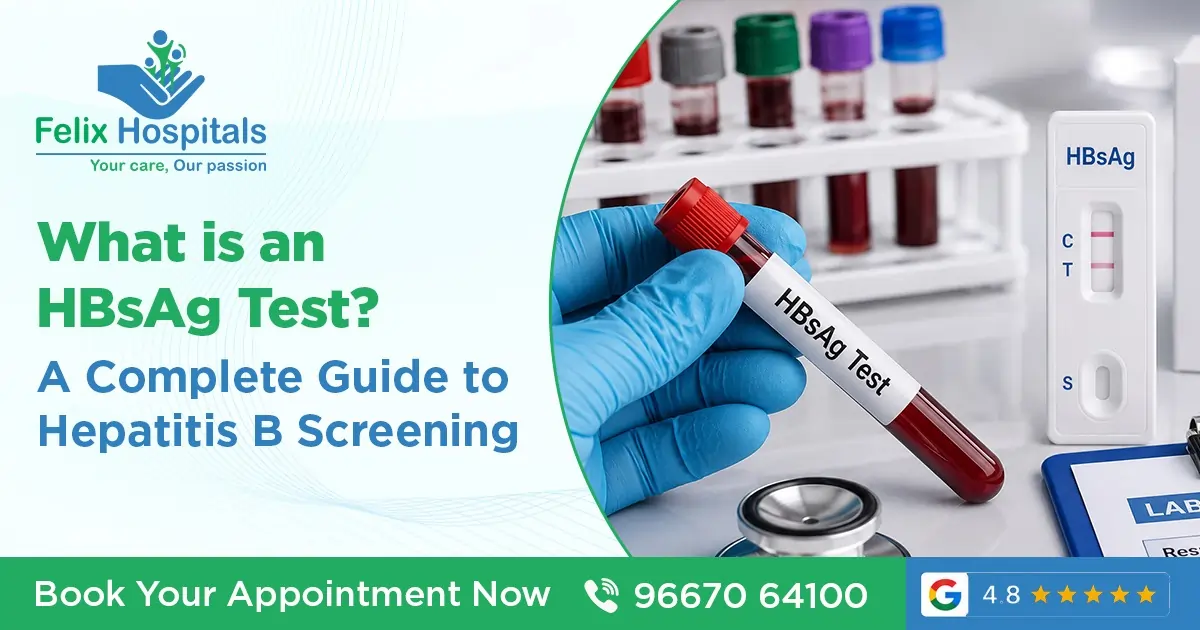
The HBsAg test is a blood test. A few millilitres from a vein in your arm. That sample goes to a certified lab where it's mixed with engineered antibodies that bind specifically to HBsAg , and only to HBsAg. If the antigen is there, it shows up. If it isn't, it doesn't.
The result is binary: Reactive (positive) or Non-Reactive (negative).
What makes this test powerful is timing. HBsAg shows up in your blood 1–9 weeks after exposure , often weeks before any symptoms appear, if symptoms appear at all. That early window is exactly why it's used for routine screening, not just when someone is already sick.
Over 40 million Indians are estimated to be living with chronic hepatitis B, and the majority don't know it. Not because they haven't been tested , but because no one ever told them they should be.
You should get an HBsAg test if:
You've never been tested and you weren't vaccinated as a child
You're pregnant , this is a mandatory prenatal test for good reason
A family member has been diagnosed with hepatitis B
You work in healthcare, emergency services, or anywhere with blood exposure
You've had unprotected sex with multiple partners
You've ever shared personal items like razors or nail cutters with someone (yes, it transmits that way)
You have unexplained fatigue, yellowish skin, or your liver enzymes came back elevated
No fasting. No special preparation. No lifestyle changes needed before you go.
You show up. A small sample of blood is drawn, typically from the inner elbow. The whole process takes under five minutes. You might feel a brief sting and possibly minor bruising afterward; that's the worst of it.
The sample goes to the lab. Using a method called immunoassay (ELISA or ECLIA), the lab detects whether HBsAg is present. If the initial result is reactive, a confirmatory neutralisation test is automatically run, this is a safeguard against false positives, which can occasionally occur due to certain autoimmune conditions or lab variables.
Results arrive in 8 to 72 hours depending on the lab. At Felix Hospital's NABL-accredited lab in Noida, most patients receive results the same day.
Non-Reactive (Negative)
No HBsAg detected. You don't have an active hepatitis B infection right now.
But, and this is important , a negative result doesn't automatically mean you're immune. It could mean:
You were never exposed (great!)
You were exposed and your body cleared it
You're in the window period (more on this below)
To know whether you actually have protection, you need a separate test: the anti-HBs antibody test. That's what confirms immunity from vaccination or past resolved infection.
HBsAg is present. This confirms you have an active hepatitis B infection.
A lot of people shut down at this point, stop reading, stop thinking, sometimes stop going back to the doctor. That's understandable. It's also the exact wrong response.
A positive HBsAg tells you one thing: the virus is currently in your system. What it doesn't tell you is whether this is a recent (acute) infection your body may clear on its own, or a long-standing (chronic) infection that needs management. For that, you need additional tests, which your doctor will order.
The signal falls in a grey zone. This isn't common, but when it happens, the test is simply repeated 2–4 weeks later. One ambiguous result doesn't mean anything on its own.
Labs report results as a ratio compared to the detection threshold (S/CO), or in IU/mL for quantitative tests.
Result | S/CO Ratio | Meaning |
Non-Reactive | < 0.90 | No HBsAg detected |
Borderline | 0.90 – 1.00 | Repeat testing advised |
Reactive | > 1.00 | HBsAg confirmed present |
For quantitative HBsAg (used in treatment monitoring, not routine screening), values are measured in IU/mL. Levels above 1,000 IU/mL are associated with higher viral activity, sustained decline in quantitative HBsAg during treatment is actually one of the best signs that therapy is working.
A positive HBsAg could mean two very different things:
Acute hepatitis B is a fresh infection, usually acquired within the past 6 months. Most healthy adults (about 95%) will clear it naturally. The immune system fights back, HBsAg disappears, and protective antibodies develop. You may feel genuinely unwell for a few weeks , fatigue, nausea, sometimes jaundice , or you may feel nothing at all.
Chronic hepatitis B is when HBsAg remains positive beyond 6 months. The immune system hasn't cleared it. This is where long-term risk accumulates , not immediately, but over years and decades. Untreated chronic hepatitis B can slowly damage the liver, leading to cirrhosis or, in some cases, liver cancer.
Here's what no one tells you about chronic hepatitis B: most people feel completely fine for years. That's precisely what makes it dangerous. The damage is silent. You feel healthy. Life continues normally. And then a scan reveals something that's been building for a decade.
The difference between acute and chronic is determined by:
How long you've had a positive HBsAg (6-month threshold)
The anti-HBc IgM blood test , positive in fresh infections
Your HBV DNA levels (viral load)
Liver enzyme levels (ALT/AST)
A reactive result is the beginning of a process, not a verdict.
Step 1, Confirm it's real. The neutralisation confirmatory test rules out false positives.
Step 2, Understand the infection. Additional tests your doctor will order:
Step 3, Decide on treatment. Not everyone with chronic hepatitis B needs antiviral medication immediately. Treatment decisions depend on viral load, liver enzyme levels, degree of fibrosis, and age. The two main antivirals used today , tenofovir and entecavir, are highly effective, well-tolerated, and available in India at reasonable cost.
Step 4, Tell the people who need to know. This part is hard. But your sexual partner and close household members need to be tested. If they're not immune, they need the vaccine. This is one of the most important things you can do.
This is the gap most people don't know about.
After exposure to hepatitis B, HBsAg doesn't appear immediately. It takes 1 to 9 weeks to become detectable. During that window, the test will return negative , but the person is infected and potentially contagious.
If you've had a high-risk exposure recently:
Don't rely on a single negative test taken too soon
Repeat the test 12 weeks after the exposure
If the exposure was within 24 hours, ask a doctor about post-exposure prophylaxis, a combination of hepatitis B immunoglobulin (HBIG) and vaccine that can prevent infection from taking hold.
Hepatitis B transmission from mother to child during childbirth is one of the most common routes of chronic infection globally , and almost entirely preventable.
If you test positive during pregnancy:
Your newborn must receive hepatitis B immunoglobulin (HBIG) + the first vaccine dose within 12 hours of birth
This combination reduces transmission risk by over 95%
If your viral load is very high (HBV DNA > 200,000 IU/mL), your obstetrician may recommend antiviral therapy in your third trimester to reduce transmission risk further
At Felix Hospital, our obstetrics team screens every expectant mother for HBsAg as part of standard antenatal care. It's not optional. It's just care.
Hepatitis B carries a stigma that is wildly disproportionate to its actual modes of transmission. People lose relationships over a diagnosis. They hide results from spouses for months. They delay treatment because they're too ashamed to tell their doctor they tested positive years ago and did nothing.
Here's the medical reality: hepatitis B is transmitted through blood contact, sexual contact, and from mother to child. It is not spread through sharing food, hugging, shaking hands, coughing, or using the same toilet. Chronic hepatitis B is a managed condition, like diabetes or hypertension. Millions of people live full, healthy lives with it, with appropriate monitoring and, when needed, medication.
The biggest risk factor for serious liver disease isn't having hepatitis B. It's having hepatitis B and not knowing about it , or knowing and not doing anything.
Getting tested takes twenty minutes. Not getting tested can cost you years.
One patient we saw last year, a 34-year-old software engineer from Sector 62 , had been sitting on a positive result for eight months, too scared to tell his wife. His liver was fine. His wife got vaccinated. He's on a monitoring plan and doing well. The eight months of silence did more damage to him psychologically than the virus had done physically.
When doctors run a complete hepatitis B panel, here's how to read the combinations:
HBsAg | Anti-HBs | Anti-HBc | What it means |
Negative | Negative | Negative | Never exposed , get vaccinated |
Negative | Positive | Negative | Immune from vaccination |
Negative | Positive | Positive | Past infection, now immune |
Positive | Negative | Positive (IgM+) | Acute hepatitis B |
Positive | Negative | Positive (IgG+) | Chronic hepatitis B |
Negative | Negative | Positive | Past exposure, unclear status, repeat testing needed |
If your HBsAg comes back negative and you're not immune, this is your moment.
The hepatitis B vaccine is one of the safest and most effective vaccines ever made. Three doses over six months , that's it. More than 95% protection, lasting decades, possibly lifelong.
Standard adult schedule:
Dose 1: Day 0
Dose 2: 1 month later
Dose 3: 6 months after Dose 1
For people who need rapid protection (healthcare workers, travellers), an accelerated schedule is available.
At Felix Hospital, hepatitis B vaccination is available for adults and children without a prior appointment. Call +91 9667064100 and our team will sort out everything from test to vaccination to follow-up.
The HBsAg test is one of the most affordable diagnostic tests available:
Setting | Approximate Cost |
Government hospital / CGHS | ₹50 – ₹150 |
Diagnostic labs (NABL-accredited) | ₹200 – ₹500 |
Private multispecialty hospital | ₹300 – ₹700 |
Home collection (with pickup) | ₹350 – ₹600 |
Quantitative HBsAg (treatment monitoring) | ₹700 – ₹2,000 |
At Felix Hospital's NABL-certified laboratory in Sector 137, Noida, the HBsAg test is available at transparent, published pricing, no hidden charges, no upselling. Results the same day for most patients.
If you've been putting off this test, maybe because you're a little scared of what the result might be, or because it feels unnecessary since you feel fine, we understand.
But the HBsAg test is not something to fear. It's something to do. It takes less time than scrolling through this article. And the information it gives you, one way or the other, is genuinely useful. Either you confirm you're protected, or you find out something that's completely treatable when caught early.
If you're in Noida or the NCR region and want to get tested, get a follow-up consultation, or start a hepatitis B vaccination series, our team at Felix Hospital is available 24/7 at +91 9667064100. We're at Paras Tierea, Sector 137, two minutes off the Noida Expressway, right next to the Sector 137 metro exit.
Not completely. A negative result rules out active infection at the time of testing, but it doesn't confirm immunity. You need the anti-HBs test for that. And if you had a recent exposure, the window period means a negative result should be re-confirmed at 12 weeks.
Absolutely, and this is the most important thing to understand about chronic hepatitis B. Most people with chronic infection feel perfectly normal for years, even decades, while the virus quietly affects the liver. Symptoms, if they appear, are often mistaken for ordinary fatigue or digestive issues.
Not automatically. HBsAg is positive in both acute and chronic infection. If your positive result is recent and confirmed within 6 months of a suspected exposure, you may clear the virus on your own. The 6-month mark is when chronic infection is officially diagnosed.
Not necessarily. Treatment decisions depend on viral load, liver enzyme levels, and fibrosis. Some patients need long-term antivirals; others are monitored without medication. A small number achieve what's called "functional cure" , sustained HBsAg clearance after treatment. This is the goal that hepatitis B research is actively working toward.
Yes. With proper management, including HBIG and vaccination for your newborn within 12 hours of birth, transmission can be reduced to under 5%. Talk to your specialist before or early in pregnancy so a plan is in place.
No. All blood donations are screened for HBsAg, and reactive donors are permanently deferred from donation. This is a standard safety protocol to protect the blood supply.
Rarely, yes , particularly in people with certain autoimmune conditions or rheumatoid factors. This is why reactive results are automatically run through a confirmatory neutralisation test before a positive diagnosis is made.
Dr. Ravi Sharma is a senior physician with 42+ years of experience, known for compassionate and comprehensive patient care in Noida.

Consult the best general physician for dengue fever at Felix Hospital. Their expertise in diagnosing and managing dengue virus infections can lead to timely and effective treatment.

Take special care of the health of your kids, especially young children, amidst the changing seasons.

Nipah virus infection causes severe fever and brain inflammation. It spreads through infected animals or close contact and requires strict preventive measures.


Subscribe to our
© Copyright 2026. All Rights Reserved by Felix Healthcare Private Limited
Design and development by :


 +(91)9667064100
 Emergency : +(91)9667064100