 Emergency:
  WhatsApp

Subscribe to our
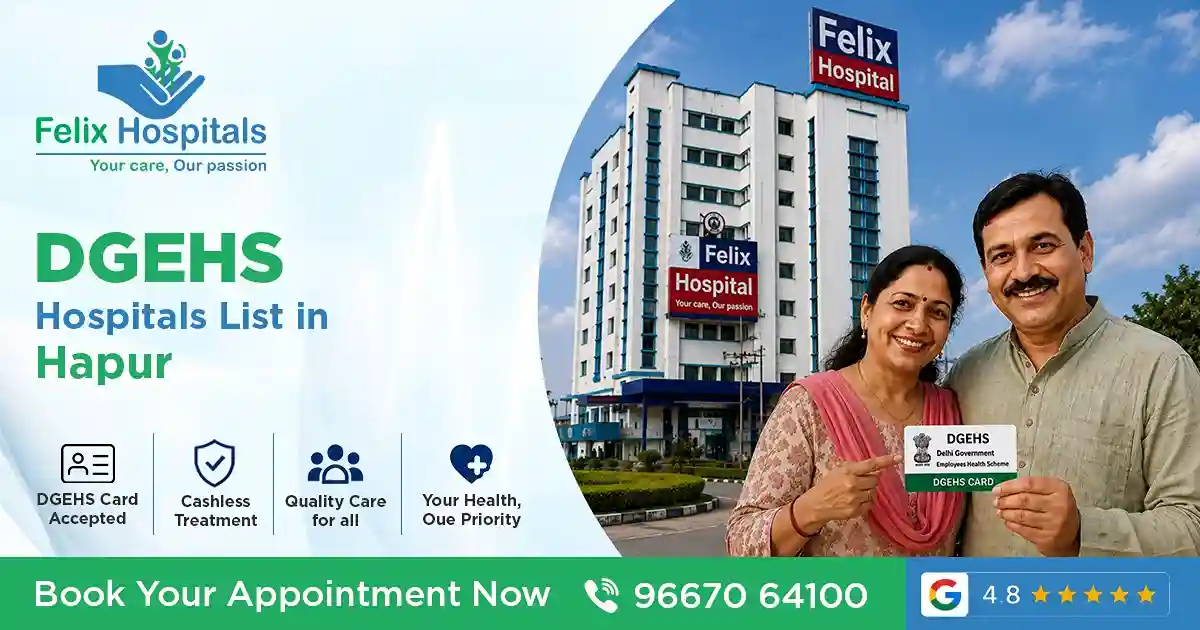
If you're a Delhi Government employee or pensioner living in Hapur, your DGEHS card entitles you to cashless medical care at empanelled hospitals across the NCR region. The challenge most beneficiaries run into isn't the scheme itself — it's not knowing which hospital is close enough to actually use, and whether the card works this far from Delhi.
It does. Hapur became a separate district in 2011, but DGEHS empanelment doesn't follow district boundaries — it covers hospitals across Delhi and the entire NCR region. The official DGEHS list includes government dispensaries and a few private setups, but for Hapur residents who need tertiary care — a cardiac procedure, a joint replacement, a high-risk delivery — most of those options mean going back into Delhi. Felix Hospital in Greater Noida is the practical alternative. Take the Hapur-Dasna road and stay on NH-9 toward Ghaziabad, then cut south toward Greater Noida — most Hapur city patients reach Felix Hospital in 50 to 65 minutes on a clear run. That's a meaningfully shorter journey than going into central Delhi, and without the Ghaziabad city traffic problem if you time it right.
DGEHS Helpdesk at Felix Hospital: +91 9667064100
All procedures within DGEHS approved rates are cashless for entitled beneficiaries and their dependants.
Specialty | Key Procedures Covered |
Cardiology and Cardiac Surgery | Angiography, angioplasty, bypass surgery, valve replacement, pacemaker, heart failure management |
Orthopaedics and Joint Replacement | Knee replacement, hip replacement, spine surgery, fracture fixation, bone infection, revision joint surgery |
Neurology and Neurosurgery | Stroke management, brain surgery, spinal conditions, epilepsy treatment |
Oncology | Cancer diagnosis, chemotherapy, radiation therapy, surgical oncology |
Gynaecology and Obstetrics | Normal delivery, C-section, hysterectomy, fibroid surgery, Level III NICU available |
Urology | Laser kidney stone treatment, prostate surgery, urinary tract procedures, dialysis |
General and Laparoscopic Surgery | Gallbladder removal, hernia repair, appendectomy, bariatric surgery |
Paediatrics | Paediatric surgical and medical conditions |
ENT and Ophthalmology | Cataract, ear surgery, tonsillectomy, septoplasty |
Pulmonology | Respiratory conditions, COPD, bronchoscopy, sleep apnoea |
Nephrology and Dialysis | Chronic kidney disease, haemodialysis, 24/7 dialysis unit |
Gastroenterology | Endoscopy, colonoscopy, liver conditions |
Physical Medicine and Rehabilitation | Physiotherapy, occupational therapy, post-surgical rehabilitation |
The Delhi Government Employees Health Scheme is a health protection programme run by the Government of National Capital Territory of Delhi. It covers cashless medical treatment for serving and retired Delhi Government employees and their dependent family members at empanelled hospitals across Delhi and the NCR.
Hapur has a significant population of retired Delhi Government employees — people who spent their working years commuting into the capital and came back home after retirement. They've earned this entitlement. The problem is that Hapur's local medical infrastructure handles routine care well enough, but it doesn't have the tertiary care depth for complex cardiac conditions, robotic joint surgery, or high-dependency deliveries. Felix Hospital in Greater Noida fills that gap — fully empanelled under DGEHS, with zero upfront payment for covered procedures.
Serving Delhi Government employees across all departments and grades are covered. Retired employees drawing pension from the Delhi Government treasury are entitled. So are dependent family members — spouse, unmarried children up to 25 who aren't independently employed, and dependent parents whose income falls below the prescribed threshold.
A dependent child with a certified disability stays covered under the DGEHS card regardless of age, as long as the disability is documented and the child remains financially dependent on the cardholder. Bring the disability certificate issued by a competent authority to the Felix Hospital DGEHS helpdesk at the time of admission.
The DGEHS card is what identifies you as an entitled beneficiary and triggers cashless treatment. At Felix Hospital, you present it at the dedicated helpdesk first. The team verifies your card against the DGEHS system, confirms entitlement, and starts the admission process.
For planned procedures, pre-authorisation is submitted by Felix Hospital on your behalf. For emergencies, treatment begins immediately and authorisation is handled retrospectively. You don't need to visit any DGEHS office or follow up with any government department separately — the hospital's desk manages it.
Cosmetic or aesthetic procedures that aren't medically necessary aren't covered. Experimental treatments or procedures not yet approved in standard clinical practice are excluded. Dental work beyond basic extractions generally falls outside the scheme unless it results from an accident. Spectacles, hearing aids, and assistive devices are covered only within specified limits. Procedures at non-empanelled hospitals don't qualify for cashless treatment — reimbursement claims in these cases are frequently partial or rejected outright.
If you're unsure about a specific procedure, call the Felix Hospital DGEHS helpdesk before you travel.
Room entitlement is determined by the pay level or grade of the serving employee, or the pension equivalent drawn by the retired employee.
Beneficiary Category | Room Entitlement |
Grade A Officers, senior scale and above | Private Room |
Grade B Officers | Semi-Private Room |
Grade C and below | General Ward |
Pensioners | As per last pay drawn equivalent |
Dependants | As per the cardholder's entitlement |
If you choose a higher room category than your entitlement, you pay only the difference in room rent (though most of our DGEHS patients from Hapur find the semi-private rooms more than adequate for a planned stay). All clinical charges — surgery, medicines during admission, investigations — remain at DGEHS approved rates regardless of which room you're in. Confirm your entitlement at the Felix Hospital helpdesk on arrival, or call +91 9667064100 in advance.
Technically, you have two options under DGEHS — cashless at an empanelled hospital, or paying upfront and applying for reimbursement later. In practice, the difference is enormous.
Factor | Reimbursement Route | Cashless at Felix Hospital |
Upfront payment | Required, often substantial | Zero |
Paperwork burden | Bills, forms, submissions, follow-ups | Handled entirely by Felix DGEHS desk |
Waiting period | Weeks to months | Settled directly with DGEHS |
Rate risk | Excess above DGEHS rate not reimbursed | DGEHS rate charged directly |
Stress during hospitalisation | High | Eliminated |
When a family member is unwell, chasing a reimbursement claim is the last thing anyone should be dealing with. Choosing cashless at Felix Hospital removes that entirely.
The cashless claim process at Felix Hospital is handled entirely by the hospital's DGEHS administrative desk. Three things cause most rejections — and all three are avoidable.
First: missing or incomplete documents. An expired DGEHS card, a missing dependent registration, or an Aadhaar mismatch will stall a claim instantly. Carrying the full checklist eliminates this.
Second: treatment at a non-empanelled hospital followed by a reimbursement application — these claims are routinely rejected or only partially settled.
Third: procedures falling outside DGEHS approved packages being started without prior clarity on coverage.
At Felix Hospital, the DGEHS helpdesk checks all of this before admission proceeds, not after discharge.
For planned treatment: Planned treatment at a referral hospital like Felix Hospital requires a referral from the Medical Officer at your designated DGEHS dispensary or the Chief Medical Officer of your department. The referral specifies the department and nature of care required.
Bring the referral letter, your DGEHS card, and your Aadhaar to the Felix Hospital DGEHS helpdesk. From there, the hospital manages registration, pre-authorisation, and admission. You don't follow up with any DGEHS office separately.
For emergencies: No referral needed. Walk straight into the Felix Hospital emergency department. DGEHS rules permit direct emergency admission at any empanelled hospital. The clinical team treats first. Documentation and retrospective authorisation are handled after stabilisation.
Mandatory — verification cannot proceed without these:
Valid DGEHS card (physical or digital copy)
Aadhaar card of the patient, original plus one photocopy
Referral letter from DGEHS dispensary or departmental CMO (for planned treatment)
Proof of dependency registration on the DGEHS card (for dependent family members)
Previous medical records, prescriptions, or discharge summaries for ongoing conditions
Disability certificate for dependants covered under the disability provision
Department identity card of the serving or retired employee as secondary identification
For emergencies, come first. Documents can follow once the patient is stable.
Heart attack, Stroke, Major trauma, Respiratory failure.
Don't wait. Just get here.
DGEHS rules explicitly permit direct emergency admission at any empanelled hospital without a prior referral. The Felix Hospital emergency team starts treatment immediately. The DGEHS desk handles documentation and claim submission after the patient is stabilised. When you arrive, tell the emergency team you're a DGEHS beneficiary. That's all you need to do.
Ambulance: +91 9667064100 — 24 hours
The ambulance dispatches toward you via the NH-9 and Dasna corridor. For Hapur, calling as early as possible allows the team to coordinate the fastest route or arrange a handover en route for critical cases.
Hapur's medical facilities cover day-to-day needs. But when a family member needs a cardiac bypass, a knee replacement, a cancer diagnosis with radiation therapy, or a delivery where the NICU needs to be ready — local options aren't enough. The default has always been Delhi. Felix Hospital in Greater Noida is a closer answer.
Via the Hapur-Dasna road and NH-9, Hapur city residents typically reach Felix Hospital in 50 to 65 minutes. Pilkhuwa, being closer to the Ghaziabad-Greater Noida belt, usually runs 40 to 50 minutes. Garh Mukteshwar, on the northern edge of the district near the Ganga, takes 70 to 80 minutes via Hapur town — but that's still a faster and less draining journey than fighting your way through Delhi. Simbhaoli comes in around 55 to 65 minutes via the Hapur bypass.
Felix Hospital is a tertiary care centre with a 24/7 digital cath lab for cardiac emergencies, robotic and computer-assisted surgery for joint replacement, a Level III NICU for high-risk deliveries, zero-cut laser technology for kidney stone treatment, and laminar airflow operation theatres. NABH accreditation means standards are externally audited, not self-declared.
DGEHS beneficiaries at Felix Hospital get the same doctors, the same operation theatres, and the same post-operative care as every other patient. No separate ward. No lower-priority queue. The billing arrangement doesn't change the treatment.
Area | Route | Approx. Time from Felix |
Hapur city | NH-9 via Dasna toward Greater Noida | 50 to 65 mins |
Pilkhuwa | Via Ghaziabad-Greater Noida belt | 40 to 50 mins |
Simbhaoli | Via Hapur bypass | 55 to 65 mins |
Garh Mukteshwar | Via Hapur town, NH-9 | 70 to 80 mins |
Dadri | Direct via Greater Noida road | 20 to 25 mins |
Greater Noida Central, Alpha, Beta | Nearest to Felix | 10 to 15 mins |
For emergencies from Hapur, call the Felix Hospital ambulance immediately. It operates 24 hours and dispatches via the NH-9 and Dasna corridor toward your location.
Delhi Government employees and pensioners living in Hapur have earned their DGEHS entitlement. Felix Hospital makes sure it's honoured — specialist doctors, advanced surgical technology, a dedicated DGEHS administrative desk, and guaranteed cashless treatment for covered procedures, reachable in under 65 minutes via NH-9 and the Dasna corridor.
Felix Hospital, Greater Noida. DGEHS Empanelled, serving Hapur, Pilkhuwa, Simbhaoli, Garh Mukteshwar, and the broader Hapur district.
Visit the DGEHS section on the Delhi Government health portal or delhi.gov.in for the current NCR empanelled hospital list. Felix Hospital appears in the empanelled list for the NCR region. For immediate verbal confirmation of empanelment and procedure coverage, call +91 9667064100.
Yes — even though Hapur is a separate district, DGEHS empanelment covers hospitals across Delhi and the entire NCR region. District boundaries don't restrict entitlement. Felix Hospital in Greater Noida is empanelled and accepts cashless treatment for covered procedures. Delhi Government employees and pensioners living in Hapur can access it directly under the scheme.
For Hapur residents needing tertiary care, Felix Hospital is the closest fully equipped DGEHS empanelled private hospital, reachable in 50 to 65 minutes from Hapur city via NH-9 and the Dasna corridor.
Visit the DGEHS section on the Delhi Government health portal. The NCR empanelled hospital list is available for download. Always download a fresh copy — the list is updated periodically and older versions may not reflect current empanelment status.
For planned treatment, yes — a referral from your DGEHS dispensary or departmental CMO is required before elective admission. For emergencies, no referral is needed. Walk directly into the Felix Hospital emergency department and tell the team you're a DGEHS beneficiary.
DGEHS rules permit direct emergency admission at any empanelled hospital without prior referral. At Felix Hospital, the emergency team treats first and the DGEHS desk handles retrospective documentation after stabilisation.
Yes. Diagnostics including MRI, CT scan, ultrasound, and blood investigations ordered during an inpatient stay are covered under the DGEHS cashless package at Felix Hospital. All diagnostic facilities are on-site. For outpatient diagnostics, coverage depends on the specific DGEHS package applicable to your entitlement.
Serving Delhi Government employees, retired employees drawing Delhi Government pension, their dependent spouse, unmarried children up to 25 years, dependent parents below the prescribed income threshold, and dependent children with certified disabilities regardless of age.
Your entitlement is determined by your pay level or pension equivalent. Grade A officers get a private room, Grade B semi-private, and Grade C and below a general ward. The Felix Hospital DGEHS helpdesk confirms your entitlement on arrival.
Mandatory: your valid DGEHS card, Aadhaar card of the patient with one photocopy, referral letter from your DGEHS dispensary or CMO for planned treatment, and proof of dependency for dependent family members. For emergencies, come first and arrange documents after stabilisation.
Dr. Ashima Ranjan is an experienced Psychiatry Consultant with 12+ years of expertise in treating depression, anxiety, bipolar disorder, schizophrenia, and other mental health conditions. Known for her compassionate and personalized approach, she is recognized among the Best Psychologists In Noida, providing trusted and patient-focused mental healthcare.
Stay updated with trusted hospitals, specialist care, and ESIC-approved medical facilities across Noida.
Discover the updated list of Ayushman Bharat (PMJAY) hospitals in Dadri for 2026.
Looking for an Ayushman Bharat hospital in Delhi NCR? Discover how Felix Hospital provides quality healthcare services under the Ayushman Bharat Yojana in 2026.
Searching for Ayushman Card hospitals in Ghaziabad? Felix Hospital offers advanced medical care and cashless treatment facilities under the Ayushman Bharat Yojana in 2026.


Subscribe to our
© Copyright 2026. All Rights Reserved by Felix Healthcare Private Limited
Design and development by :


 +(91)9667064100
 Emergency : +(91)9667064100