 Emergency:
  WhatsApp



Subscribe to our
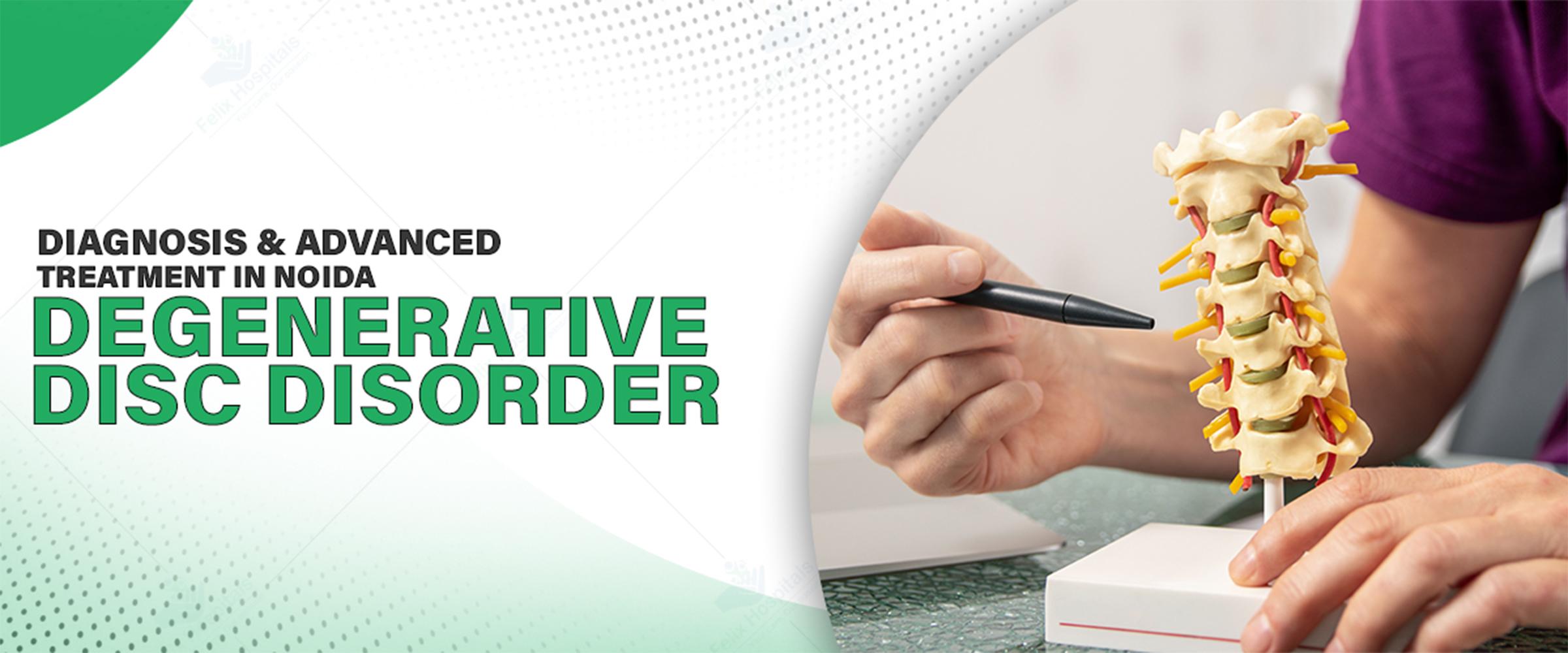
People often complain about back and neck pain these days, and it's often because of a condition called Degenerative Disc Disorder (DDD). A lot of adults over 40 have this condition. If you have chronic back pain, stiffness, or trouble moving, it might be time to see a spine specialist doctor near me for a correct diagnosis and good treatment. Fortunately, people can get treatment at the best Neurosurgery hospital in Noida. This hospital offers both basic and advanced treatments that are tailored to each patient's needs.
Make an appointment at +91 9667064100 to get your mobility back and live without pain.
Degenerative Disc Disorder is an Intervertebral Disc Disease in which the soft, cushion-like discs between your spine's vertebrae start to break down because of age, injury, or repeated stress. These discs act like shock absorbers, giving your spine flexibility and movement. Over time, they may lose water, elasticity, and structural integrity, which can cause pain and other problems with the spine.
As the discs get worse, they may not be able to cushion the vertebrae enough, which can make them rub against each other. The friction can cause things like:
Back and neck pain that comes and goes or can also lasts for a long time
Tingling or numbness in the arms and legs
Less flexibility
Pain that spreads when you move
Weakness in the muscles
If you don't treat Degenerative Disc Disorder it can get worse and cause problems with your spine, like spinal stenosis, herniated discs, or spondylolisthesis.
Different parts of the spine can degenerate:
The most common type is lumbar DDD, which usually affects the L4-L5 or L5-S1 discs.
Cervical DDD (neck) makes it hard to move around by making your neck stiff, give you headaches, and hurt your shoulders.
Multilevel DDD affects more than one part of the spine and is common in older people or people who have had spine problems for a long time.
Knowing the stages of degeneration can help you find the right treatment:
Dysfunction: Early wear and tear, which can be uncomfortable but not too bad.
Dehydration: Discs loses water which makes them less flexible.
Stabilisation: The spine tries to stay stable, which can lead to bone growths and nerve compression.
Collapse: A serious condition in which the vertebrae may touch, causing long-term pain and limited movement.
For effective treatment, it is very important to diagnose disc problems quickly and correctly. At a specialised clinic or hospital, the process of making a diagnosis includes:
Medical History and Physical Exam: Doctors look for problems with movement, neurological symptoms, and muscle strength.
X-rays show that the disc space is getting smaller and that there are bone spurs.
MRI (Magnetic Resonance Imaging) gives you clear pictures of soft tissue, showing things like disc degeneration, herniations, or nerve compression.
CT scans give very clear pictures of bone structures.
Discography: This is when dye is injected into a disc to find the source of pain.
These tests help figure out how bad the disorder is and what the best treatments are for disc degeneration.
Once the diagnosis is confirmed, treatment plans are made based on the patient's age, the severity of the condition, and their way of life. There are both surgical and non-surgical options for treating Intervertebral Disc Disease.
Physical Therapy: The goal of therapy is to strengthen the muscles that support the spine and core to lessen pain and improve flexibility.
NSAIDs, such as ibuprofen, lower inflammation.
Muscle relaxants help stop spasms.
Steroids and neuromodulators can help with pain that comes from nerves.
Steroid Injections: Injections near the affected nerves or joints that are targeted reduce swelling and give short-term relief.
Radiofrequency Neurotomy: This method uses heat to block pain signals from getting to the brain. It is not very invasive.
Spine surgery in Noida is an option if non-invasive treatments don't work. Some of the methods are:
Discectomy: In this the parts of the disc that are damaged are removed to relieve pressure on the nerves.
Foraminotomy and laminectomy - These surgeries that take out bone or tissue that is putting pressure on nerves.
Spinal fusion - In this surgery two or more vertebrae are connected to make the spine more stable and get rid of pain that comes from moving.
Disc Replacement Surgery: Replaces worn-out discs with fake ones to keep movement and ease pain.
These surgeries, done by skilled surgeons with cutting-edge tools, can greatly improve mobility and quality of life.
The price of treating disc disorder in Noida depends on the method used:
Consultation and diagnosis: ₹2,000 to ₹8,000
Physical therapy sessions cost between ₹1,000 and ₹2,500 each.
Steroid shots cost between ₹15,000 and ₹30,000 each time.
The cost of spinal surgery ranges from ₹1,50,000 to ₹4,00,000, depending on the type and how hard it is.
Daily habits also affect recovery, even though professional treatment is important:
Swimming, walking, or biking are all low-impact exercises that help keep your spine strong without putting too much strain on it.
Stretching and yoga can help you stand up straighter and ease stiffness.
Alternating between hot and cold packs helps with pain and swelling.
Felix Hospital is a great place to go for spine and neurosurgery care because they take a whole-person approach to treatment. Felix has a team of neurologists, orthopaedists, and spine surgeons who work together to provide personalised care using the latest diagnostic tools and surgical methods. They are a popular choice for disc-related problems because of their modern facilities, patient-first approach, and clear billing. Felix makes sure that you are safe, comfortable, and get good results at every step, whether you are thinking about non-invasive treatment or advanced spine surgery in Noida.
Call +91 9667064100 for expert help with degenerative disc disorder.
Degenerative Disc Disorder is a condition that gets worse over time but can be managed. People can live an active, pain-free life if they get diagnosed early, make changes to their lifestyle, and get expert medical care. Noida is now home to some of the best medical centres in the country, which offer full care from diagnosis to rehabilitation. You can get help with anything from finding the best Neurologists in Noida to figuring out how much it costs to treat a disc disorder in Noida. Taking action right away not only stops problems from getting worse, but it also helps you get your health and mobility back.
Q1. Can I get rid of Degenerative Disc Disorder, or will I have to live with it forever?
Ans: There is no cure for DDD, but the right treatment and changes to your lifestyle can help you deal with its symptoms.
Q2. How can I tell if my back pain is really Degenerative Disc Disorder?
Ans: If your back pain lasts for weeks and gets worse when you move, you should see a spine specialist for a proper diagnosis.
Q3. Is it possible for me to avoid surgery if I have Degenerative Disc Disorder?
Ans: Yes, many cases get better with physical therapy, medications, and other non-surgical methods. Surgery is only an option if these don't work.
Q4. How long should I try treatments that don't involve surgery before thinking about surgery?
Ans: Doctors usually suggest at least 6 to 12 weeks of conservative treatment unless the symptoms are very bad or getting worse.
Q5. After spine surgery for Degenerative Disc Disorder, will I be able to walk or work out?
Ans: Most patients get their mobility back after surgery and can start doing light exercise again within a few weeks, depending on the type of surgery and how well they heal.

Spinal cord injury is one of the most serious injuries one can have. The damages can be permanent if not treated on time.

Orthopedics is a specialized branch that takes care of your musculoskeletal problems related to joints, bones, muscles, spine, ligaments, and tissues.


Subscribe to our
© Copyright 2026. All Rights Reserved by Felix Healthcare Private Limited
Design and development by :


 +(91)9667064100
 Emergency : +(91)9667064100