 WhatsApp
 Emergency:
Subscribe to our
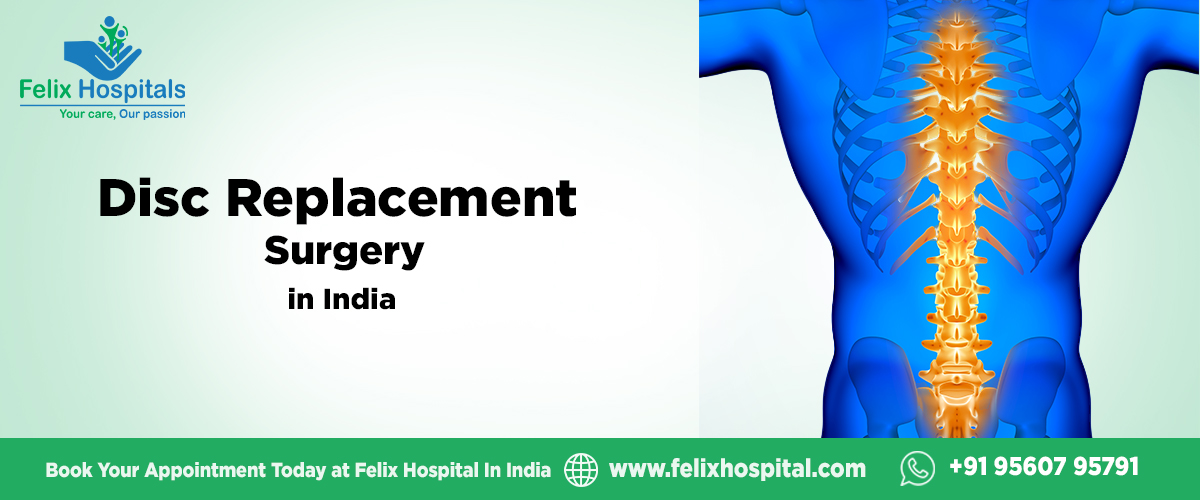
The Center for Bone & Joint Care at Felix Hospital is one of the top hospitals in India in Disc Replacement Surgery where spinal surgery is done with an aim of restoring mobility along with spine stability and pain relief. Our team of highly qualified spine surgeons and orthopedic professionals is well trained to diagnose and treat a broad spectrum of spinal illnesses such as degenerative disc disease, herniated discs and traumatic disc injuries.
In Felix Hospital, patients are treated individually on a multidisciplinary basis involving the application of high-level imaging, minimum invasive surgical equipment, and specialized rehabilitation services after surgery. Our spine specialists are patient-focused to guarantee sustained outcomes and better quality of life based on patient safety, accuracy, and recovery.
Get world-class Knee Replacement Surgery in India at Felix Hospital, Noida. Call Us: +919560795791 And WhatsApp +919560795791 us now for expert care and quick assistance!
Disc Replacement Surgery (or Artificial Disc Replacement (ADR)) is a surgical technique done on the spine to substitute a damaged or degenerated intervertebral disc with an artificial one (also called Total Disc Replacement). Depending on the cause of the pain or the instability the surgery is usually done in the cervical (neck) or lumbar (lower back) region of the spine.
The disc replacement provides movement of the spine as opposed to spinal fusion surgery, which fuses two bones together; it solves the pain that comes as a result of pressure on the spinal nerves. The man-made disc is normally made of steel and plastic materials of medical grade that are produced in such a way that they can mimic the flexibility and cushioning capacity of the natural disc.
This surgery is done in the neck area and is used to treat degenerative disc disease, or compression of nerves that result in either neck or radiating arm pain. The injured cervical disc is excised and an artificial disc inserted which permits normal movement among vertebrae.
It is a procedure that aims at the lower back part to restore the lost or torn lumbar disc that causes chronic low back pain, and nerve pain. The patients usually report a great deal of pain relief and better posture by maintaining the disc motion and stability.
In partial disc replacement, healthy disc material is retained and it is only the injured area of the disc that is substituted with a prosthetic implant. Applicable in patients whose degenerative changes of the disc are in the early and middle stage.
Revision surgery is done to patients whose previous disc replacement procedure has been unsuccessful or still report pain as part of the implantation. This is a complicated process performed by expert methods of spine surgery under the supervision of skilled surgeons of Felix Hospital.
Diagnosis is a critical step to be carried out properly before administering a disc replacement surgery. In Felix Hospital, a critical assessment entails:
Physical Examination: Evaluating the movement of the spine, nerve conduction and muscle strength.
Tests of Imaging: MRI scans, CT scans or X-rays aid in establishing the degree and the amount of disc degeneration.
Neurological Testing: To assess compression of nerves and the spinal cord.
Medical History and Lifestyle Analysis: Evaluation of the symptoms, previous injuries or medical interventions that could influence surgical planning.
Your back doctor will determine whether you qualify to have disc replacement or whether other non-operative therapies are to be activated before surgery.
Disclose information about all medications, supplements, and any surgeries or allergies experienced to your physician. Some drugs might have to be stopped either prior to an operation in order to minimize blood loss or anesthesia complications.
Stop smoking and reduce alcohol intake prior to surgery since both may slow down wound healing and predispose to complications.
Stretching and light exercise before the surgery are recommended to keep the spinal muscles flexible and enhance the recovery process after surgery.
Prepare post-operative living quarters- have necessities at hand, furnish supportive furniture and have no extreme bending or twisting.
To make sure that they are ready to provide care after surgery, patients are supposed to talk about their recovery schedule, stay at the hospital, and rehabilitation with their surgeon and physiotherapy team.
Anesthesia:
General anesthesia is administered to the patients to make it comfortable during the operation.
Incision & Access:
This is a small incision in the back (cervical) or side (lumbar) of the spine. The affected disc is reached by moving the muscles and tissues aside in a gentle manner.
Disc Removal:
Precision tools are used to pull out the damaged disc and care is taken not to damage nearby nerves or ligaments.
Implant Placement:
The artificial disc is placed in-between the vertebrae and is firmly stable letting the spine to move naturally.
Final Adjustments & Closure:
Once alignment and stability are examined, the incision is sealed. Patients are transferred to recovery to be monitored and treated for the pain.
The procedure is minimally invasive, which means that less tissue is destroyed, hospitals will spend less time, and recovery will occur faster.
Even though it is normally safe, disc replacement surgery may pose a risk like:
Surgical site infection.
Bleeding or blood clots
Damage to the nerves resulting in numbness or weakness.
Anesthetic or implant allergic reaction.
Implant shifting or loosening.
Constant or chronic back pain.
Problem with swallowing (in cervical surgeries)
Stiffness of the spine or movement difficulty.
Most of the patients start light movements after surgery within the range of 24 and 48 hours and they can go home within a few days. How soon one is recovering depends on the type of surgery, health of the patient, most individuals go back to normal work in 4- 6 weeks, and full recovery is experienced in 3-6 months.
Adhere to the directions given by your doctor on physiotherapy.
Do not carry objects that are heavy or twist or sit long.
Wipe the place of the incision dry.
Take prescribed pain medication frequently.
Rebuilds the function of the spine and muscular flexibility.
Alleviates pain in the long term.
Avoids the degeneration of the neighboring discs.
Facilitates recovery speed as opposed to spinal fusion.
Minimizes the use of pain drugs.
Enhances quality of life and posture.
Encourages early work or exercise.
Felix Hospital (At the Center of Spine Care) has included the most modern diagnostic equipment and the latest cutting edge surgical machinery to provide successful treatment to all patients.
Superiorly Qualified Spinal Surgeons.
Minimally Invasive Surgical Procedures.
New Technology in Imaging and Navigation.
State-of-the-Art Modular Operation Theatres.
24/7 Emergency and Critical Care.
It can be used in patients whose degenerative processes in the discs are at the single level and have fallen short of response to other conservative care measures, including physiotherapy, medications, or injections.
The majority of patients can get back to light activities 4-6 weeks later although it can take as long as 3-6 months to get fully back on their feet.
Yes, in many cases. With disc replacement, the flexibility is maintained and there is very little stress on the rest of the spinal levels, whereas in fusion, movement is limited.
Yes. Felix hospital provides tailor-made physiotherapy and rehabilitation therapy to facilitate a safe recovery period and to avoid spinal complications in the future.
Get world-class Knee Replacement Surgery in India at Felix Hospital, Noida. Call Us: +919560795791 And WhatsApp +919560795791 us now for expert care and quick assistance!

Subscribe to our
© Copyright 2026. All Rights Reserved by Felix Healthcare Private Limited
Design and development by :


 +(91)9667064100
 Emergency : +(91)9667064100