 Emergency:
  WhatsApp

Subscribe to our
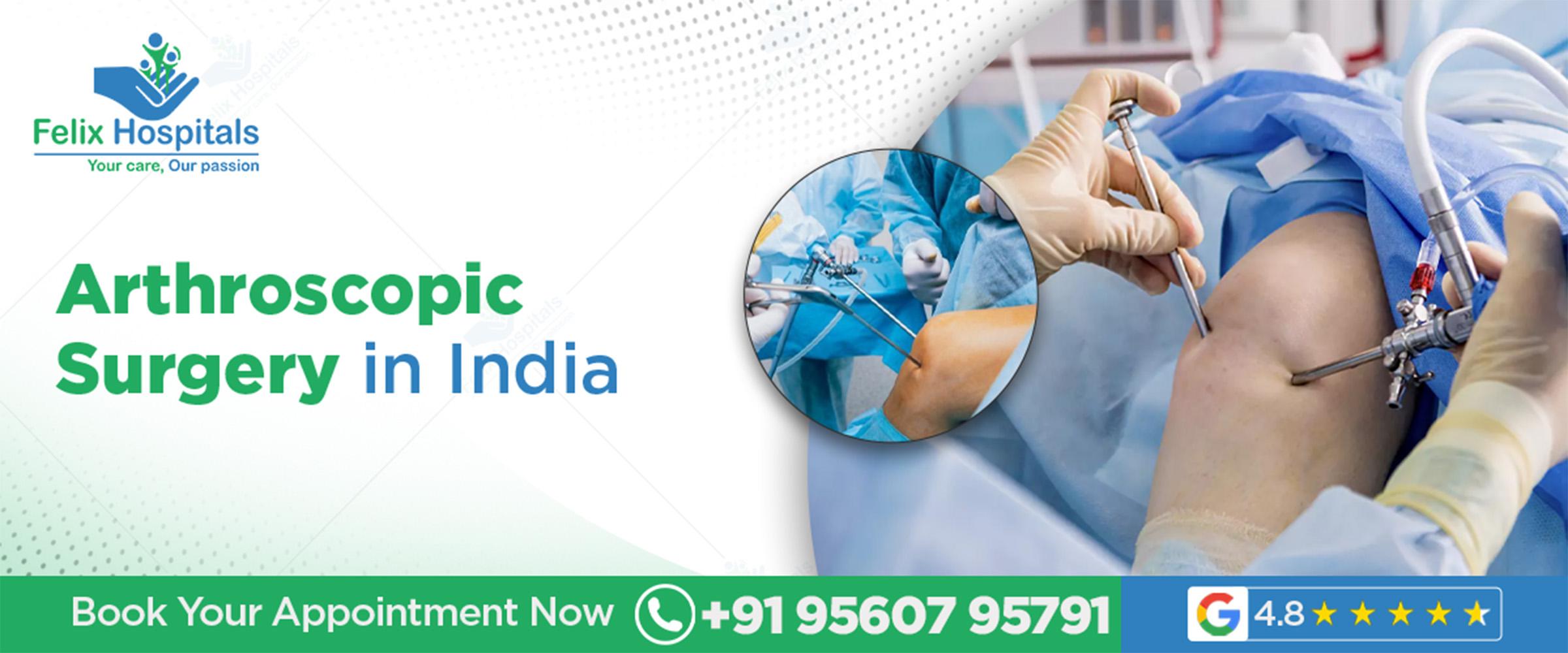
Arthroscopy has become one of the most widely performed orthopaedic procedures worldwide due to its precision, minimal tissue disruption, and faster rehabilitation. In India, the demand for arthroscopic procedures has grown significantly, supported by advanced surgical units, improved imaging technology, and experienced orthopaedic specialists. This guide provides a comprehensive, professional overview of Arthroscopic Surgery in India, including types of procedures, indications, benefits, risks, recovery expectations, and why selecting the right hospital matters.
Schedule Arthroscopic Surgery at Felix Hospital, Noida India Call Us: +919560795791 And WhatsApp +919560795791 us now. Our team will help you book the best treatment and arrange your medical visa hassle-free.
Arthroscopic surgery is a minimally invasive orthopaedic technique that allows surgeons to diagnose and treat joint conditions through very small incisions. A specialised instrument called an arthroscope—equipped with a camera and fibre-optic light—is inserted into the joint. Live magnified images are displayed on a monitor, enabling the surgeon to evaluate internal structures such as cartilage, ligaments, tendons, and synovium with exceptional clarity.
Alongside the arthroscope, micro-instruments are introduced through additional tiny portals to perform corrective procedures. Because the surgery avoids large incisions, patients typically experience less pain, minimal scarring, reduced infection risk, and faster mobilization compared to open surgery.
Arthroscopy is commonly performed on joints such as the knee, shoulder, hip, elbow, wrist, and ankle, making it a crucial component of modern orthopaedic care in India.
Professionals recommend arthroscopy when symptoms and diagnostic tests indicate internal joint pathology that cannot be adequately managed with medications, physiotherapy, or injections.
Typical indications include:
Persistent joint pain affecting mobility or daily activities
Mechanical symptoms such as locking, catching, or instability
Arthroscopy also allows surgeons to confirm diagnosis in complex cases where imaging alone does not provide complete clarity.
The types of arthroscopic surgery performed depend on the specific joint and the underlying problem. In India, the following procedures are among the most commonly conducted:
Used for:
Knee arthroscopy is one of the highest-volume arthroscopic procedures in the country due to sports injuries and degenerative changes.
Used for:
This procedure offers excellent visualization of the glenohumeral joint, making it preferred over open techniques for many conditions.
Used for:
Hip arthroscopy requires high surgical expertise and advanced equipment due to the joint’s depth and complex anatomy.
Used for:
It provides quick recovery for athletes and patients with recurrent instability.
Used for:
Performed on small joints of the foot and hand using micro-scope systems for precise stabilisation and debridement.
Across India, the availability of these types of arthroscopic surgery has grown due to improved training, dedicated arthroscopy units, and better rehabilitation support.
The advantages of arthroscopy surgery extend beyond reduced incision size. Some of the most clinically relevant benefits include:
High-definition cameras deliver magnified images, enabling accurate diagnosis and precise surgical correction that may not be possible with open surgery.
Surgeons operate through tiny portals (0.5–1 cm), significantly reducing trauma to surrounding muscles, ligaments, and skin.
Smaller incisions and sterile arthroscopy suites reduce postoperative risks, making recovery smoother.
Patients typically begin mobilisation early, with many returning to daily activities sooner than with conventional open surgery.
Most arthroscopic procedures are performed as day-care or short-stay surgeries.
Minimal scarring and smaller sutures contribute to better aesthetic results, especially for younger patients and athletes.
These advantages make Arthroscopic Surgery in India an optimal choice for both traumatic injuries and degenerative joint disorders.
Although arthroscopy is generally safe, it is still a surgical procedure with potential complications. Understanding these risks allows for transparent patient counselling.
Possible complications include:
Infection (rare due to small incisions and sterile technique)
Recovery depends on the type of surgery performed, the joint involved, and patient-specific factors.
Typical recovery timeline:
Day 1–3: Pain control, icing, elevation, and gentle mobilisation
Week 1–2: Suture removal, improved mobility, initiation of basic physiotherapy
Week 3–6: Strength training, gait correction (for lower limb surgeries)
Month 3 onwards: Return to sports or high-demand activities, depending on healing
Rehabilitation is a critical part of recovery. Physiotherapists focus on range-of-motion exercises, muscle strengthening, proprioceptive training, and functional retraining to ensure optimal joint performance.
Adherence to postoperative advice determines long-term outcomes.
India has emerged as a strong centre for arthroscopic procedures owing to the presence of experienced orthopaedic surgeons, modern surgical infrastructure, advanced imaging, and cost-effective treatment. Patients from across India and abroad choose arthroscopic treatment due to:
Felix Hospital offers comprehensive orthopaedic care supported by advanced technology and experienced surgical teams. Our arthroscopy unit provides:
Felix prioritises clinical outcomes, safety, and evidence-based management for every patient undergoing arthroscopic procedures.
It repairs injuries with minimal downtime, helping athletes return to sport faster.
Results are long-lasting if rehabilitation is followed and no major reinjury occurs.
Desk jobs can usually resume within a few days; physical jobs take longer.
Yes, most hospitals provide coordinators to help with appointments, reports, and follow-ups.
It is significantly more affordable than many countries, with no compromise on medical standards.
Schedule Arthroscopic Surgery at Felix Hospital, Noida India Call Us: +919560795791 And WhatsApp +919560795791 us now. Our team will help you book the best treatment and arrange your medical visa hassle-free.

Ankle Replacement Surgery, also known as Total Ankle Arthroplasty,is a type of orthopaedic surgery that is utilized in the management of chronic ankle pains, restoration of mobility and to enhance the quality of life of patients with advanced arthritis, t

At Felix Hospital India, international patients receive world-class care with advanced surgical technology, a multidisciplinary orthopaedic team, and personalized treatment plans tailored to individual anatomy and medical history. India has emerged as a l

Subscribe to our
© Copyright 2026. All Rights Reserved by Felix Healthcare Private Limited
Design and development by :


 +(91)9667064100
 Emergency : +(91)9667064100