 WhatsApp
 Emergency:
  WhatsApp







Subscribe to our
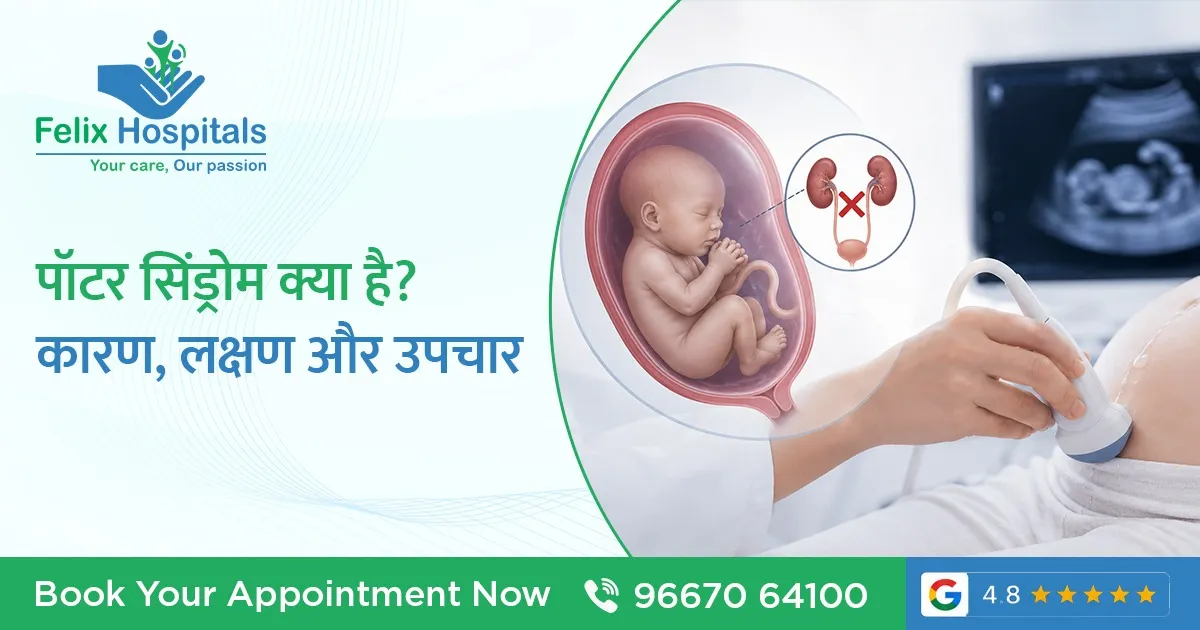
पॉटर सिंड्रोम (Potter Syndrome) एक दुर्लभ लेकिन गंभीर जन्मजात (Congenital) स्थिति है, जिसमें गर्भ में शिशु के आसपास मौजूद एमनियोटिक फ्लूइड (Amniotic Fluid) की मात्रा बहुत कम (Oligohydramnios) या बिल्कुल नहीं होती। इस फ्लूइड की कमी के कारण शिशु के फेफड़ों, किडनी और चेहरे के विकास पर गंभीर असर पड़ता है। Best pediatric Hospital In Noida में उपलब्ध है। कई मामलों में यह स्थिति जन्म के बाद जीवन के लिए खतरनाक साबित हो सकती है।
अभी अपॉइंटमेंट शेड्यूल करें – कॉल करें: +91 9667064100
पॉटर सिंड्रोम एक ऐसी गंभीर जन्मजात स्थिति है, जिसमें गर्भ में शिशु के आसपास मौजूद एमनियोटिक फ्लूइड की मात्रा बहुत कम हो जाती है या बिल्कुल नहीं रहती। यह फ्लूइड शिशु के सुरक्षित और सामान्य विकास के लिए बेहद जरूरी होता है। जब इसकी कमी हो जाती है, तो शिशु के शरीर के कई महत्वपूर्ण अंगों खासकर फेफड़े, किडनी और चेहरे की संरचना का विकास प्रभावित होने लगता है। यह समस्या अक्सर तब उत्पन्न होती है जब शिशु की किडनी सही तरीके से विकसित नहीं होती या वे पर्याप्त मात्रा में यूरिन नहीं बना पातीं। गर्भावस्था के दौरान एमनियोटिक फ्लूइड का एक बड़ा हिस्सा शिशु के मूत्र से ही बनता है, इसलिए यदि मूत्र का निर्माण नहीं होता, तो फ्लूइड का स्तर तेजी से घट जाता है। इसके अलावा, कुछ मामलों में यूरिनरी ट्रैक्ट में रुकावट, किडनी की आनुवंशिक बीमारियां या एमनियोटिक थैली में लीक होने जैसी स्थितियां भी इस समस्या का कारण बन सकती हैं।
एमनियोटिक फ्लूइड शिशु के विकास के लिए बेहद जरूरी होता है:
शिशु को बाहरी चोट से बचाता है
फेफड़ों के विकास में मदद करता है
शिशु को हिलने-डुलने की जगह देता है
तापमान नियंत्रित रखता है
जब यह फ्लूइड कम हो जाता है, तो शिशु के अंगों का विकास रुक सकता है।
पॉटर सिंड्रोम के पीछे सबसे बड़ा कारण गर्भ में एमनियोटिक फ्लूइड की कमी (Oligohydramnios) होता है। यह कमी कई अलग-अलग कारणों से हो सकती है, जिनमें शिशु की किडनी, मूत्र मार्ग और प्लेसेंटा से जुड़ी समस्याएं शामिल हैं। नीचे इनके प्रमुख कारणों को विस्तार से समझाया गया है:
यह पॉटर सिंड्रोम का सबसे प्रमुख और गंभीर कारण माना जाता है। इस स्थिति में शिशु की एक या दोनों किडनी जन्म से ही विकसित नहीं होतीं। दोनों किडनी का न होना (Bilateral Renal Agenesis) सबसे खतरनाक स्थिति है। किडनी न होने पर शिशु मूत्र नहीं बना पाता। इससे एमनियोटिक फ्लूइड का स्तर बहुत तेजी से कम हो जाता है। परिणामस्वरूप फेफड़ों और अन्य अंगों का विकास रुक जाता है
इसमें शिशु की किडनी में छोटे-छोटे सिस्ट (गांठ जैसी संरचनाएं) बन जाती हैं। किडनी की कार्यक्षमता प्रभावित हो जाती है। मूत्र का निर्माण कम या बाधित हो जाता है। धीरे-धीरे एमनियोटिक फ्लूइड कम होने लगता है। यह समस्या कई बार आनुवंशिक होती है और परिवार में चल सकती है
शिशु के मूत्र मार्ग (Urinary System) में किसी भी तरह की रुकावट फ्लूइड की कमी का कारण बन सकती है।
मूत्र बनने के बाद भी बाहर नहीं निकल पाता
मूत्राशय में दबाव बढ़ जाता है
किडनी पर असर पड़ता है और उनका विकास प्रभावित होता है
इससे एमनियोटिक फ्लूइड का स्तर धीरे-धीरे कम हो जाता है
कुछ मामलों में एमनियोटिक थैली में छेद या कमजोरी के कारण फ्लूइड बाहर निकलने लगता है। यह समस्या प्रिमेच्योर रप्चर ऑफ मेम्ब्रेन के कारण हो सकती है। धीरे-धीरे या अचानक फ्लूइड की मात्रा कम हो जाती है। लंबे समय तक लीक रहने पर शिशु के विकास पर गंभीर असर पड़ता है
प्लेसेंटा शिशु को पोषण और ऑक्सीजन देने का मुख्य स्रोत होता है। यदि प्लेसेंटा सही से काम नहीं करता, तो शिशु को पर्याप्त पोषण नहीं मिल पाता। इससे किडनी और अन्य अंगों का विकास प्रभावित होता है। परिणामस्वरूप मूत्र का निर्माण कम हो जाता है और फ्लूइड घटने लगता है।
गर्भावस्था के दौरान:
पेट का आकार अपेक्षा से छोटा होना
कम एमनियोटिक फ्लूइड (Ultrasound में पता चलता है)
जन्म के बाद शिशु में:
चपटा चेहरा (Flattened face)
छोटी ठोड़ी
कानों का असामान्य आकार
सांस लेने में दिक्कत
कमजोर या अविकसित फेफड़े
पॉटर सिंड्रोम में एमनियोटिक फ्लूइड की कमी शिशु के समग्र विकास पर गहरा असर डालती है। यह फ्लूइड केवल सुरक्षा ही नहीं देता, बल्कि अंगों के सही विकास के लिए भी जरूरी होता है। इसकी कमी से शिशु के शरीर पर लगातार दबाव पड़ता है और कई महत्वपूर्ण अंग ठीक से विकसित नहीं हो पाते। नीचे इसके प्रमुख प्रभावों को विस्तार से समझाया गया है:
यह पॉटर सिंड्रोम का सबसे गंभीर प्रभाव माना जाता है।
एमनियोटिक फ्लूइड फेफड़ों के विकास में अहम भूमिका निभाता है
फ्लूइड की कमी से फेफड़े पूरी तरह विकसित नहीं हो पाते
जन्म के बाद शिशु को सांस लेने में गंभीर दिक्कत होती है
कई मामलों में ऑक्सीजन या वेंटिलेटर सपोर्ट की जरूरत पड़ती है
यह स्थिति जीवन के लिए सबसे बड़ा खतरा बन सकती है
पॉटर सिंड्रोम अक्सर किडनी से जुड़ी समस्या के कारण ही होता है।
किडनी का विकास अधूरा या असामान्य हो सकता है
मूत्र का निर्माण प्रभावित होता है
जन्म के बाद शिशु में किडनी फेल होने की संभावना रहती है
ऐसे मामलों में डायलिसिस या भविष्य में किडनी ट्रांसप्लांट की जरूरत पड़ सकती है
एमनियोटिक फ्लूइड की कमी से शिशु को गर्भ में हिलने-डुलने की पर्याप्त जगह नहीं मिलती।
शरीर पर लगातार दबाव पड़ने से हड्डियों का आकार प्रभावित होता है
हाथ-पैर टेढ़े या असामान्य स्थिति में विकसित हो सकते हैं
चेहरे की बनावट बदल सकती है (जैसे चपटा चेहरा, छोटी ठोड़ी)
जोड़ों (Joints) में जकड़न या कठोरता आ सकती है
गंभीर मामलों में पॉटर सिंड्रोम जीवन के लिए बड़ा खतरा बन जाता है।
फेफड़ों और किडनी दोनों के प्रभावित होने से स्थिति जटिल हो जाती है
शिशु को जन्म के तुरंत बाद गहन चिकित्सा (एनआईसीयू) की जरूरत पड़ती है
कई मामलों में शिशु लंबे समय तक जीवित नहीं रह पाता
हालांकि, हल्के मामलों में उचित इलाज और देखभाल से स्थिति संभाली जा सकती है
जिनकी पिछली प्रेग्नेंसी में यह समस्या रही हो
आनुवंशिक समस्याएं
किडनी से संबंधित रोग
गर्भावस्था में फ्लूइड लीक होना
अल्ट्रासाउंड– फ्लूइड की मात्रा और किडनी की जांच
एमनियोटिक फ्लूइड इंडेक्स (एएफआई)
फीटल एमआरआई– गंभीर मामलों में
जेनेटिक टेस्टिंग
पॉटर सिंड्रोम का संदेह या पुष्टि होने पर गर्भावस्था को हाई-रिस्क प्रेग्नेंसी की तरह मैनेज किया जाता है। इसका मुख्य उद्देश्य शिशु की स्थिति पर लगातार नजर रखना और संभावित जटिलताओं को समय रहते संभालना होता है।
नियमित अल्ट्रासाउंड मॉनिटरिंग
गर्भ में एमनियोटिक फ्लूइड की मात्रा (AFI) को बार-बार जांचा जाता है। शिशु के अंगों, खासकर किडनी और फेफड़ों के विकास का आकलन किया जाता है। ग्रोथ (वजन, लंबाई) और मूवमेंट पर भी नजर रखी जाती है। इससे बीमारी की गंभीरता और प्रोग्रेस का पता चलता है।
विशेषज्ञ (फीटल मेडिसिन स्पेशलिस्ट) नियमित रूप से फ्लूइड स्तर का मूल्यांकन करते हैं। यदि फ्लूइड तेजी से कम हो रहा हो, तो अतिरिक्त सावधानी बरती जाती है। मां की सेहत, ब्लड प्रेशर, और अन्य पैरामीटर भी मॉनिटर किए जाते हैं
कुछ मामलों में एमनियोइन्फ्यूजनः
यह एक प्रक्रिया है जिसमें गर्भाशय में कृत्रिम रूप से फ्लूइड डाला जाता है। इसका उद्देश्य अस्थायी रूप से शिशु के लिए बेहतर वातावरण बनाना होता है। सभी मामलों में यह प्रभावी नहीं होता, लेकिन कुछ स्थितियों में लाभ मिल सकता है। यह प्रक्रिया केवल विशेषज्ञ केंद्रों में और सावधानीपूर्वक की जाती है।
हाई-रिस्क प्रेग्नेंसी के रूप में विशेष देखभालः
ऐसी गर्भावस्था में नियमित फॉलो-अप और विशेषज्ञ टीम की जरूरत होती है। जरूरत पड़ने पर समय से पहले डिलीवरी की योजना बनाई जा सकती है। माता-पिता को काउंसलिंग दी जाती है ताकि वे संभावित परिणामों के लिए तैयार रहें।
पॉटर सिंड्रोम में उपचार पूरी तरह इस बात पर निर्भर करता है कि शिशु की स्थिति कितनी गंभीर है। अधिकतर मामलों में सपोर्टिव केयर ही मुख्य इलाज होता है।
यदि शिशु के फेफड़े पूरी तरह विकसित नहीं होते, तो सांस लेने में दिक्कत होती है। ऐसे में ऑक्सीजन या वेंटिलेटर की सहायता दी जाती है। यह जीवन बचाने के लिए शुरुआती और सबसे जरूरी कदम होता है
किडनी फेल होने पर डायलिसिसः
किडनी के काम न करने पर शरीर में विषैले पदार्थ जमा होने लगते हैं। ऐसे में डायलिसिस के जरिए खून को साफ किया जाता है। यह एक अस्थायी समाधान होता है जब तक आगे का इलाज तय न हो
अगर शिशु की स्थिति स्थिर हो जाए, तो आगे चलकर किडनी ट्रांसप्लांट पर विचार किया जा सकता है। यह लंबे समय के लिए बेहतर समाधान हो सकता है, लेकिन हर केस में संभव नहीं होता।
नवजात आईसीयू (एनआईसीयू) में देखभालः
जन्म के तुरंत बाद शिशु को नवजात गहन चिकित्सा इकाई (एनआईसीयू (NICU)) में रखा जाता है यहां 24 घंटे मॉनिटरिंग, दवाएं और आवश्यक सपोर्ट दिया जाता है। शिशु की सांस, दिल की धड़कन और अन्य जरूरी कार्यों पर नजर रखी जाती है
पॉटर सिंड्रोम को पूरी तरह रोकना हमेशा संभव नहीं है, क्योंकि यह अक्सर जन्मजात और आनुवंशिक कारणों से जुड़ा होता है। Best pediatrician In Noida में उपलब्ध है। फिर भी कुछ सावधानियों से जोखिम को कम किया जा सकता है।
नियमित प्रेग्नेंसी चेकअप-
समय-समय पर डॉक्टर से जांच करवाने से किसी भी समस्या का जल्दी पता चल सकता है। शुरुआती पहचान से बेहतर मैनेजमेंट संभव होता है।
समय पर अल्ट्रासाउंड-
अल्ट्रासाउंड के जरिए एमनियोटिक फ्लूइड और शिशु के अंगों की स्थिति का पता चलता है। इससे बीमारी की पहचान और गंभीरता का आकलन किया जा सकता है।
हाई-रिस्क केस में विशेषज्ञ डॉक्टर की निगरानीः
जिन महिलाओं में पहले ऐसी समस्या रही हो या जोखिम अधिक हो, उन्हें विशेष निगरानी की जरूरत होती है। फीटल मेडिसिन एक्सपर्ट की सलाह बेहद जरूरी होती है
संक्रमण और दवाओं का सावधानी से उपयोगः
गर्भावस्था के दौरान किसी भी दवा का उपयोग डॉक्टर की सलाह से ही करें। संक्रमण से बचाव के लिए साफ-सफाई और सही जीवनशैली अपनाएं।
अभी अपॉइंटमेंट शेड्यूल करें – कॉल करें: +91 9667064100
पॉटर सिंड्रोम एक गंभीर लेकिन दुर्लभ स्थिति है, जो मुख्य रूप से एमनियोटिक फ्लूइड की कमी के कारण होती है। समय पर जांच और सही देखभाल से कुछ मामलों में स्थिति को बेहतर तरीके से मैनेज किया जा सकता है। पॉटर सिंड्रोम एक जटिल और गंभीर स्थिति है, जिसमें समय पर पहचान, नियमित मॉनिटरिंग और विशेषज्ञ देखभाल बेहद महत्वपूर्ण होती है। हालांकि इसका पूर्ण बचाव हमेशा संभव नहीं है, लेकिन सही प्रबंधन और चिकित्सा सहायता से कुछ मामलों में बेहतर परिणाम हासिल किए जा सकते हैं।
Dr. Charu Yadav is an obstetrician and gynecologist with 12+ years of experience, specializing in high-risk and twin pregnancies, ectopic pregnancy, and menstrual disorders. Trained in laparoscopic surgery, she provides care for pregnancy, infertility, menopause, and gynae procedures. She is also recognized among the Best Gynecologists in Noida for her patient-focused treatment.
गर्भावस्था के दौरान बाह्य बवासीर एक आम समस्या है, जो महिला के शरीर में हार्मोनल बदलाव और बढ़ते दबाव के कारण होती है। समय पर सावधानी और सही इलाज से इससे राहत मिल सकती है।
गर्भाशय ग्रीवा कैंसर एचपीवी वायरस से होता है। समय पर जांच और टीकाकरण से बचाव संभव है।
गर्भ में पानी अधिक होना (पॉलीहाइड्रेमनिओस) एक स्थिति है जो गर्भावस्था में जटिलताएँ पैदा कर सकती है और डॉक्टर की निगरानी जरूरी होती है
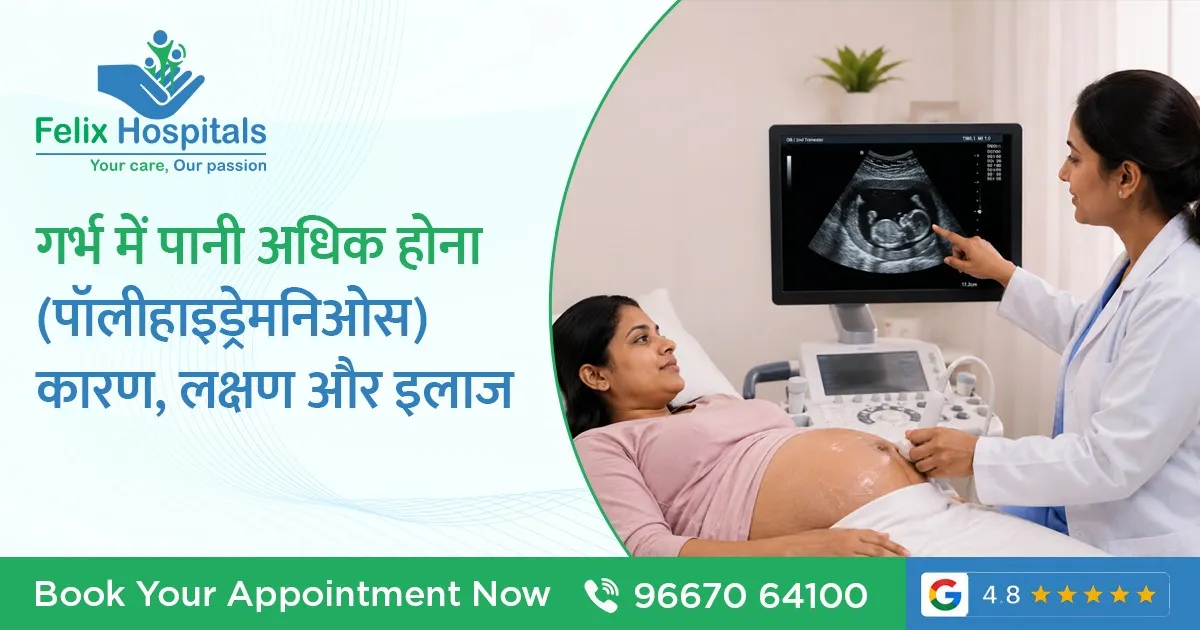
गर्भावस्था के दौरान शिशु एक तरल पदार्थ (एमनियोटिक फ्लूइड) में रहता है। जो उसके विकास के लिए बेहद जरूरी होता है। लेकिन जब यह तरल सामान्य से ज्यादा हो जाता है, तो इस स्थिति को पॉलीहाइड्रेमनिओस (Polyhydramnios) कहा जाता है। Best Gynecology Hospital In Noida में उपलब्ध है। यह समस्या हल्की भी हो सकती है और गंभीर भी इसलिए समय पर पहचान और सही इलाज बहुत जरूरी है।
📞 अभी अपॉइंटमेंट शेड्यूल करें – कॉल करें: +91 9667064100
पॉलीहाइड्रेमनिओस एक ऐसी स्थिति है जिसमें गर्भ में एमनियोटिक फ्लूइड की मात्रा सामान्य से अधिक हो जाती है। यह फ्लूइड शिशु को सुरक्षा, पोषण और सही विकास के लिए जरूरी होता है, लेकिन इसकी अधिकता जटिलताएं पैदा कर सकती है।
गर्भावस्था के दौरान एमनियोटिक फ्लूइड शिशु के चारों ओर मौजूद एक सुरक्षा कवच की तरह काम करता है। यह न केवल शिशु को बाहरी झटकों से बचाता है, बल्कि उसके फेफड़ों, पाचन तंत्र और मांसपेशियों के सही विकास में भी महत्वपूर्ण भूमिका निभाता है। इसलिए इसकी मात्रा का संतुलित रहना बेहद जरूरी है। डॉक्टर आमतौर पर अल्ट्रासाउंड के माध्यम से एफआई (एमनियोटिक द्रव सूचकांक) या एकल सबसे गहरी जेब (एसडीपी )के जरिए फ्लूइड की मात्रा मापते हैं।
8–18 सेमी AFI को सामान्य माना जाता है
5 सेमी से कम होने पर ओलिगोहाइड्रेमनिओस (पानी की कमी) माना जाता है
24 सेमी से अधिक होने पर पॉलीहाइड्रेमनिओस (पानी अधिक) माना जाता है
गर्भावस्था के अलग-अलग चरणों में फ्लूइड की मात्रा बदलती रहती है:
दूसरे ट्राइमेस्टर में धीरे-धीरे बढ़ती है
तीसरे ट्राइमेस्टर (लगभग 32–34 सप्ताह) में यह अपने उच्चतम स्तर पर होती है
डिलीवरी के करीब आते-आते यह थोड़ी कम हो सकती है
यदि फ्लूइड सामान्य सीमा में है, तो यह संकेत है कि शिशु का विकास सही तरीके से हो रहा है। लेकिन यदि यह सीमा से बाहर जाता है, तो डॉक्टर अतिरिक्त निगरानी या इलाज की सलाह दे सकते हैं।
पॉलीहाइड्रेमनिओस को इसकी गंभीरता (Severity) के आधार पर तीन मुख्य प्रकारों में बांटा जाता है। यह वर्गीकरण डॉक्टर को यह तय करने में मदद करता है कि मरीज को केवल निगरानी की जरूरत है या सक्रिय उपचार की।
एएफआई: 24–29 सेमी
यह सबसे सामान्य प्रकार है और लगभग 60–70% मामलों में पाया जाता है
अधिकतर मामलों में कोई गंभीर लक्षण नहीं होते
अक्सर यह स्थिति बिना किसी जटिलता के मैनेज हो जाती है
केवल नियमित चेकअप और अल्ट्रासाउंड से निगरानी की जाती है। अच्छी बात यह है कि माइल्ड केस में मां और बच्चे दोनों पर जोखिम कम होता है।
एएफआई: 30–34 सेमी
इस स्तर पर लक्षण दिखाई देना शुरू हो सकते हैं, जैसे:
पेट में ज्यादा खिंचाव
सांस लेने में हल्की परेशानी
डॉक्टर अधिक बार जांच और मॉनिटरिंग की सलाह देते हैं
कुछ मामलों में दवाओं की जरूरत पड़ सकती है
यह स्थिति मध्यम जोखिम वाली होती है और नियमित मेडिकल सुपरविजन जरूरी होता है।
एएफआई: 35 सेमी या उससे अधिक
यह गंभीर स्थिति होती है और तुरंत ध्यान देने की आवश्यकता होती है
लक्षण अधिक स्पष्ट होते हैं:
तेज सांस फूलना
पेट में दर्द और अत्यधिक सूजन
समय से पहले प्रसव का खतरा
ऐसे मामलों में:
अस्पताल में भर्ती करना पड़ सकता है
अम्नियोरिडक्शन (अतिरिक्त फ्लूइड निकालना) किया जा सकता है
डॉक्टर डिलीवरी का समय पहले तय कर सकते हैं
इस स्थिति में मां और शिशु दोनों की सुरक्षा के लिए विशेषज्ञ निगरानी बेहद जरूरी होती है।
गर्भावस्था में डायबिटीज(Diabetes)
शिशु में जन्मजात विकार
जुड़वा या मल्टीपल प्रेग्नेंसी
संक्रमण (Infection)
आरएच असंगति
कई बार कारण पता नहीं चलता
पेट का अचानक बहुत ज्यादा बढ़ना
सांस लेने में तकलीफ
पैरों और पेट में सूजन
पेट में भारीपन या दर्द
शिशु की हलचल में बदलाव
डायबिटीज से पीड़ित महिलाएं
मल्टीपल प्रेग्नेंसी (Pregnancy) (जुड़वा बच्चे)
पहले भी ऐसी समस्या हो चुकी हो
संक्रमण या ब्लड ग्रुप असंगति
समय से पहले जन्म
भ्रूण की गलत पोजिशन
नाल की समस्या
विकास में देरी
पॉलीहाइड्रेमनिओस (गर्भ में पानी अधिक होना) की सही पहचान के लिए समय पर जांच बेहद जरूरी होती है। डॉक्टर आमतौर पर मरीज के लक्षण, मेडिकल हिस्ट्री और कुछ विशेष टेस्ट के आधार पर यह तय करते हैं कि स्थिति कितनी गंभीर है और आगे क्या उपचार किया जाना चाहिए। नीचे प्रमुख जांचों को विस्तार से समझाया गया है:
यह सबसे महत्वपूर्ण और पहली जांच होती है। अल्ट्रासाउंड के जरिए डॉक्टर गर्भ में शिशु की स्थिति, विकास और एमनियोटिक फ्लूइड की मात्रा का आकलन करते हैं। इससे यह भी पता चलता है कि कहीं शिशु में कोई जन्मजात समस्या तो नहीं है। साथ ही प्लेसेंटा (नाल) की स्थिति और ब्लड फ्लो भी देखा जाता है। नियमित अंतराल पर अल्ट्रासाउंड करवाने से स्थिति की लगातार निगरानी की जा सकती है।
एफआई एक विशेष माप है, जिससे गर्भ में पानी की सटीक मात्रा का अंदाजा लगाया जाता है।
इसमें गर्भाशय को चार भागों में बांटकर हर हिस्से में फ्लूइड की गहराई मापी जाती है
सभी माप को जोड़कर कुल AFI निकाला जाता है
इसी के आधार पर तय किया जाता है कि फ्लूइड सामान्य है, कम है या ज्यादा
यह टेस्ट पॉलीहाइड्रेमनिओस की गंभीरता (माइल्ड, मॉडरेट, सीवियर) तय करने में सबसे अहम होता है।
गर्भावस्था में डायबिटीज (गर्भावस्थाजन्य मधुमेह) पॉलीहाइड्रेमनिओस का एक आम कारण है।
इसलिए डॉक्टर फास्टिंग ब्लड शुगर और ओजीटीटी (ओरल ग्लूकोज़ टॉलरेंस टेस्ट) की सलाह देते हैं
अगर ब्लड शुगर ज्यादा पाई जाती है, तो उसे कंट्रोल करना जरूरी होता है
शुगर कंट्रोल में रहने से एमनियोटिक फ्लूइड का स्तर भी संतुलित रह सकता है।
कुछ संक्रमण भी इस समस्या का कारण बन सकते हैं।
टार्ट प्रोफाइल (जैसे टॉक्सोप्लाज़्मा, रूबेला, सीएमवी, हर्पीस)
अन्य बैक्टीरियल या वायरल संक्रमण की जांच
यूरिन टेस्ट भी किया जा सकता है
संक्रमण की समय पर पहचान से मां और शिशु दोनों को गंभीर जटिलताओं से बचाया जा सकता है।
अतिरिक्त जांच जरूरत के अनुसार
कई बार स्थिति को और स्पष्ट समझने के लिए डॉक्टर अन्य जांच भी कर सकते हैं:
फीटल इकोकार्डियोग्राफी– बच्चे के दिल की जांच
डॉपलर स्टडी– ब्लड फ्लो की स्थिति जानने के लिए
नॉन-स्ट्रेस टेस्ट– बच्चे की हार्ट रेट और मूवमेंट मॉनिटर करने के लिए
पॉलीहाइड्रेमनिओस का इलाज इस बात पर निर्भर करता है कि फ्लूइड कितना अधिक है, गर्भावस्था का कौन-सा चरण चल रहा है और मां-बच्चे की कुल स्थिति कैसी है। सही समय पर उपचार और निगरानी से ज्यादातर मामलों को सुरक्षित तरीके से मैनेज किया जा सकता है। नीचे उपचार के विकल्पों को विस्तार से समझाया गया है:
यदि फ्लूइड की मात्रा थोड़ी ही ज्यादा है और कोई गंभीर लक्षण नहीं हैं, तो आमतौर पर आक्रामक इलाज की जरूरत नहीं पड़ती।
नियमित मॉनिटरिंग: डॉक्टर समय-समय पर चेकअप और फॉलो-अप की सलाह देते हैं
बार-बार अल्ट्रासाउंड: AFI स्तर और शिशु के विकास पर नजर रखने के लिए
फीटल मूवमेंट पर निगरानी: मां को बच्चे की हलचल पर ध्यान रखने को कहा जाता है
जीवनशैली में सुधार: संतुलित आहार, पर्याप्त पानी और आराम
कई बार यह स्थिति अपने आप नियंत्रित हो जाती है, खासकर गर्भावस्था के अंतिम चरण में।
जब फ्लूइड का स्तर बढ़ता रहता है या लक्षण दिखाई देने लगते हैं, तब डॉक्टर दवाइयों की मदद लेते हैं।
फ्लूइड कम करने वाली दवाएं: जैसे कुछ विशेष दवाएं जो एमनियोटिक फ्लूइड के उत्पादन को कम करती हैं
डायबिटीज कंट्रोल: अगर कारण गर्भावस्था में शुगर है, तो इंसुलिन या अन्य दवाएं दी जाती हैं
संक्रमण का इलाज: यदि संक्रमण पाया जाए तो उसके अनुसार एंटीबायोटिक्स या एंटीवायरल दवाएं
गर्भावस्था में किसी भी दवा का उपयोग केवल डॉक्टर की सलाह से ही करना चाहिए।
यह एक मेडिकल प्रक्रिया है, जिसका उपयोग तब किया जाता है जब फ्लूइड बहुत अधिक हो जाए और मां को परेशानी होने लगे। इसमें एक पतली सुई की मदद से गर्भाशय से अतिरिक्त फ्लूइड निकाला जाता है। यह प्रक्रिया अल्ट्रासाउंड गाइडेंस में की जाती है, जिससे सुरक्षा बनी रहती है। इससे सांस फूलना, पेट में दर्द और दबाव जैसी समस्याओं में तुरंत राहत मिलती है। कुछ मामलों में यह प्रक्रिया एक से अधिक बार भी करनी पड़ सकती है।
यदि पॉलीहाइड्रेमनिओस गंभीर हो और जटिलताएं बढ़ने लगें, तो अधिक सतर्क और उन्नत उपचार की जरूरत होती है। हॉस्पिटल में भर्ती: लगातार मॉनिटरिंग के लिए। फीटल मॉनिटरिंग: बच्चे की हार्ट रेट, मूवमेंट और ऑक्सीजन सप्लाई पर नजर।
यदि मां या बच्चे को खतरा हो, तो डॉक्टर जल्दी डिलीवरी का निर्णय ले सकते हैं यह निर्णय पूरी तरह स्थिति की गंभीरता और गर्भावस्था के हफ्तों पर निर्भर करता है। Best Gynecologist In Noida में उपलब्ध है। ऐसे मामलों में मल्टी-स्पेशलिस्ट टीम (गायनेकोलॉजिस्ट, पीडियाट्रिशियन, कार्डियोलॉजिस्ट) मिलकर इलाज करती है।
खुद से कोई दवा या घरेलू उपचार न करें
नियमित चेकअप बिल्कुल न छोड़ें
किसी भी नए या गंभीर लक्षण को नजरअंदाज न करें
तुरंत संपर्क करें यदि:
सांस लेने में दिक्कत हो
पेट तेजी से बढ़ रहा हो
तेज दर्द या संकुचन हो
शिशु की हलचल कम लगे
📞 सलाह के लिए कॉल करें: +91 9667064100
ब्लड शुगर कंट्रोल रखें
नियमित चेकअप कराएं
संतुलित आहार लें
किसी भी लक्षण को नजरअंदाज न करें
पॉलीहाइड्रेमनिओस एक ऐसी स्थिति है जिसे नजरअंदाज नहीं किया जाना चाहिए। हालांकि, सही समय पर जांच और इलाज से ज्यादातर मामलों को सुरक्षित तरीके से मैनेज किया जा सकता है। मां और शिशु दोनों की सुरक्षा के लिए नियमित निगरानी बेहद जरूरी है। पॉलीहाइड्रेमनिओस का इलाज संभव है, बशर्ते समय पर सही जांच और उपचार किया जाए। हल्के मामलों में केवल निगरानी ही काफी होती है, जबकि गंभीर मामलों में विशेष चिकित्सा हस्तक्षेप की जरूरत पड़ सकती है। सही देखभाल और डॉक्टर की सलाह से मां और शिशु दोनों को सुरक्षित रखा जा सकता है।
Dr. Charu Yadav is an obstetrician and gynecologist with 12+ years of experience, specializing in high-risk and twin pregnancies, ectopic pregnancy, and menstrual disorders. Trained in laparoscopic surgery, she provides care for pregnancy, infertility, menopause, and gynae procedures. She is also recognized among the Best Gynecologists in Noida for her patient-focused treatment.
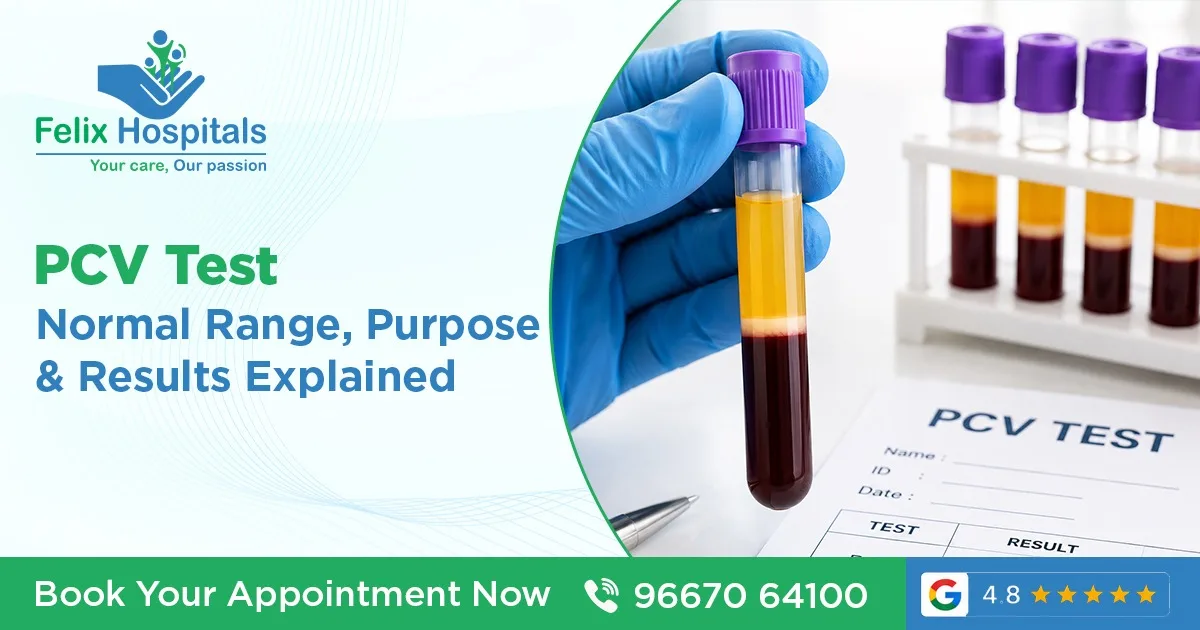
Every week, someone walks into Felix Hospital holding a blood report, finger pointed at three letters, PCV, asking what they mean. The number next to it is either slightly low, slightly high, or flagged in red. And the person holding it has spent the last 24 hours imagining the worst.
Most of the time, there's a straightforward explanation. Sometimes there isn't, and we need to dig deeper. But the one thing that never helps is a generic article that just lists numbers and walks away.
PCV = Packed Cell Volume.
You'll also see it written as HCT or haematocrit on some reports, same test, different name depending on whether your lab is using older British terminology or American. If your report says PCV HCT or PCv haematocrit, don't let that confuse you. It's all measuring the same thing.
What is that thing? Simple: the percentage of your blood that is made up of red blood cells.
Your blood isn't just red liquid. It's a mixture , red blood cells, white blood cells, platelets, and plasma (the yellowish fluid everything floats in). The PCV test spins a sample of your blood in a centrifuge until the red cells pack tightly at the bottom. Then it measures what percentage of the total tube they occupy.
If that percentage is 42%, it means 42 out of every 100 millilitres of your blood is red blood cells. The rest is plasma and other components.
That single number tells your doctor a surprising amount about what's going on in your body.
Red blood cells do one job, they carry oxygen from your lungs to every tissue in your body. When there are too few of them (low PCV), your tissues are running on less oxygen than they need. When there are too many (high PCV), your blood thickens and starts moving poorly through small vessels.
The conditions a PCV test helps detect or monitor include:
Anaemia - the most common reason a PCV comes back low in India, particularly in women and children
Dehydration - which artificially raises PCV because there's less plasma diluting the red cells
Polycythaemia vera - a bone marrow condition causing excessive red cell production
Chronic kidney disease - the kidneys produce a hormone (erythropoietin) that stimulates red cell production; when they fail, production drops
Internal bleeding - even slow, hidden bleeding drops PCV over weeks
Nutritional deficiencies -iron, B12, and folate are all essential for red cell production
It's also one of the first tests ordered before surgery, during pregnancy monitoring, and as part of any complete blood count (CBC).
No fasting required. No special preparation. You can eat breakfast, drink water, and go about your morning normally.
A small blood sample is drawn from a vein in your arm , the same needle-in-elbow process as any routine blood test. The sample goes to the lab. A centrifuge spins it at high speed, separating the components by density. The red cells , being the heaviest , settle at the bottom. The lab measures the ratio of red cells to total blood volume.
Result in hand within a few hours. At Felix Hospital's NABL-accredited lab in Sector 137, same-day results are standard for most patients.
One thing worth knowing: the method matters. There are two ways labs measure PCV.
Microhaematocrit method, the original, where blood is spun in a small capillary tube and the packed red cell layer is measured directly. Still used widely. Highly accurate.
Calculated HCT, modern automated analysers calculate PCV mathematically from red cell count and size rather than spinning it. Almost identical results, faster turnaround. Most urban labs in India now use this.
Your report may not specify which method. It doesn't usually matter clinically, but if your doctor wants a manual microhaematocrit for any reason, they'll specify it.
This is where most articles give you one number and move on. The problem is that "normal" genuinely varies by sex, age, and life stage. Here's the full picture:
Group | PCV Normal Range |
Adult men | 40% – 54% |
Adult women | 36% – 48% |
Pregnant women | 33% – 44% (lower due to expanded plasma volume) |
Newborns | 44% – 64% (naturally high at birth) |
Infants (3–6 months) | 28% – 42% |
Children (1–12 years) | 34% – 44% |
Elderly (65+) | Slightly lower than adult range; interpreted with other markers |
People living at high altitude naturally have higher PCV because the body compensates for thinner air by producing more red cells. If you've recently moved from a hill station or spent time at high altitude, mention it to your doctor, it can affect interpretation.
Below the normal range, the likely territory is some form of anemia or blood loss. But "anaemia" is a symptom, not a diagnosis, there are dozens of underlying causes, and the treatment differs depending on which one you have.
Common causes of low PCV in India:
Iron deficiency - by far the most common, especially in women of reproductive age, adolescents, and vegetarians. Heavy periods, inadequate dietary iron, poor absorption.
Vitamin B12 or folate deficiency - produces larger, abnormally shaped red cells that die earlier than normal
Chronic disease- infections, kidney disease, autoimmune conditions can suppress red cell production
Blood loss - acute (injury, surgery) or chronic (undetected gastrointestinal bleeding, heavy periods)
Bone marrow disorders - less common, but low PCV combined with low white cells and platelets raises red flags
Pregnancy - PCV physiologically drops in pregnancy because blood volume expands faster than red cell production. This is expected, not alarming, unless it drops below 33%.
Symptoms when PCV is genuinely low: fatigue that doesn't resolve with sleep, breathlessness on mild exertion, pale skin or inner eyelids, dizziness, poor concentration, cold hands and feet. Some people feel nothing at all , the body adapts slowly to gradual drops.
Above the normal range, the blood is carrying more red cells than it should , or has less fluid than it should.
Common causes of high PCV:
Dehydration - the most common and most benign explanation. Less plasma = higher proportion of red cells. Drink water, retest.
Living at high altitude - the body's natural compensation for lower oxygen.
Chronic lung disease (COPD) - low oxygen levels from damaged lungs trigger the same compensation.
Congenital heart disease - similar mechanism.
Polycythaemia vera, a bone marrow disorder causing the body to overproduce red cells. Rare, but persistent high PCV with no obvious cause needs investigation.
Excessive erythropoietin use - a performance-enhancing substance used (illegally) in sport.
High PCV makes blood viscous and slow-moving. Risks include blood clots, stroke, and cardiovascular events in severe or untreated cases.
A result that's slightly outside the normal range , 1 or 2 percentage points , isn't automatically a crisis. Labs have reference ranges, and those ranges represent 95% of healthy people. That means 5% of perfectly healthy people will fall outside them on any given day.
Your doctor won't panic over a PCV of 35% in an otherwise healthy adult woman. They'll look at the whole picture , haemoglobin, red cell size (MCV), white cell count, symptoms, diet, and history, before deciding what to do.
One number in isolation is never the whole story.
PCV rarely comes back alone. It's almost always part of a CBC (Complete Blood Count). Here's how the markers work together, and what combinations actually mean:
PCV | Haemoglobin | MCV (Cell Size) | Most Likely Cause |
Low | Low | Low (small cells) | Iron deficiency anaemia |
Low | Low | High (large cells) | B12 / folate deficiency |
Low | Low | Normal | Chronic disease, blood loss, bone marrow issue |
Normal | Low | Normal | Haemoglobin disorder (e.g. thalassaemia trait) |
High | High | Normal | Dehydration, polycythaemia, altitude |
High | High | Low | Iron overload (rare) |
This is why your doctor asks follow-up questions when one value is off. They're not being overly cautious. They're triangulating.
This deserves its own section because it creates enormous unnecessary anxiety.
During pregnancy , particularly from the second trimester onward, blood plasma volume increases by about 40–50%. Red cell mass also increases, but by less (around 20–30%). The net effect is that PCV drops even in a healthy pregnancy. This is called physiological haemodilution and it is normal.
A pregnant woman at 28 weeks with a PCV of 34% is not necessarily anaemic. Her body is doing exactly what it's supposed to do.
The concern begins when PCV drops below 33% in pregnancy, or when haemoglobin falls below 10.5 g/dL. At that point, iron supplementation (which is already standard in Indian prenatal care) may need to be intensified, and dietary assessment matters.
At Felix Hospital, every expectant mother's PCV is tracked as part of routine antenatal monitoring , not as a one-time test, but longitudinally, so trends matter more than single readings. If you're pregnant and confused by a low PCV reading, call us before you spiral. +91 9667064100. Someone will explain it to you without making you wait for an appointment.
There's a particular problem with how anemia , the most common reason for a low PCV , gets discussed in India.
Women, especially, are told their tiredness is normal. That feeling exhausted is just what happens when you have a job, a home, children, and aging parents. That weakness is a character issue, not a health issue. Doctors sometimes reinforce this by handing out iron tablets without investigating why the levels are low , which means the underlying cause goes untreated and the cycle repeats.
We see it at Felix regularly. A woman comes in for something unrelated and a routine CBC shows a PCV of 28%. She's been running on that for years. She assumed she was just "not a morning person." Her husband thought she was lazy. She thought so too, by the end.
The other side is men who won't test because a blood disorder feels emasculating. Or who see a low result and quietly assume it'll sort itself out.
It won't. Low PCV doesn't self-correct without addressing the cause. And the causes, iron deficiency, B12 deficiency, slow bleeding, early kidney disease, are all treatable, some very simple, if caught.
The fatigue you've normalised might not be normal at all.
Not every abnormal PCV needs immediate action. But these combinations are worth same-day medical attention:
PCV below 20% (severe anaemia , oxygen supply is critically compromised)
PCV below 33% in a pregnant woman with symptoms
High PCV plus headaches, blurred vision, facial redness, and itching after a hot shower (classic polycythaemia vera presentation)
Low PCV plus low white cells plus low platelets (suggests bone marrow isn't producing any blood cells properly)
Any rapidly falling PCV over days (suggests active bleeding)
For anything else, a borderline result, a mildly low reading, confusion about what the number means, a phone call is faster than panic-Googling.
If PCV is mildly low: Iron studies (serum iron, TIBC, ferritin) to check iron stores. Vitamin B12 and folate levels. Sometimes a peripheral blood smear to look at cell shape under a microscope.
If PCV is very low or dropping: Reticulocyte count (to check if bone marrow is responding), plus kidney function tests, and sometimes a haematology referral.
If PCV is high: Retest after proper hydration. If still high, erythropoietin levels, bone marrow evaluation, and a haematologist's input.
If you're pregnant with a low PCV: Iron and folate supplementation review, dietary assessment, and closer monitoring intervals.
The PCV test in India is among the cheapest useful blood tests available:
Setting | Approximate Cost |
Government hospital / CGHS | ₹30 – ₹100 |
Standalone diagnostic lab | ₹80 – ₹200 |
NABL-accredited chain lab | ₹150 – ₹350 |
Private multispecialty hospital | ₹200 – ₹500 |
CBC (includes PCV + full panel) | ₹250 – ₹600 |
At Felix Hospital in Sector 13, Noida, the CBC including PCV is available at published, transparent pricing. No hidden lab charges, no upselling. If you're coming from the Noida Expressway, we're just off the Sector 137 metro exit , two minutes from the main road.
If you're holding a blood report right now and the PCV number is flagged , either direction , resist the urge to diagnose yourself with whatever the third search result suggests.
A single number without context is not a diagnosis. It's a lead. Your doctor follows that lead with the right questions, the right follow-up tests, and your personal history.
What you can do right now: call +91 9667064100 and speak to our team at Felix Hospital. Walk-ins are welcome. We're at Paras Tierea, Sector 137, right off the Noida Expressway, next to the Sector 137 metro exit. Our NABL-certified lab processes CBC results the same day, and a doctor can walk you through what the numbers mean in the context of your actual health, not just a reference chart.
Dr. Ravi Sharma is a senior physician with 42+ years of experience, known for compassionate and comprehensive patient care in Noida.

Consult the best general physician for dengue fever at Felix Hospital. Their expertise in diagnosing and managing dengue virus infections can lead to timely and effective treatment.
Take special care of the health of your kids, especially young children, amidst the changing seasons.

Nipah virus infection causes severe fever and brain inflammation. It spreads through infected animals or close contact and requires strict preventive measures.
If you are a Central Government employee or pensioner in Noida, you know that the CGHS card is a powerful tool—but using it isn't always easy. The scheme itself is excellent, covering major surgeries and treatments. However, the real challenge often happens at the hospital desk: the long waits for pre-authorization and the feeling that your card is being treated as a burden rather than a right.
For those living along the Noida Expressway or in Greater Noida, Felix Hospital (Sector 137) has become a primary hub for CGHS beneficiaries. Unlike many facilities where the CGHS desk is a side-thought, Felix has integrated the scheme into its core operations, offering 24/7 cardiac care and robotic surgeries under the cashless model.
Don’t rely on old PDFs floating around WhatsApp groups. The official list changes. Always check cghs.gov.in for the most recent updates.
Felix Hospital remains a permanent fixture on this list. If you need to verify if a specific surgery (like a knee replacement or a heart stent) is currently covered, you can call their desk directly at +91 9667064100.
Serving Central Government employees and their dependents
Central Government pensioners and their dependents
Widows and family pensioners of deceased Central Government employees
Certain autonomous body employees where CGHS has been extended
Members of Parliament, sitting and former, and certain constitutional post holders
CGHS card (beneficiary card with photo)
Aadhaar card
Referral letter from your allocated CGHS Wellness Centre (for planned treatment)
All procedures within CGHS approved rates are cashless for entitled beneficiaries and their dependents. The following specialties are covered under CGHS empanelment at Felix Hospital.
Cardiology and Cardiac Surgery Angiography, angioplasty with stenting, bypass surgery (CABG), valve replacement and repair, pacemaker implantation, ICD implantation, heart failure management , all covered under CGHS at Felix Hospital's 24/7 digital catheterisation lab.
Orthopaedics and Joint Replacement Total knee replacement, total hip replacement, partial and revision joint surgery, complex fracture management, spine surgery , covered under CGHS package rates. Computer-assisted robotic surgical guidance is used for joint replacement at Felix. No implant surcharges beyond CGHS entitled limits.
Neurology and Neurosurgery Stroke management, brain surgery, epilepsy treatment, peripheral nerve disorders , with on-site MRI and CT for same-day diagnostic workup.
Oncology Full cancer care pathway under one roof: surgical oncology, chemotherapy, radiation therapy. CGHS beneficiaries do not need a separate empanelment check for each treatment modality at Felix.
Urology Zero-cut laser kidney stone removal, prostate surgery, haemodialysis. The dialysis unit runs 24 hours a day , no facility downtime for patients on regular schedules.
Gynaecology and Obstetrics Normal and caesarean deliveries, hysterectomy, gynaecological procedures. The Level III NICU at Felix handles newborns who arrive with complications immediately on-site.
General and Laparoscopic Surgery Laparoscopic cholecystectomy, hernia repair, appendectomy, bariatric surgery.
ENT and Ophthalmology Cataract surgery, ear surgery, tonsillectomy, sinus procedures , all cashless under CGHS at Felix.
Pulmonology COPD, bronchoscopy, sleep apnoea management.
Nephrology and Dialysis Chronic kidney disease management and haemodialysis , 24/7 unit.
Gastroenterology Endoscopy, colonoscopy, liver condition management.
Paediatrics Paediatric medical and surgical conditions for dependent children of CGHS beneficiaries.
Physical Medicine and Rehabilitation Post-surgical physiotherapy, occupational therapy, rehabilitation , beginning the day after surgery, not weeks later.
CGHS empanelment tells you a hospital is on the list. It doesn't tell you whether the hospital can actually handle what the patient needs. Felix Hospital is a NABH-accredited tertiary care centre , accreditation that is externally audited, not self-declared. Here is what that means for CGHS patients in Noida.
24/7 Digital Catheterisation Lab Cardiac emergencies do not follow office hours. The cath lab at Felix is staffed and operational around the clock. A patient arriving at 3am with chest pain receives angiography in the same time window as a daytime case. No morning-slot delays when minutes are being counted.
Joint Replacement :The system maps the patient's anatomy before the first incision. Implant positioning is more accurate than conventional technique. Recovery is meaningfully faster. In-house physiotherapy begins the day after surgery.
Level III NICU For newborns who arrive with complications immediately after delivery , on-site, not requiring transfer to a separate children's hospital.
Zero-Cut Laser , Kidney Stones No incision. No stitches. Discharge typically within 48 hours.
On-Site Advanced Diagnostics MRI, CT scan, digital X-ray, ultrasound, endoscopy , all under one roof. No external lab referrals for investigations ordered during the admission.
Laminar Airflow Operation Theatres Infection-controlled surgical environment meeting NABH standards.
The Felix Hospital cardiac centre is one of the few in the Noida-Greater Noida corridor with a 24/7 operational catheterisation lab. For CGHS beneficiaries in Noida Sectors 15, 18, 62, 93, 137, or along the Expressway , a cardiac emergency reaches a fully equipped cath lab in under 30 minutes.
For planned cardiac procedures under CGHS, the Felix desk handles pre-authorisation entirely. The patient does not call any CGHS office. The family does not fill additional forms. Bring the CGHS card, referral letter from the Wellness Centre, and Aadhaar. The desk manages everything from there.
Government employees who have been putting off an angiography or stress test because they assumed a private hospital means out-of-pocket costs should know clearly: at Felix Hospital, covered cardiac procedures are cashless. Covered under CGHS at Felix: angiography, angioplasty with stenting, CABG, valve replacement and repair, pacemaker implantation, ICD placement, heart failure management.
Desk jobs, long service years, and age converge in the same place: knees and hips that have stopped cooperating. For Central Government pensioners in Noida who have reached that point, total knee replacement and total hip replacement are covered under CGHS package rates at Felix Hospital , no balance billing, no implant surcharges beyond entitled limits.
Felix uses computer-assisted surgical guidance for joint replacement. The procedure is planned in three dimensions before the first incision. The implant fits more precisely. The patient recovers faster. In-house physiotherapy begins the next morning , not after discharge, not after a week, the next morning , because the timing of rehabilitation determines the final outcome.
A pensioner who came in with a cane has, in more than a few cases, left without one. That is the clinical goal. Felix is built to reach it.
Some CGHS beneficiaries still end up on the reimbursement route , paying upfront at a facility that is empanelled on paper but poorly set up in practice, then spending months filing claims and chasing offices for money already spent.
Factor | Reimbursement Route | Cashless at Felix Hospital |
Upfront payment required | Yes , often several lakhs | Zero |
Paperwork burden | Bills, forms, follow-up over months | Handled entirely by Felix CGHS desk |
Waiting period for money | Weeks to months | Settled directly with CGHS |
Risk of shortfall | High , excess above CGHS rate not reimbursed | None for covered procedures |
Stress during hospitalisation | High , family manages finances mid-treatment | Managed by hospital team |
The reimbursement route is not a neutral alternative. A family managing a financial crisis at the same time as a medical one carries a burden that the cashless model at Felix Hospital removes entirely. The desk exists so the patient focuses on recovery. That is what the scheme was built to deliver.
Your pay level or pensioner category determines your room entitlement under CGHS. Felix Hospital follows CGHS entitlement norms strictly.
CGHS Beneficiary Category | Room Entitlement at Felix Hospital |
Pay Level 12 and above (serving) / Group A Officers | Private Room |
Pay Level 6 to 11 / Group B Officers | Semi-Private Room |
Pay Level 1 to 5 / Group C employees | General Ward |
Pensioners | As per last pay level drawn |
Dependents | As per the primary beneficiary's entitlement |
Choosing a higher room category is permitted. You pay only the difference in room rent per day. All clinical charges , surgery, investigations, inpatient medicines , remain at CGHS approved rates regardless of which room you recover in.
For planned treatment, start at your allocated CGHS Wellness Centre. The Medical Officer assesses your condition and, if hospital-level care is required, issues a referral letter naming Felix Hospital and the relevant department.
Carry three things to the Felix CGHS helpdesk: referral letter, CGHS card, Aadhaar. The desk takes it from there , pre-authorisation, admission documentation, discharge claim. You do not contact any CGHS office separately. The family does not manage paperwork during the admission.
For pensioners: The process is identical. Your CGHS card, the referral from your Wellness Centre, and Aadhaar are sufficient. The pensioner category on the card determines room entitlement and applicable rates.
If your Wellness Centre Medical Officer has not issued a referral and you believe hospital-level care is warranted, bring any private specialist documentation to the next visit. The CMO has clinical discretion , documented evidence changes the conversation.
Heart attack, Stroke, Major trauma, Respiratory failure.
Do not wait for a referral. Come directly to Felix Hospital.
CGHS rules permit direct emergency admission at any empanelled hospital without prior referral, without pre-authorisation, and without contacting any CGHS office beforehand. The clinical team starts treatment when the patient arrives. Documentation is handled retrospectively after stabilisation. The family's only responsibility is to present the CGHS card when it is practical to do so.
Too many families have lost critical time trying to arrange paperwork during a cardiac emergency. That time matters. The rule exists precisely so it doesn't have to be spent that way.
Felix Hospital is in Sector 137, Noida Expressway. For CGHS beneficiaries living across Noida , whether in the older sectors like Sector 15 and Sector 18, or the newer residential pockets along the Expressway in Sectors 93, 100, 128, and 137 , the hospital is directly accessible without navigating Delhi traffic.
What Felix offers that congested hospitals in central Noida or Delhi cannot is same-day specialist availability. For a Government of India pensioner who needs a cardiology opinion or an orthopaedic pre-surgical assessment, waiting three weeks for an appointment is a real clinical risk, not merely an inconvenience. At Felix, those consultations are available without weeks of lead time.
The CGHS desk at Felix operates every day. It is staffed by people who know the scheme , who understand the difference between a wellness centre referral and an emergency admission, who can read a CGHS card and confirm entitlement without putting the family through a phone tree. That operational competence is not universal across empanelled hospitals. At Felix, it is standard.
The reasons CGHS beneficiaries in Noida choose Felix Hospital are rarely about the scheme itself. They are about what happens after the card is presented.
Same senior doctors. Same robotic surgical suites. Same priority as any private-paying patient , no separate CGHS queue, no different standard of care, no lower-tier ward. A retired IAS officer and a private patient in the room beside them are under the same surgical team the next morning.
The CGHS desk absorbs the administrative complexity so the patient and family do not have to. Pre-authorisation follow-up, discharge paperwork, claim submission , the desk handles it. The patient handles recovery.
For government employees in Noida who have watched colleagues navigate hospitalisation paperwork while managing a medical crisis, Felix Hospital is built to be the alternative.
Area | Route | Approximate Travel Time |
Sector 137, 150, 168 (Noida Expressway) | Direct | Under 10 minutes |
Sectors 93, 100, 128 | Noida Expressway | 10–15 minutes |
Sectors 62, 63, 78 | Noida Expressway | 15–20 minutes |
Sectors 15, 18, 27 (Old Noida) | Noida Expressway | 20–30 minutes |
Greater Noida , Knowledge Park, Alpha, Beta | Expressway link roads | 20–25 minutes |
Indirapuram, Crossing Republik (Ghaziabad) | NH-9 to Noida Expressway | 25–35 minutes |
South Delhi , Okhla, Sarita Vihar | DND Flyway to Noida Expressway | 35–45 minutes |
East Delhi , Mayur Vihar, Laxmi Nagar | NH-9 | 35–45 minutes |
Central Government service , decades of it , earns real entitlement under CGHS. Felix Hospital is empanelled to honour that entitlement, not process it slowly.
The CGHS desk at Felix exists so that a retired IFS officer in Sector 93, or a Group C pensioner in Sector 62, or a serving government employee in Greater Noida does not have to become their own insurance adjuster during a hospitalisation. The card is enough. The desk handles the rest.
Verify current empanelment at cghs.gov.in. Call +91 9667064100 to confirm your procedure coverage before travelling. For anything that cannot wait , come directly.
Dr. Ravi Sharma is a senior physician with 42+ years of experience, known for compassionate and comprehensive patient care in Noida.

Stay updated with trusted hospitals, specialist care, and ESIC-approved medical facilities across Noida.

DGEHS empanelled hospitals in Modinagar 2026 provide cashless treatment for eligible government employees and pensioners under the Delhi Government health scheme.

DGEHS empanelled hospitals in Delhi 2026 provide cashless treatment for eligible government employees and pensioners under the Delhi Government health scheme.

Searching for Ayushman Card hospitals in Ghaziabad? Felix Hospital offers advanced medical care and cashless treatment facilities under the Ayushman Bharat Yojana in 2026.
If you served in the Indian Armed Forces, Army, Navy, or Air Force , and you or a family member needs hospital treatment in Faridabad or the surrounding region, this guide is written for you.
Navigating the Ex-Servicemen Contributory Health Scheme (ECHS) can feel like a second deployment. Referral letters, pre-authorisation windows, empanelment status checks, room entitlement rules , the system was designed to protect veterans, but the paperwork can exhaust the very people it was built to serve.
Faridabad has a substantial retired defence community. Veterans who spent careers in the Army, Navy, or Air Force have settled across sectors like NIT, Ballabhgarh, Sector 15, Sector 37, and the newer residential pockets along the Faridabad-Noida-Gurgaon highway corridor. When tertiary-level care is needed, cardiac surgery, joint replacement, cancer treatment, Faridabad veterans often find themselves caught between congested Delhi hospitals and local facilities that cannot handle the complexity. This guide explains how ECHS works for hospital treatment in Faridabad, what you are entitled to, and how Felix Hospital , a fully empanelled ECHS tertiary care centre on the Noida Expressway, handles the process so you and your family do not have to.
The Ex-Servicemen Contributory Health Scheme is a Central Government health scheme administered by the Ministry of Defence. It provides cashless medical care to retired defence personnel and their dependents at empanelled hospitals across India.
Who is eligible:
Retired officers and personnel below officer rank (PBOR) of the Army, Navy, and Air Force
Family pensioners of deceased service personnel
Dependants as defined under ECHS rules: spouse, unmarried daughters, sons below 25 years, and parents wholly dependent on the veteran
What you need to carry at every hospital visit:
ECHS smart card (primary beneficiary or dependant card)
Aadhaar card
Referral letter from your allocated ECHS Polyclinic (for planned treatment)
Faridabad has ECHS Polyclinics serving the city's retired defence population. Your allocated polyclinic is where your treatment journey begins for planned (non-emergency) care
.
Step 1 -Visit your allocated ECHS Polyclinic Present your ECHS card and describe your condition. The Medical Officer assesses you and, if specialist or hospital-level treatment is required, issues a referral letter.
Step 2 - The referral letter This letter specifies the hospital name, the department, and the nature of treatment required. It is a formal document , keep it safe and carry multiple photocopies.
Step 3 - Report to the empanelled hospital Carry your referral letter, ECHS card, and Aadhaar. At Felix Hospital, the dedicated ECHS helpdesk takes over from this point. You do not call any ECHS office separately. You do not fill any additional form. The desk handles pre-authorisation, documentation, and direct settlement with ECHS.
Step 4 - Treatment and discharge Treatment proceeds cashlessly at ECHS approved rates. On discharge, the hospital submits the claim directly. No reimbursement chasing. No financial gap to bridge.
This is the most important rule every ECHS beneficiary must know.
For life-threatening emergencies , heart attack, stroke, major trauma, respiratory failure , you do not need a referral letter. Walk straight to the emergency department of any ECHS empanelled hospital.
ECHS guidelines are explicit on this point. Emergency admission at any empanelled hospital across India is permitted without prior referral, without pre-authorisation, and without contacting any ECHS office beforehand. The hospital treats first. The documentation is handled retrospectively after the patient is stabilised.
At Felix Hospital, the emergency team begins treatment the moment the patient arrives. The ECHS desk handles all retrospective paperwork. The family's only responsibility is to present the ECHS card as soon as it is practical to do so.
Many veterans have heard the word "cashless" and still ended up at a billing counter. It is worth being precise.
Cashless at a properly empanelled hospital means:
Zero upfront payment for procedures covered under ECHS approved rates
No deposit at the time of admission for covered treatment
Direct settlement between the hospital and ECHS , the patient is not in the financial chain
Medicines during admission are covered within the approved package, no separate pharmacy bill for inpatient medicines
Investigations ordered during the admission are covered, no external lab bills
What cashless does not mean:
Procedures outside ECHS approved rates are not covered cashlessly
If you choose a room above your rank entitlement, you pay the difference in room rent only , all clinical charges remain at ECHS rates
At Felix Hospital, the ECHS desk clarifies coverage before admission for planned procedures. Veterans are not surprised by bills on discharge day.
Rank Category | Room Entitlement at Felix Hospital |
Officers , Colonel and above | Private Room |
Officers below Colonel rank and JCOs | Semi-Private Room |
Other Ranks (PBOR) | General Ward |
Dependants | As per the primary beneficiary's entitlement |
Upgrading to a higher room category is permitted. You pay only the difference in room rent per day. All surgical, diagnostic, and medication charges remain at ECHS approved rates regardless of room choice.
Felix Hospital, located in Sector 137 on the Noida Expressway, is a NABH-accredited tertiary care centre fully empanelled under ECHS for the Delhi NCR region, which covers Faridabad and its surrounding areas including Ballabhgarh, NIT, Sector 15, Sector 37, and the FNG corridor.
For Faridabad veterans, Felix Hospital is accessible via the Faridabad-Noida-Gurgaon (FNG) Expressway, which connects Faridabad directly to the Noida Expressway without passing through Delhi. From most parts of Faridabad, the journey to Felix is 40 to 60 minutes via this route , significantly faster than navigating central Delhi traffic toward larger ECHS hospitals, particularly during morning OPD hours when those facilities are at peak congestion.
Veterans from Faridabad travelling for planned treatment should call +91 9667064100 before departing so the Felix ECHS desk can confirm pre-authorisation status and room availability on the day of travel.
The ECHS desk at Felix Hospital operates every day. It is staffed by personnel who understand the scheme , not a general billing counter that treats ECHS as an afterthought.
Every specialty below is covered under ECHS empanelment. All procedures within approved ECHS rates are cashless for entitled beneficiaries and their dependants.
The Felix Hospital cardiac centre runs a 24/7 digital catheterisation lab , reachable from Faridabad via the FNG Expressway in under an hour. For veterans in Faridabad who have been deferring a cardiac investigation because they were unsure about coverage at a private hospital, the position is clear: the procedure is covered, the lab is available around the clock, and the desk manages pre-authorisation.
Covered under ECHS: Angiography, angioplasty with stenting, coronary artery bypass grafting (CABG), valve replacement and repair, pacemaker implantation, implantable cardioverter defibrillator (ICD), heart failure management.
Years of service leave their mark. Many veterans are managing joint degeneration that has moved from manageable to limiting. Total knee replacement, total hip replacement, partial replacement, and revision joint surgery are all covered under ECHS package rates at Felix Hospital , no implant surcharges beyond entitled limits, no balance billing.
Felix Hospital uses computer-assisted (robotic-guided) surgery for joint replacement. The procedure is mapped to the patient's anatomy before the first incision. Recovery is faster. Implant positioning is more accurate. In-house physiotherapy begins the same day as surgery
.
Covered under ECHS: Total knee replacement, total hip replacement, partial knee replacement, revision arthroplasty, complex fracture management, spine surgery.
Stroke management, brain surgery, epilepsy treatment, peripheral nerve disorders , covered under ECHS empanelment with on-site MRI and CT for rapid diagnosis.
Full cancer care pathway: surgical oncology, chemotherapy, and radiation therapy , all covered under ECHS at Felix Hospital. Veterans diagnosed with cancer should not have to navigate a separate empanelment check for each stage of their treatment.
Kidney stone treatment using zero-cut laser technology , no incision, no stitches, significantly shorter stay. Prostate surgery, bladder conditions, and haemodialysis are all covered. The dialysis unit operates 24 hours a day.
Normal delivery, caesarean section, hysterectomy, and other gynaecological procedures covered under ECHS. The hospital has a Level III NICU for newborns requiring intensive neonatal care immediately after delivery, a facility that veterans' families in Faridabad would otherwise need to travel to a specialised Delhi hospital to access.
Gallbladder removal (laparoscopic cholecystectomy), hernia repair, appendectomy, bariatric surgery, covered under ECHS package rates.
Cataract surgery, ear surgery, tonsillectomy, sinus procedures, common procedures that many veterans have been deferring. All covered cashlessly.
COPD management, bronchoscopy, sleep apnoea , covered under ECHS. Veterans with respiratory conditions from service exposure should confirm specific procedure coverage by calling +91 9667064100 before travelling.
Chronic kidney disease management and haemodialysis, the 24/7 dialysis unit at Felix Hospital serves both emergency and scheduled patients.
Endoscopy, colonoscopy, liver condition management, covered under ECHS.
Paediatric medical and surgical conditions for dependent children of ECHS beneficiaries.
Post-surgical physiotherapy, occupational therapy, and rehabilitation, an area often overlooked in ECHS planning. Recovery does not end at discharge. The rehabilitation team at Felix Hospital begins working with the patient from the day after surgery.
ECHS empanelment is about coverage. Clinical outcome depends on what the hospital can actually do.
24/7 Digital Catheterisation Lab - cardiac emergencies treated immediately, no morning-slot waiting
Computer-Assisted (Robotic) Joint Replacement - image-guided surgery for knee and hip
Level III NICU - for newborns requiring intensive neonatal care
Zero-Cut Laser for Kidney Stones - no incision, faster recovery
On-Site Advanced Diagnostics- MRI, CT scan, digital X-ray, ultrasound, endoscopy under one roof
Laminar Airflow Operation Theatres - infection-controlled environment
NABH Accreditation - independently audited quality standards
Area | Route | Approximate Travel Time |
Sector 15, NIT Faridabad | FNG Expressway to Noida Expressway | 40–55 minutes |
Sector 37, Sector 46 | FNG Expressway to Noida Expressway | 45–55 minutes |
Ballabhgarh | FNG Expressway via Faridabad | 50–65 minutes |
Old Faridabad, NHPC Chowk | FNG Expressway | 45–60 minutes |
Suraj Kund, Mewla Maharajpur | FNG Expressway | 35–50 minutes |
Badarpur, Sarita Vihar (border area) | DND Flyway to Noida Expressway | 35–50 minutes |
Noida Sectors 62, 93, 137 | Noida Expressway | 15–20 minutes |
Some veterans still use the reimbursement route , pay first at a non-empanelled or poorly equipped facility, then file for reimbursement later. Here is what that actually looks like in practice.
Factor | Reimbursement Route | Cashless at Felix Hospital |
Upfront payment required | Yes , often several lakhs | Zero |
Paperwork burden | Bills, forms, follow-up over months | Handled entirely by Felix ECHS desk |
Waiting period for money | Weeks to months | Settled directly with ECHS |
Risk of shortfall | High , excess above ECHS rate not reimbursed | None for covered procedures |
Stress during hospitalisation | High , family manages finances mid-treatment | Managed by hospital team |
The reimbursement route is not a neutral alternative. It means a family managing a financial crisis at the same time they are managing a medical one. Cashless at Felix Hospital removes that burden entirely.
The person reading this is often not the veteran , it is a spouse, a son or daughter, a sibling trying to figure out the system under pressure.
The ECHS desk at Felix Hospital exists for exactly this situation. You do not need to know every rule. You do not need to have memorised the referral process. Bring the ECHS card, the referral letter if you have it, and the Aadhaar. The desk takes it from there.
For emergencies, bring only the patient. Everything else follows.
Dr. Ravi Sharma is a senior physician with 42+ years of experience, known for compassionate and comprehensive patient care in Noida.
Stay updated with trusted hospitals, specialist care, and ESIC-approved medical facilities across Noida.

Discover the updated list of Ayushman Bharat (PMJAY) hospitals in Dadri for 2026.

Looking for an Ayushman Bharat hospital in Delhi NCR? Discover how Felix Hospital provides quality healthcare services under the Ayushman Bharat Yojana in 2026.
Searching for Ayushman Card hospitals in Ghaziabad? Felix Hospital offers advanced medical care and cashless treatment facilities under the Ayushman Bharat Yojana in 2026.
If you served in the Indian Armed Forces, Army, Navy, or Air Force, and you or a family member needs hospital treatment in Aligarh or the surrounding region, this guide is written for you.
Navigating the Ex-Servicemen Contributory Health Scheme (ECHS) can feel like a second deployment. Referral letters, pre-authorisation windows, empanelment status checks, room entitlement rules , the system was designed to protect veterans, but the paperwork can exhaust the very people it was built to serve.
Aligarh has a long military association. The city and its surrounding districts have produced generations of defence personnel, and a significant retired defence population lives across Aligarh city, the cantonment areas, and towns like Hathras, Iglas, and Khair. For tertiary-level care, cardiac surgery, robotic joint replacement, cancer treatment, Aligarh's local options are limited, and veterans have historically had to travel to Agra or Delhi. The Yamuna Expressway has changed that calculation. This guide explains how ECHS works for hospital treatment in Aligarh, what you are entitled to, and how Felix Hospital, a fully empanelled ECHS tertiary care centre on the Noida Expressway, handles the process so you and your family do not have to.
The Ex-Servicemen Contributory Health Scheme is a Central Government health scheme administered by the Ministry of Defence. It provides cashless medical care to retired defence personnel and their dependents at empanelled hospitals across India.
Who is eligible:
Retired officers and personnel below officer rank (PBOR) of the Army, Navy, and Air Force
Family pensioners of deceased service personnel
Dependants as defined under ECHS rules: spouse, unmarried daughters, sons below 25 years, and parents wholly dependent on the veteran
What you need to carry at every hospital visit:
ECHS smart card (primary beneficiary or dependant card)
Aadhaar card
Referral letter from your allocated ECHS Polyclinic (for planned treatment)
Aligarh has ECHS Polyclinics serving the city's retired defence population. Your allocated polyclinic is where your treatment journey begins for planned (non-emergency) care.
Step 1 Visit your allocated ECHS Polyclinic Present your ECHS card and describe your condition. The Medical Officer assesses you and, if specialist or hospital-level treatment is required, issues a referral letter.
Step 2 The referral letter This letter specifies the hospital name, the department, and the nature of treatment required. It is a formal document , keep it safe and carry multiple photocopies.
Step 3 Report to the empanelled hospital Carry your referral letter, ECHS card, and Aadhaar. At Felix Hospital, the dedicated ECHS helpdesk takes over from this point. You do not call any ECHS office separately. You do not fill any additional form. The desk handles pre-authorisation, documentation, and direct settlement with ECHS.
Step 4 Treatment and discharge Treatment proceeds cashlessly at ECHS approved rates. On discharge, the hospital submits the claim directly. No reimbursement chasing. No financial gap to bridge.
This is the most important rule every ECHS beneficiary must know.
For life-threatening emergencies , heart attack, stroke, major trauma, respiratory failure , you do not need a referral letter. Walk straight to the emergency department of any ECHS empanelled hospital.
ECHS guidelines are explicit on this point. Emergency admission at any empanelled hospital across India is permitted without prior referral, without pre-authorisation, and without contacting any ECHS office beforehand. The hospital treats first. The documentation is handled retrospectively after the patient is stabilised.
At Felix Hospital, the emergency team begins treatment the moment the patient arrives. The ECHS desk handles all retrospective paperwork. The family's only responsibility is to present the ECHS card as soon as it is practical to do so.
Many veterans have heard the word "cashless" and still ended up at a billing counter. It is worth being precise.
Cashless at a properly empanelled hospital means:
Zero upfront payment for procedures covered under ECHS approved rates
No deposit at the time of admission for covered treatment
Direct settlement between the hospital and ECHS , the patient is not in the financial chain
Medicines during admission are covered within the approved package, no separate pharmacy bill for inpatient medicines
Investigations ordered during the admission are covered, no external lab bills
What cashless does not mean:
Procedures outside ECHS approved rates are not covered cashlessly
If you choose a room above your rank entitlement, you pay the difference in room rent only , all clinical charges remain at ECHS rates
At Felix Hospital, the ECHS desk clarifies coverage before admission for planned procedures. Veterans are not surprised by bills on discharge day.
Rank Category | Room Entitlement at Felix Hospital |
Officers , Colonel and above | Private Room |
Officers below Colonel rank and JCOs | Semi-Private Room |
Other Ranks (PBOR) | General Ward |
Dependants | As per the primary beneficiary's entitlement |
Upgrading to a higher room category is permitted. You pay only the difference in room rent per day. All surgical, diagnostic, and medication charges remain at ECHS approved rates regardless of room choice.
Felix Hospital, located in Sector 137 on the Noida Expressway, is a NABH-accredited tertiary care centre fully empanelled under ECHS for the Delhi NCR region. Veterans holding an ECHS card from an Aligarh polyclinic can be referred to Felix Hospital for specialist and tertiary care that is not available locally.
From Aligarh, Felix Hospital is approximately 100 to 120 minutes via the Yamuna Expressway , a direct, largely uninterrupted highway route that connects Aligarh to the Noida Expressway without passing through Delhi or navigating city traffic. For a veteran from Aligarh facing a cardiac event, a joint replacement, or an oncology referral, this is the fastest high-quality highway route to a 24/7 catheterisation lab, robotic surgical suites, and a Level III NICU in the NCR.
The alternative , travelling to Agra for tertiary care , involves similar distances but significantly fewer ECHS-empanelled tertiary options. The Yamuna Expressway to Felix Hospital is the more direct route to the clinical capability Aligarh veterans are entitled to under ECHS.
Veterans from Aligarh travelling for planned treatment should call +91 9667064100 before departing so the Felix ECHS desk can confirm pre-authorisation status, room availability, and documentation requirements for inter-city referrals.
The ECHS desk at Felix Hospital operates every day. It is staffed by personnel who understand the scheme , not a general billing counter that treats ECHS as an afterthought.
Every specialty below is covered under ECHS empanelment. All procedures within approved ECHS rates are cashless for entitled beneficiaries and their dependants.
The Felix Hospital cardiac centre runs a 24/7 digital catheterisation lab , reachable from Aligarh via the Yamuna Expressway in under two hours, on a route with no city traffic between Aligarh and the expressway junction. For veterans in Aligarh who have been deferring a cardiac investigation because local tertiary cardiac care is limited, the position at Felix is clear: the procedure is covered, the lab is available around the clock, and the desk manages pre-authorisation.
Covered under ECHS: Angiography, angioplasty with stenting, coronary artery bypass grafting (CABG), valve replacement and repair, pacemaker implantation, implantable cardioverter defibrillator (ICD), heart failure management.
Years of service leave their mark. Many veterans are managing joint degeneration that has moved from manageable to limiting. Total knee replacement, total hip replacement, partial replacement, and revision joint surgery are all covered under ECHS package rates at Felix Hospital , no implant surcharges beyond entitled limits, no balance billing.
Felix Hospital uses computer-assisted (robotic-guided) surgery for joint replacement. The procedure is mapped to the patient's anatomy before the first incision. Recovery is faster. Implant positioning is more accurate. In-house physiotherapy begins the same day as surgery.
Covered under ECHS: Total knee replacement, total hip replacement, partial knee replacement, revision arthroplasty, complex fracture management, spine surgery.
Stroke management, brain surgery, epilepsy treatment, peripheral nerve disorders , covered under ECHS empanelment with on-site MRI and CT for rapid diagnosis.
Full cancer care pathway: surgical oncology, chemotherapy, and radiation therapy , all covered under ECHS at Felix Hospital. Veterans diagnosed with cancer should not have to navigate a separate empanelment check for each stage of their treatment.
Kidney stone treatment using zero-cut laser technology, no incision, no stitches, significantly shorter stay. Prostate surgery, bladder conditions, and haemodialysis are all covered. The dialysis unit operates 24 hours a day.
Normal delivery, caesarean section, hysterectomy, and other gynaecological procedures covered under ECHS. The hospital has a Level III NICU for newborns requiring intensive neonatal care immediately after delivery, a facility that veterans' families in Aligarh would otherwise need to travel to Agra or Delhi to access.
Gallbladder removal (laparoscopic cholecystectomy), hernia repair, appendectomy, bariatric surgery, covered under ECHS package rates.
Cataract surgery, ear surgery, tonsillectomy, sinus procedures, common procedures that many veterans have been deferring. All covered cashlessly.
COPD management, bronchoscopy, sleep apnoea , covered under ECHS. Veterans with respiratory conditions from service exposure should confirm specific procedure coverage by calling +91 9667064100 before travelling.
Chronic kidney disease management and haemodialysis , the 24/7 dialysis unit at Felix Hospital serves both emergency and scheduled patients.
Endoscopy, colonoscopy, liver condition management, covered under ECHS.
Paediatric medical and surgical conditions for dependent children of ECHS beneficiaries.
Post-surgical physiotherapy, occupational therapy, and rehabilitation , an area often overlooked in ECHS planning. Recovery does not end at discharge. The rehabilitation team at Felix Hospital begins working with the patient from the day after surgery.
ECHS empanelment is about coverage. Clinical outcome depends on what the hospital can actually do.
24/7 Digital Catheterisation Lab cardiac emergencies treated immediately, no morning-slot waiting
Computer-Assisted (Robotic) Joint Replacement image-guided surgery for knee and hip
Level III NICU for newborns requiring intensive neonatal care
Zero-Cut Laser for Kidney Stones no incision, faster recovery
On-Site Advanced Diagnostics MRI, CT scan, digital X-ray, ultrasound, endoscopy under one roof
Laminar Airflow Operation Theatres infection-controlled environment
NABH Accreditation independently audited quality standards
Area | Route | Approximate Travel Time |
Aligarh city, Cantonment area | Yamuna Expressway to Noida Expressway | 100–120 minutes |
Aligarh , GT Road side | NH-19 to Yamuna Expressway | 105–125 minutes |
Hathras | Yamuna Expressway via Aligarh | 90–110 minutes |
Iglas, Khair | NH-509 to Yamuna Expressway | 110–130 minutes |
Tappal (en route) | Yamuna Expressway | 70–85 minutes |
Jewar (en route) | Yamuna Expressway | 35–50 minutes |
Greater Noida , Knowledge Park | Noida Expressway | 20–25 minutes |
Some veterans still use the reimbursement route, pay first at a non-empanelled or poorly equipped facility, then file for reimbursement later. Here is what that actually looks like in practice.
Factor | Reimbursement Route | Cashless at Felix Hospital |
Upfront payment required | Yes , often several lakhs | Zero |
Paperwork burden | Bills, forms, follow-up over months | Handled entirely by Felix ECHS desk |
Waiting period for money | Weeks to months | Settled directly with ECHS |
Risk of shortfall | High , excess above ECHS rate not reimbursed | None for covered procedures |
Stress during hospitalisation | High , family manages finances mid-treatment | Managed by hospital team |
The reimbursement route is not a neutral alternative. It means a family managing a financial crisis at the same time they are managing a medical one. Cashless at Felix Hospital removes that burden entirely.
The person reading this is often not the veteran, it is a spouse, a son or daughter, a sibling trying to figure out the system under pressure.
The ECHS desk at Felix Hospital exists for exactly this situation. You do not need to know every rule. You do not need to have memorised the referral process. Bring the ECHS card, the referral letter if you have it, and the Aadhaar. The desk takes it from there.
For emergencies, bring only the patient. Everything else follows.
Call +91 9667064100 any time , day or night , and someone will guide you through the next step.
Dr. Ravi Sharma is a senior physician with 42+ years of experience, known for compassionate and comprehensive patient care in Noida.
Stay updated with trusted hospitals, specialist care, and ESIC-approved medical facilities across Noida.
Discover the updated list of Ayushman Bharat (PMJAY) hospitals in Dadri for 2026.
Looking for an Ayushman Bharat hospital in Delhi NCR? Discover how Felix Hospital provides quality healthcare services under the Ayushman Bharat Yojana in 2026.
Searching for Ayushman Card hospitals in Ghaziabad? Felix Hospital offers advanced medical care and cashless treatment facilities under the Ayushman Bharat Yojana in 2026.
If you served in the Indian Armed Forces, Army, Navy, or Air Force, and you or a family member needs hospital treatment in Mathura or the surrounding region, this guide is written for you.
Navigating the Ex-Servicemen Contributory Health Scheme (ECHS) can feel like a second deployment. Referral letters, pre-authorisation windows, empanelment status checks, room entitlement rules, the system was designed to protect veterans, but the paperwork can exhaust the very people it was built to serve.
Mathura has a long and significant military presence. The Mathura Cantonment is one of the older cantonment towns in Uttar Pradesh, and thousands of retired Army personnel and their families live across Mathura, Vrindavan, and the surrounding districts. For tertiary-level care, cardiac surgery, robotic joint replacement, cancer treatment, Mathura's local healthcare options are limited. This guide explains how ECHS works for hospital treatment in Mathura, what you are entitled to, and how Felix Hospital, a fully empanelled ECHS tertiary care centre on the Noida Expressway, handles the process so you and your family do not have to.
The Ex-Servicemen Contributory Health Scheme is a Central Government health scheme administered by the Ministry of Defence. It provides cashless medical care to retired defence personnel and their dependents at empanelled hospitals across India.
Who is eligible:
Retired officers and personnel below officer rank (PBOR) of the Army, Navy, and Air Force
Family pensioners of deceased service personnel
Dependants as defined under ECHS rules: spouse, unmarried daughters, sons below 25 years, and parents wholly dependent on the veteran
What you need to carry at every hospital visit:
ECHS smart card (primary beneficiary or dependant card)
Aadhaar card
Referral letter from your allocated ECHS Polyclinic (for planned treatment)
Mathura has ECHS Polyclinics serving the city's retired defence population, including personnel from the Mathura Cantonment. Your allocated polyclinic is where your treatment journey begins for planned (non-emergency) care.
Step 1 Visit your allocated ECHS Polyclinic Present your ECHS card and describe your condition. The Medical Officer assesses you and, if specialist or hospital-level treatment is required, issues a referral letter.
Step 2 The referral letter This letter specifies the hospital name, the department, and the nature of treatment required. It is a formal document, keep it safe and carry multiple photocopies.
Step 3 Report to the empanelled hospital Carry your referral letter, ECHS card, and Aadhaar. At Felix Hospital, the dedicated ECHS helpdesk takes over from this point. You do not call any ECHS office separately. You do not fill any additional form. The desk handles pre-authorisation, documentation, and direct settlement with ECHS.
Step 4 Treatment and discharge Treatment proceeds cashlessly at ECHS approved rates. On discharge, the hospital submits the claim directly. No reimbursement chasing. No financial gap to bridge.
This is the most important rule every ECHS beneficiary must know.
For life-threatening emergencies, heart attack, stroke, major trauma, respiratory failure, you do not need a referral letter. Walk straight to the emergency department of any ECHS empanelled hospital.
ECHS guidelines are explicit on this point. Emergency admission at any empanelled hospital across India is permitted without prior referral, without pre-authorisation, and without contacting any ECHS office beforehand. The hospital treats first. The documentation is handled retrospectively after the patient is stabilised.
At Felix Hospital, the emergency team begins treatment the moment the patient arrives. The ECHS desk handles all retrospective paperwork. The family's only responsibility is to present the ECHS card as soon as it is practical to do so.
Many veterans have heard the word "cashless" and still ended up at a billing counter. It is worth being precise.
Cashless at a properly empanelled hospital means:
Zero upfront payment for procedures covered under ECHS approved rates
No deposit at the time of admission for covered treatment
Direct settlement between the hospital and ECHS , the patient is not in the financial chain
Medicines during admission are covered within the approved package , no separate pharmacy bill for inpatient medicines
Investigations ordered during the admission are covered , no external lab bills
What cashless does not mean:
Procedures outside ECHS approved rates are not covered cashlessly
If you choose a room above your rank entitlement, you pay the difference in room rent only , all clinical charges remain at ECHS rates
At Felix Hospital, the ECHS desk clarifies coverage before admission for planned procedures. Veterans are not surprised by bills on discharge day.
Rank Category | Room Entitlement at Felix Hospital |
Officers , Colonel and above | Private Room |
Officers below Colonel rank and JCOs | Semi-Private Room |
Other Ranks (PBOR) | General Ward |
Dependants | As per the primary beneficiary's entitlement |
Upgrading to a higher room category is permitted. You pay only the difference in room rent per day. All surgical, diagnostic, and medication charges remain at ECHS approved rates regardless of room choice.
Felix Hospital, located in Sector 137 on the Noida Expressway, is a NABH-accredited tertiary care centre fully empanelled under ECHS for the Delhi NCR region. Veterans holding an ECHS card from a Mathura polyclinic can be referred to Felix Hospital for specialist and tertiary care that is not available locally.
From Mathura, Felix Hospital is approximately 90 to 110 minutes via the Yamuna Expressway , a largely uninterrupted highway route that connects Mathura directly to the Noida Expressway without passing through Delhi or central Noida city traffic. For a retired veteran from the Mathura Cantonment facing a cardiac event, a joint replacement, or a cancer diagnosis, this route is the fastest highway connection to a 24/7 catheterisation lab, robotic surgical suites, and a Level III NICU in the NCR.
Veterans from Mathura travelling for planned treatment should call +91 9667064100 before departing so the Felix ECHS desk can confirm pre-authorisation status, room availability, and any documentation requirements specific to inter-city referrals.
The ECHS desk at Felix Hospital operates every day. It is staffed by personnel who understand the scheme , not a general billing counter that treats ECHS as an afterthought.
Every specialty below is covered under ECHS empanelment. All procedures within approved ECHS rates are cashless for entitled beneficiaries and their dependants.
The Felix Hospital cardiac centre runs a 24/7 digital catheterisation lab, reachable from Mathura via the Yamuna Expressway in under two hours, with no city traffic on the route. For veterans in Mathura who have been deferring a cardiac investigation because local tertiary cardiac care is limited, the position at Felix is clear: the procedure is covered, the lab is available around the clock, and the desk manages pre-authorisation.
Covered under ECHS: Angiography, angioplasty with stenting, coronary artery bypass grafting (CABG), valve replacement and repair, pacemaker implantation, implantable cardioverter defibrillator (ICD), heart failure management
Years of service leave their mark. Many veterans are managing joint degeneration that has moved from manageable to limiting. Total knee replacement, total hip replacement, partial replacement, and revision joint surgery are all covered under ECHS package rates at Felix Hospital, no implant surcharges beyond entitled limits, no balance billing.
Felix Hospital uses computer-assisted (robotic-guided) surgery for joint replacement. The procedure is mapped to the patient's anatomy before the first incision. Recovery is faster. Implant positioning is more accurate. In-house physiotherapy begins the same day as surgery.
Covered under ECHS: Total knee replacement, total hip replacement, partial knee replacement, revision arthroplasty, complex fracture management, spine surgery.
Stroke management, brain surgery, epilepsy treatment, peripheral nerve disorders , covered under ECHS empanelment with on-site MRI and CT for rapid diagnosis.
Full cancer care pathway: surgical oncology, chemotherapy, and radiation therapy, all covered under ECHS at Felix Hospital. Veterans diagnosed with cancer should not have to navigate a separate empanelment check for each stage of their treatment.
Kidney stone treatment using zero-cut laser technology , no incision, no stitches, significantly shorter stay. Prostate surgery, bladder conditions, and haemodialysis are all covered. The dialysis unit operates 24 hours a day.
Normal delivery, caesarean section, hysterectomy, and other gynaecological procedures covered under ECHS. The hospital has a Level III NICU for newborns requiring intensive neonatal care immediately after delivery , a facility that veterans' families in Mathura would otherwise need to travel to Agra or Delhi to access.
Gallbladder removal (laparoscopic cholecystectomy), hernia repair, appendectomy, bariatric surgery, covered under ECHS package rates.
Cataract surgery, ear surgery, tonsillectomy, sinus procedures , common procedures that many veterans have been deferring. All covered cashlessly.
COPD management, bronchoscopy, sleep apnoea , covered under ECHS. Veterans with respiratory conditions from service exposure should confirm specific procedure coverage by calling +91 9667064100 before travelling.
Chronic kidney disease management and haemodialysis, the 24/7 dialysis unit at Felix Hospital serves both emergency and scheduled patients.
Endoscopy, colonoscopy, liver condition management, covered under ECHS.
Paediatric medical and surgical conditions for dependent children of ECHS beneficiaries.
Post-surgical physiotherapy, occupational therapy, and rehabilitation, an area often overlooked in ECHS planning. Recovery does not end at discharge. The rehabilitation team at Felix Hospital begins working with the patient from the day after surgery.
ECHS empanelment is about coverage. Clinical outcome depends on what the hospital can actually do.
24/7 Digital Catheterisation Lab, cardiac emergencies treated immediately, no morning-slot waiting
Computer-Assisted (Robotic) Joint Replacement , image-guided surgery for knee and hip
Level III NICU, for newborns requiring intensive neonatal care
Zero-Cut Laser for Kidney Stones, no incision, faster recovery
On-Site Advanced Diagnostics, MRI, CT scan, digital X-ray, ultrasound, endoscopy under one roof
Laminar Airflow Operation Theatres, infection-controlled environment
NABH Accreditation, independently audited quality standards
Area | Route | Approximate Travel Time |
Mathura Cantonment, Civil Lines | Yamuna Expressway to Noida Expressway | 90–110 minutes |
Mathura city, Dampier Nagar | Yamuna Expressway to Noida Expressway | 95–115 minutes |
Vrindavan | Yamuna Expressway via Mathura | 100–120 minutes |
Govardhan, Barsana | NH-2 to Yamuna Expressway | 110–130 minutes |
Jewar (en route) | Yamuna Expressway | 35–50 minutes |
Greater Noida , Knowledge Park | Noida Expressway | 20–25 minutes |
Noida Sector 137 | Noida Expressway | Direct , under 5 minutes |
Some veterans still use the reimbursement route , pay first at a non-empanelled or poorly equipped facility, then file for reimbursement later. Here is what that actually looks like in practice.
Factor | Reimbursement Route | Cashless at Felix Hospital |
Upfront payment required | Yes , often several lakhs | Zero |
Paperwork burden | Bills, forms, follow-up over months | Handled entirely by Felix ECHS desk |
Waiting period for money | Weeks to months | Settled directly with ECHS |
Risk of shortfall | High , excess above ECHS rate not reimbursed | None for covered procedures |
Stress during hospitalisation | High , family manages finances mid-treatment | Managed by hospital team |
The reimbursement route is not a neutral alternative. It means a family managing a financial crisis at the same time they are managing a medical one. Cashless at Felix Hospital removes that burden entirely.
The person reading this is often not the veteran , it is a spouse, a son or daughter, a sibling trying to figure out the system under pressure.
The ECHS desk at Felix Hospital exists for exactly this situation. You do not need to know every rule. You do not need to have memorised the referral process. Bring the ECHS card, the referral letter if you have it, and the Aadhaar. The desk takes it from there.
For emergencies, bring only the patient. Everything else follows.
Dr. Ravi Sharma is a senior physician with 42+ years of experience, known for compassionate and comprehensive patient care in Noida.
Stay updated with trusted hospitals, specialist care, and ESIC-approved medical facilities across Noida.
Discover the updated list of Ayushman Bharat (PMJAY) hospitals in Dadri for 2026.
Looking for an Ayushman Bharat hospital in Delhi NCR? Discover how Felix Hospital provides quality healthcare services under the Ayushman Bharat Yojana in 2026.
Searching for Ayushman Card hospitals in Ghaziabad? Felix Hospital offers advanced medical care and cashless treatment facilities under the Ayushman Bharat Yojana in 2026.

You've confirmed the pregnancy. The first scan is done. And now someone tells you that you'll need ultrasounds at roughly 11 weeks, 20 weeks, and 32 weeks — each one at a separate centre, each one with a separate consultation fee, each one adding to a bill that keeps climbing.
Most families in Greater Noida spend ₹3,500–₹6,000 on pregnancy scans alone. Before delivery. Before blood tests. Before anything else.
We did the math differently.
Felix Diagnostic's Pregnancy Care Plan at ₹2,499 covers three obstetric ultrasounds and two gynaecologist consultations across your entire pregnancy. Diet advice included. Same-day reports. One centre. One relationship with one clinical team that knows your case from second trimester to delivery.
Book your Pregnancy Care Plan call us at +91 9667064100
No fine print. No "subject to availability." Here is exactly what the package covers:
What's Included | When It Happens |
USG Obs -Scan 1 (GA & FWB) | Second trimester - gestational age confirmation, anatomy scan |
USG Obs -Scan 2 (GA & FWB) | Growth monitoring - foetal size, position, amniotic fluid |
USG Obs - Scan 3 (GA & FWB) | Third trimester - foetal wellbeing, placenta, delivery planning |
Gynaecologist Consultation 1 | After Scan 1 findings - questions answered, concerns addressed |
Gynaecologist Consultation 2 | After Scan 2 or 3 - birth planning, red flags reviewed |
Diet Advice | Trimester-specific nutrition guidance - second and third trimester |
GA = Gestational Age assessment. FWB = Foetal Wellbeing — amniotic fluid, foetal movement, placental position, umbilical blood flow.
This is something our gynaecology team explains to almost every new patient who walks into our Gamma-1 centre.
A single ultrasound is a photograph. Three ultrasounds across pregnancy are a story.
Each scan in this plan serves a specific clinical purpose — and none of them can substitute for the others.
At this stage, all major foetal structures are visible for the first time. Our radiologist assesses:
This scan is not optional. It is the window that closes. Nuchal translucency measurement is only accurate between 11 and 13 weeks 6 days. After that, the window is gone — and cannot be recreated at a later scan.
The most detailed scan of any pregnancy. Every major organ system is assessed. Our radiologist examines:
This is the scan that identifies the majority of structural anomalies that are detectable in pregnancy. Missing it — or doing it outside the 18–22 week window — significantly reduces its clinical value.
By the third trimester, the questions change. Growth. Position. Fluid. Placenta. The fetal head is now engaging. Delivery planning begins.
Our radiologist assesses:
This scan directly informs delivery decisions — normal vaginal delivery, planned caesarean, or closer monitoring before term.
Three very different scans. Three different clinical conversations. All covered in one package.
Most pregnant women receive a report that says "fetal wellbeing appears satisfactory" and have no idea what was actually assessed.
When our gynaecologist reviews your FWB findings in your consultation, you get a plain-language explanation of what these numbers mean for your specific pregnancy — not just a reassuring nod at a report you don't understand.
Generic pregnancy diet advice on the internet assumes you're eating salmon, avocado, and Greek yoghurt. Most families in Knowledge Park, Gaur City, and the Noida Extension residential belt are eating dal, roti, sabzi, and whatever can be made quickly after a long work commute.
Our diet guidance is built around that reality.
Second trimester focus:
Third trimester focus:
This is practical advice from a team that knows what local kitchens look like. Not a printed sheet with foods that aren't available in any market in Greater Noida.
You're in your first trimester and planning ahead. Smart. Booking the Pregnancy Care Plan now means your scans are scheduled, your gynaecologist knows your case from early on, and there are no last-minute scrambles to find a scan centre with availability at 20 weeks.
You've already had your first scan somewhere else and need ongoing care. The Pregnancy Care Plan picks up from wherever you are. Bring your previous scan reports when you come in, our team reviews them in context.
You're managing pregnancy on a budget without wanting to compromise on care. Three scans and two consultations for ₹2,499 is not a compromise. It is what comprehensive antenatal monitoring should cost, and almost never does at separate centres.
You had complications in a previous pregnancy. Early booking into a structured scan plan gives our gynaecologist the monitoring framework to catch changes before they become emergencies. Tell our team your history when you book, it affects scan timing and what our radiologist specifically looks for.
The Pregnancy Care Plan covers the three core obstetric ultrasounds. Some pregnancies need additional monitoring. Our team will recommend upgrades based on clinical findings — not upselling.
Additional growth scans — for pregnancies with gestational diabetes, hypertension, twins, or identified growth restriction, more frequent scanning is standard clinical practice. Additional scans can be booked individually at Felix Diagnostic.
Doppler studies — umbilical and uterine artery Doppler is included in routine FWB assessment. Middle cerebral artery Doppler and other specialist Doppler studies are available if clinically indicated.
Delivery Plan — ₹7,499 — for families delivering at Felix Hospital, this package includes 3 ultrasounds + 3 doctor consultations + diet advice + 20% discount on delivery charges. If you are planning to deliver with us, this is the complete path from late pregnancy to the delivery room.
Ask our team which plan fits your stage: +91 9667064100
Basic Health Ultrasound — ₹699 USG Abdomen + Specialist Consultation. Liver, gallbladder, pancreas, spleen, kidneys, bladder — full abdominal screen.
Kidney Health Ultrasound — ₹699 USG KUB + Doctor Consultation (Online + Offline). Kidney stones, UTIs, back pain, urinary tract assessment.
Women Wellness Package (PCOS/PCOD) — ₹1,499 USG Pelvis + Thyroid Profile + Vitamin B12 + Vitamin D + Gynaecology Consultation. Complete hormonal workup near Pari Chowk — one visit, full picture.
Pregnancy Starter Package — ₹999 USG TVS / First Obstetric Ultrasound + Gynaecology Consult + Diet Advice. First pregnancy scan — location, heartbeat, dating. The foundation everything else is built on.
Pregnancy Care Plan (Up to 9 Months) — ₹2,499 3 Ultrasounds + 2 Doctor Consults + Diet Advice. Three scans, two consultations, diet guidance — your complete mid-to-late pregnancy monitoring plan.
Senior Citizen Ultrasound Package — ₹1,299 USG Abdomen + ECG + Doctor Consult + Vitamin D + Vitamin B12 + 20% Discount on Follow-Up + Privilege Card.
Delivery Plan — ₹7,499 3 Ultrasounds + 3 Doctor Consults + Diet Advice + 20% Discount on Delivery. Complete pregnancy-to-delivery package for families delivering at Felix Hospital.
If you're in your first trimester: Start with the Pregnancy Starter Package at ₹999 for your first scan and confirmation. Then move into the Pregnancy Care Plan for your ongoing scans.
If you've already had your dating scan: Call us at +91 9667064100, tell us your current gestational week, and our team schedules your Pregnancy Care Plan scans at the clinically appropriate intervals from where you are now.
Walk-ins welcome at Felix Diagnostic, Gamma-1 — though calling ahead confirms your gynaecologist slot and reduces waiting time significantly.
Preparation for obstetric ultrasound: Moderately full bladder for transabdominal scans — 2–3 glasses of water an hour before your appointment. Bring all previous scan reports and blood test results. Your partner is welcome in the scan room.
Felix Diagnostic, Gamma-1, Greater Noida — 5 minutes from Pari Chowk Metro.
Families from Knowledge Park, Alpha-Beta-Gamma sectors, Omicron, Noida Extension, Gaur City, Dadri, and Surajpur reach us in under 30 minutes. For couples along the Noida Expressway — Sector 100 through 137 — travel time is 25–30 minutes off-peak.
We see a significant number of pregnant women from the Knowledge Park student and young professional community, and from the residential sectors of Noida Extension and Gaur City. The commute pressures, indoor lifestyles, and nutritional patterns of Greater Noida families are ones our team understands — and our diet and monitoring guidance reflects that, not generic national guidelines.
📞 +91 9667064100 | Open Daily
Dr. Pragati Jain is an Obstetrician and Gynecologist with 6+ years of expertise in high-risk pregnancies, infertility treatment, gynecological surgeries, and women's healthcare.
PCOS/PCOD के कारण महिलाओं में वजन बढ़ना एक आम समस्या है। जानिए इसके कारण, सही डाइट प्लान और प्रभावी इलाज
पीसीओडी (PCOD) महिलाओं में होने वाली एक सामान्य हार्मोनल समस्या है जो पीरियड्स, वजन और फर्टिलिटी को प्रभावित कर सकती है।

Most health problems in people above 60 do not announce themselves.
No dramatic symptoms. No clear warning. Just a slow, quiet shift — energy dropping, digestion changing, a dull ache that comes and goes — that gets dismissed as "just age."
It is not always age. Sometimes it is a fatty liver caught early. A Vitamin D deficiency that has been silently weakening bones for two years. A cardiac rhythm change that shows up on an ECG before it becomes a problem in an emergency room.
The difference between catching it early and catching it late for senior patients especially is not just clinical. It is the difference between a manageable condition and a complicated one.
At Felix Diagnostic, Gamma-1, Greater Noida, our Senior Citizen Ultrasound Package covers USG Abdomen, ECG, Doctor Consultation, Vitamin D, Vitamin B12, 20% discount on all follow-up consultations, and a Privilege Card for ₹1,299.
For families in Knowledge Park, Alpha-Beta sectors, Omicron, Gaur City, and Dadri bringing parents or grandparents for a health check — this is where to start.Book the Senior Citizen Package: +91 9667064100
What's Included | What It Checks |
USG Abdomen | Liver, gallbladder, pancreas, spleen, kidneys, bladder |
ECG | Heart rhythm, electrical activity, early cardiac changes |
Vitamin D | Bone health, immunity, muscle strength, fall risk |
Vitamin B12 | Nerve function, energy, memory, mood |
Doctor Consultation | All findings reviewed together ,one clear conversation |
20% Discount on Follow-Up | Every subsequent consultation at our center |
Privilege Card | Ongoing discounts and priority care for senior patients |
Getting these separately across Greater Noida USG at one center, ECG at a clinic, blood tests at a lab, doctor at another you are looking at ₹2,500–₹4,000 minimum. And no one sits down with all the reports together.
₹1,299. Everything in one visit. One doctor reviews it all.
This is a question worth answering properly.
A lot of "senior health packages" at diagnostic centers throw in fifteen tests that generate a thick folder of numbers most of which are normal, none of which are explained, and the family leaves more confused than when they arrived.
We chose these five components because they address the five most consistently missed health risks in patients above 60 in Greater Noida specifically.
The liver accumulates fat gradually often without symptoms until fatty liver becomes a concern for fibrosis or function. The gallbladder develops stones quietly. The kidneys shrink or develop cysts. The spleen enlarges in conditions that are entirely manageable if caught.
An abdominal ultrasound in a senior patient is not routine box-ticking. It is a baseline. Our radiologist at Felix Diagnostic measures, assesses, and flags — and our doctor explains what any finding means in plain language at the consultation.
Liver — size, texture, fatty change, cysts, masses
Gallbladder — stones, wall thickening, polyps
Pancreas — structural changes, duct dilatation
Spleen — enlargement, lesions
Kidneys — size, cortical thinning, stones, cysts, hydronephrosis
Bladder — wall changes, residual urine, stones
Aorta — screening for abdominal aortic aneurysm in relevant age groups
Atrial fibrillation irregular heart rhythm is significantly more common in patients above 65. Many patients with AF have no symptoms at all. Or they describe it as "feeling a bit off" or "tired more than usual" symptoms that are easily attributed to age.
Undetected AF dramatically increases stroke risk. A 12-lead ECG at rest identifies it in minutes.
Beyond AF, an ECG screens for:
ST segment changes suggesting ischaemia
Bundle branch blocks
Left ventricular hypertrophy - a marker of longstanding hypertension effect on the heart
Conduction abnormalities
For senior patients with diabetes or hypertension extremely common in the Greater Noida population an ECG is not optional. It is the minimum cardiac baseline.
Greater Noida senior patients have some of the lowest Vitamin D levels we see at Felix Diagnostic. The reasons are not surprising indoor living, limited time outside, North Indian dietary patterns that are naturally low in Vitamin D, and darker skin that requires more sun exposure for the same synthesis as lighter skin.
Vitamin D deficiency in seniors is not a minor inconvenience. It causes:
Bone loss and fracture risk — low Vitamin D impairs calcium absorption regardless of how much calcium is consumed.
Muscle weakness — contributing directly to fall risk, which is the leading cause of injury-related hospitalisation in patients above 65.
Immune suppression — seniors with low Vitamin D have higher rates of respiratory infections.
Mood and cognitive changes — low Vitamin D is associated with depression and cognitive decline in older patients.
Correcting Vitamin D with the right supplementation protocol dose and frequency matched to the deficiency level is one of the highest-impact, lowest-cost interventions in senior health. Our doctor prescribes specifically based on your blood level. Not a generic "take Vitamin D daily."
B12 deficiency in senior patients is alarmingly common and alarmingly misdiagnosed.
The symptoms of memory lapses, confusion, fatigue, tingling in hands and feet, mood changes, unsteady gait overlap so closely with early dementia and Parkinson's that patients are frequently sent for neurology workups before anyone checks a B12 level.
In many cases, correcting B12 with injections or high-dose supplementation resolves or significantly improves these symptoms. B12 deficiency is not dementia. But it looks like it. And it is entirely treatable.
Senior patients are at higher risk of B12 deficiency because:
Gastric acid production decreases with age, impairing B12 absorption from food.
Vegetarian and vegan diets common across our patient population contain minimal B12.
Metformin (taken by most diabetic senior patients) depletes B12 over time.
Proton pump inhibitors (for acidity, taken by a significant proportion of senior patients) also impair B12 absorption.
Our doctor reviews your B12 level and prescribes the appropriate repletion protocol oral or injectable based on the severity and your absorption capacity.
Senior patients need follow-up. That is simply the clinical reality.
A checkup is a snapshot. Managing health over time means returning visits to check whether Vitamin D has corrected with supplementation, whether a fatty liver has improved with dietary changes, whether the ECG has changed six months later.
The cost of follow-up visits is one of the main reasons senior patients in Greater Noida delay coming back. They do not want to be a burden. They do not want to spend it again.
The 20% discount on all follow-up consultations and the Privilege Card are designed specifically for this. Every subsequent visit to Felix Diagnostic costs 20% less for Privilege Card holders. The card is issued at the time of the initial package visit.
It is not a loyalty programme. It is a clinical decision we want senior patients to come back when they need to, without cost being the reason they don't.
We know that bringing a senior parent or grandparent for a diagnostic visit involves planning. Here is exactly what to expect so there are no surprises.
Registration — 5–10 minutes. Bring any previous reports, prescriptions, or discharge summaries. They give our doctor context that makes the consultation specific to your family member's history not a generic review.
Blood draw — under 5 minutes. Vitamin D and B12 require fasting for 8–10 hours. Water and essential morning medications are permitted. Our phlebotomy team is experienced with senior patients' slow draw, comfortable positioning, and no rushing.
ECG — 10 minutes. Non-invasive. The patient lies down, electrodes are placed on the chest, arms, and legs. No discomfort. Results available immediately.
USG Abdomen — 15–20 minutes. Gel on the abdomen, probe applied. The patient lies still no movement required. Senior patients who have difficulty lying flat for extended periods are accommodated. Our sonographers communicate throughout the scan.
Doctor Consultation — 20–30 minutes. All findings reviewed together. ECG read, ultrasound findings explained, blood results discussed (some blood results, depending on lab processing, may be delivered same day or next day our doctor follows up). Prescriptions, dietary advice, and follow-up plan provided.
Privilege Card issued before the patient leaves.
Total visit time: approximately 90 minutes to 2 hours, including all waiting periods. Families accompanying senior patients are welcome throughout.
Fasting: 8–10 hours before the appointment for blood tests. Water is permitted. Essential medications for blood pressure, diabetes, and thyroid should be taken as usual with a small sip of water.
For USG Abdomen: No special preparation beyond fasting. A full bladder is helpful for bladder assessment and advises the patient not to urinate immediately before the scan if possible.
Mobility: Our Gamma-1 centre is accessible. If the patient uses a walker or wheelchair, inform us when booking our team to ensure appropriate arrangements.
What to bring: All current medications list, previous blood reports, ECG reports if any, prescription history, and discharge summaries from any previous hospitalisation. The more history our doctor has, the more specific and useful the consultation.
Fatigue that is new or worsening - not the tiredness of a long day, but persistent, morning-to-night exhaustion.
Memory lapses or confusion - forgetting recent conversations, getting confused about dates or familiar places.
Tingling or numbness in hands or feet - classic B12 deficiency presentation.
Unexplained weight loss - in senior patients, always warrants abdominal assessment.
Abdominal discomfort after eating - gallstones, fatty liver, and gastric changes are all common above 60 and often present this way.
Palpitations or irregular heartbeat - even occasional, even mild.
Falls or near-falls - muscle weakness from Vitamin D deficiency is a primary contributor.
No health check in more than one year - for patients above 60, annual baseline assessment is the minimum
If three or more apply do not wait for the symptom to become a crisis. Come in.
Basic Health Ultrasound : ₹699 USG Abdomen + Specialist Consultation.
Kidney Health Ultrasound : ₹699 USG KUB + Doctor Consultation (Online + Offline).
Women Wellness Package (PCOS/PCOD) : ₹1,499 USG Pelvis + Thyroid Profile + Vitamin B12 + Vitamin D + Gynaecology Consultation.
Senior Citizen Ultrasound Package : ₹1,299 USG Abdomen + ECG + Doctor Consult + Vitamin D + Vitamin B12 + 20% Discount on Follow-Up + Privilege Card.
Neuro Quick Check : ₹1,799 CT Brain + Neurologist Consult + Same-Day Report.
Chest Infection Package : ₹2,499 CT Chest + Physician Consult + Basic Blood Panel.
Abdominal Pain Package : ₹2,999 CT Abdomen + USG Abdomen + Physician Consult.
Kidney Stone Detect Package : ₹2,499 CT KUB + Urine Routine Microscopy + Urologist Consult.
Cardio Risk Scan : ₹2,799 ECHO + ECG + Troponin-T + Cardiologist Consult.
Felix Diagnostic, Gamma-1, Greater Noida - 5 minutes from Pari Chowk Metro.
Families bringing senior parents from Alpha, Beta, Omicron, Knowledge Park, Noida Extension, Gaur City, Dadri, and Surajpur reach us within 20-30 minutes.
We see a significant number of senior patients brought in by working children who have limited time and need a centre that handles everything efficiently one visit, all tests, one doctor, clear answers before they leave. That is exactly what this package is built for.
Wheelchair access available. Family members are welcome throughout the appointment. Hindi and English are both spoken by our clinical team.
Senior patients in Greater Noida deserve a health check that is thorough, affordable, and actually explained to them, not a pile of reports handed over at a counter.
USG Abdomen. ECG. Vitamin D. Vitamin B12. Doctor consultation. 20% follow-up discount. Privilege Card.
₹1,299. One visit. One team. Everything reviewed together. Because the things that matter most at 60 and beyond are the ones that do not always make noise until they are serious. This is how you find them before that.
Dr. Ravi Sharma is a senior physician with 42+ years of experience, known for compassionate and comprehensive patient care in Noida.
Regular heart health checkups in Noida can detect risks early. Essential tests help prevent heart attack and stroke, ensuring timely treatment and a healthier future.
Book a KUB ultrasound scan in Greater Noida at Felix Hospital for just ₹699* with doctor checkup. Get accurate kidney, ureter, and bladder imaging for kidney stone diagnosis and urinary health evaluation.
At Felix Hospital, one of the most emotionally charged moments we witness every day is a woman walking in with a home pregnancy test strip in her hand hopeful, anxious, sometimes both. The strip may say positive or negative, but the question is always the same: "Doctor, can we confirm it properly?"
That's exactly where the Beta hCG test comes in.
Whether you're trying to conceive, have missed your period, or are undergoing fertility treatment, the serum beta hCG test gives you a definitive answer, not just a faint line, but an actual number that tells your doctor how your pregnancy is progressing, week by week.
This guide covers everything you need to know about the beta hCG blood test, from what it measures to what the numbers mean, and when you should be concerned.
A beta hCG test is a blood test that measures the precise amount of human chorionic gonadotropin (hCG) hormone in your body. The "beta" refers to the specific beta subunit of the hCG hormone, making this test highly accurate and specific.
hCG is often called the pregnancy hormone, and for good reason. About 10 days after conception, the fertilized egg attaches to the lining of the uterus and the body starts to make hCG. One of hCG's key roles is to support the early stages of pregnancy. It helps maintain the uterine lining and signals the ovaries to stop releasing eggs, effectively preventing your period.
hCG is a glycoprotein composed of two subunits, the alpha and beta subunits. The hormone is primarily catabolized by the liver, although about 20% is excreted in the urine. The beta subunit is what makes this test specific to pregnancy, it's unique to hCG and not shared with other hormones in the body.
The beta hCG test measures the exact concentration of the hCG hormone in your blood to help doctors with several health conditions, confirming pregnancy, estimating gestational age, monitoring pregnancy health in healthy pregnancies where hCG levels typically double every 48–72 hours during the first 8–11 weeks, diagnosing abnormal pregnancies, screening for foetal abnormalities, and detecting certain cancers.
At Felix Hospital, we recommend a serum beta hCG test when a patient:
Has missed her period and wants to confirm pregnancy definitively
Has had a positive home pregnancy test and needs medical confirmation
Is undergoing IVF or other fertility treatments
Is experiencing symptoms like unexplained abdominal pain, vaginal bleeding, or severe cramping in early pregnancy
Has a history of ectopic pregnancy or recurrent miscarriage
Needs prenatal screening for chromosomal conditions like Down syndrome
Needs monitoring for certain cancers of the ovary, testes, uterus, breast, or lung, which are known to increase hCG levels
There are two main types of hCG tests, and it's important to understand the difference:
1. Qualitative Beta hCG Test This is a simple yes-or-no test. It tells you whether hCG is present in your blood or urine. Most over-the-counter home pregnancy strips are qualitative tests. They don't give you a number , just a positive or negative result.
2. Quantitative Beta hCG Test (Serum Beta hCG) The quantitative hCG test measures the exact level of hCG in the blood. It is used to track the progress of pregnancy, detect complications like ectopic pregnancy or miscarriage, and monitor hCG levels after a miscarriage or treatment.
The test itself is straightforward and takes just a few minutes.
A healthcare professional cleans the inner arm with an antiseptic
A small blood sample is drawn from a vein
The sample is sent to the lab for analysis
Results may be ready the same day if done in a hospital; for routine cases, expect results in 12 to 24 hours.
Most people feel a quick pinch or sting from the needle, which lasts just a few seconds. If you're nervous or afraid of needles, let the provider know, they can help you feel more at ease.
One of the most reassuring things about this test: fasting is not required for a beta hCG test. You can eat and drink normally beforehand.
A few things to keep in mind:
Inform your doctor about any medications or supplements you are currently taking, as some may affect the result
Most medications such as antibiotics, pain relievers, contraception, or other hormone medications should not have any effect on a test that measures hCG, but always disclose what you're taking.
If you have had a recent miscarriage or pregnancy termination, inform your doctor as residual hCG in the bloodstream may affect interpretation.
Try to get tested at a consistent time if you're having serial measurements done.
This is the question every woman wants answered the moment she gets her report. The honest answer: hCG levels vary enormously between individuals, and a single number is rarely the full picture. It is not necessarily the level that matters, but rather the change in the level.
That said, here are the general reference ranges:
Week of Pregnancy (from LMP) | Normal hCG Range (mIU/mL) |
Week 3 | 5 – 50 |
Week 4 | 100 – 5,000 |
Week 5 | 1,000 – 25,000 |
Week 6 | 10,000 – 100,000 |
Weeks 8–11 (Peak) | 25,700 – 2,88,000 |
Weeks 12–16 | 9,000 – 2,10,000 |
Weeks 17–40 | 940 – 1,17,000 |
An hCG level of less than 5 mIU/mL is considered negative for pregnancy, and anything above 25 mIU/mL is considered positive. An hCG level between 6 and 24 mIU/mL is considered a grey area, and you'll likely need to be retested to see if your levels rise to confirm a pregnancy.
hCG levels usually hit their highest between weeks 8 and 11. After reaching their peak, hCG levels start to go down.
A positive result , meaning hCG is detected above 25 mIU/mL, almost always means you are pregnant. hCG is the first hormonal message from the placenta to the mother.
But a single positive result is only the beginning. What your doctor at Felix Hospital will watch closely next is the trend, how your hCG levels are changing over the following days. Generally, hCG levels in a healthy pregnancy should double every 48 to 72 hours during the early days, as an indication that the embryo has implanted and is growing. The higher the percentage of rise in hCG following the baseline, the better the chances for success.
If you've confirmed your pregnancy with a positive beta hCG test, your next step will typically be a dating ultrasound at around 6–7 weeks to confirm the location and viability of the pregnancy.
A negative result means hCG was not detected at a level that confirms pregnancy. There are a few scenarios:
You are not pregnant - the most common reason
You tested too early - hCG may not yet be detectable. If taken too early, a test might not detect low levels of hCG, leading to a false negative. Retesting after 48–72 hours is advisable
A very recent miscarriage - hCG levels drop after pregnancy loss. Most women can expect their levels to return to a non-pregnant range about 4–6 weeks after a pregnancy loss.
A negative test result, when interpreted alongside your symptoms and clinical history, gives your doctor an important piece of the diagnostic puzzle.
Early pregnancy is the period when hCG levels are most dynamic and most closely watched. In the first weeks, hCG levels double every 48 hours. As pregnancy goes on, this time can stretch to 72 hours or more.
For a successful intrauterine pregnancy, the beta hCG level should increase by at least 35% in 2 days. A slower rate of rise raises concern for miscarriage or ectopic pregnancy. In women having a miscarriage, beta hCG typically falls 36–47% over 2 days.
This is why at Felix Hospital, when we suspect a complication, we don't rely on a single test. We perform serial beta hCG measurements, two readings, 48 hours apart, and interpret the change in levels alongside an ultrasound.
A higher-than-expected beta hCG result can mean several things:
Multiple pregnancy, high hCG levels may suggest twins, triplets, or problems during pregnancy. An ultrasound is the only way to confirm a multiple pregnancy.
Molar pregnancy (Gestational Trophoblastic Disease), extremely high hCG levels can indicate a molar pregnancy, a rare condition where abnormal tissue grows inside the uterus.
Miscalculation of gestational age , you may simply be further along than initially estimated.
Down syndrome or chromosomal abnormalities , elevated hCG is one of the markers in the first-trimester screening.
Outside of pregnancy, elevated hCG levels can indicate underlying health issues like certain cancers, germ cell tumors, cirrhosis, stomach ulcers, or inflammatory bowel disease.
Low or slow-rising beta hCG levels in early pregnancy deserve prompt evaluation. Common causes include:
Ectopic pregnancy - abnormally low or slow-rising hCG levels can indicate an ectopic pregnancy, where the fertilized egg implants outside the uterus, often in the fallopian tubes. In an ectopic pregnancy, hCG levels may rise more slowly than they would in a normal pregnancy.
Threatened or inevitable miscarriage - in the event of a miscarriage, hCG levels typically decrease from previous measurements
Incorrect gestational dating - the pregnancy may be earlier than assumed
Blighted ovum - where a fertilised egg implants but the embryo does not develop
Don't panic if you learn your hCG levels are on the low side , it might not mean anything. A low level can also suggest an early, healthy pregnancy. It is not necessarily the level that matters but how it trends over time.
Feature | Beta hCG Blood Test | Urine Pregnancy Test |
Type | Quantitative (gives exact number) | Qualitative (yes/no) |
Sensitivity | Can detect levels as low as 1–2 mIU/mL | Detects levels from 20–50 mIU/mL |
Accuracy | Very high | Good, but false negatives possible |
Timing | Can confirm earlier | Best after missed period |
Where done | Hospital/diagnostic lab | Home or clinic |
Cost | ₹300–₹2,000 | ₹30–₹150 |
Result time | 6–24 hours | 5–10 minutes |
Serum testing is much more sensitive and specific than urine testing. However, urine testing offers greater convenience, affordability, patient comfort, a rapid turnaround time, and can be performed without a prescription.
The serum beta hCG test is among the most reliable diagnostic tests in all of medicine. Serum assays are highly sensitive and can detect beta hCG levels as low as 1 to 2 mIU/mL.
A few important caveats:
Different labs may use slightly different reference ranges, so results can vary a little. Doctors usually look at trends over time rather than a single report.
Very rarely, certain medications or medical conditions can produce a false positive
A blood test done too early, before implantation is complete , may still return a negative even in a true pregnancy
In practice, with a properly timed test and a certified lab like ours at Felix Hospital, the accuracy is extremely high.
The beta hCG test is typically conducted about 11 to 14 days after conception, or around the time you would expect your menstrual period. If you have had an insemination or an embryo transfer, the test is typically scheduled about 2 weeks after the procedure.
In general, take the test if you:
Have missed your period by more than a week
Have had a positive home pregnancy strip test
Are experiencing early pregnancy symptoms, nausea, breast tenderness, fatigue, or frequent urination
Are undergoing fertility treatment and need to confirm its success
Are experiencing worrying symptoms in an existing pregnancy, cramping, spotting, or severe abdominal pain
Results may be ready the same day if done in a hospital. For routine cases, expect results in 12 to 24 hours.
At Felix Hospital, our in-house diagnostic lab processes serum beta hCG samples quickly, and our OB-GYN team is available to walk you through your results and next steps on the same visit wherever possible.
The beta hCG blood test is extremely safe. Minor side effects from the blood draw may include slight pain or bruising at the needle site, brief lightheadedness, or minor swelling , all of which resolve quickly on their own.
There are no risks to the pregnancy from this test. It is simply a blood draw. If you feel faint during or after the draw, lie down for a few minutes and have some water, this is a common reaction and not a cause for concern.
Beta hCG test costs typically range from ₹500 to ₹2,000, the exact amount depends on which city you're in and whether you choose a hospital lab or a budget testing center.
Here's a general city-wise guide:
City | Approximate Cost |
Noida / Greater Noida | ₹270 – ₹800 |
Delhi | ₹425 – ₹1,500 |
Mumbai | ₹800 – ₹1,200 |
Bengaluru | ₹800 – ₹1,159 |
Chennai | ₹338 – ₹700 |
Many online lab booking platforms offer discounted rates on home collection. At Felix Hospital, we offer competitive pricing with same-day reporting and expert interpretation, so you're never left alone with a number you don't understand.
Finding out you're pregnant , or trying to, is one of the most significant experiences in a person's life. The beta hCG test is not just a blood test. For many women, it's the answer to a deeply personal question.
What matters most is not just getting the number, but understanding what it means for your pregnancy. A single reading is rarely the whole story. It's the trend, the timing, and the clinical context that give your doctor the full picture.
At Felix Hospital, our obstetrics and gynaecology team is experienced in guiding women through every stage, from that first nervous test to a healthy delivery. Whether your result is positive, negative, or somewhere in between, we'll help you understand what comes next.
To book a serum beta hCG test or speak with one of our specialists, call us at +91 9667064100. You don't have to figure this out alone.
Dr. Charu Yadav is an obstetrician and gynecologist with 12+ years of experience, specializing in high-risk and twin pregnancies, ectopic pregnancy, and menstrual disorders. Trained in laparoscopic surgery, she provides care for pregnancy, infertility, menopause, and gynae procedures. She is also recognized among the Best Gynecologists in Noida for her patient-focused treatment.
PCOS/PCOD के कारण महिलाओं में वजन बढ़ना एक आम समस्या है। जानिए इसके कारण, सही डाइट प्लान और प्रभावी इलाज
पीसीओडी (PCOD) महिलाओं में होने वाली एक सामान्य हार्मोनल समस्या है जो पीरियड्स, वजन और फर्टिलिटी को प्रभावित कर सकती है।


Subscribe to our
© Copyright 2026. All Rights Reserved by Felix Healthcare Private Limited
Design and development by :


 +(91)9667064100
 Emergency : +(91)9667064100