 WhatsApp
 Emergency:
  WhatsApp

Subscribe to our

Most central government pensioners in Dadri know they have a CGHS card. Far fewer know what it actually covers and almost none know that one of the best-equipped CGHS empanelled private hospitals in the entire Delhi NCR is less than 30 minutes from Dadri Bus Stand.
Felix Hospital in Gamma-1, Greater Noida is fully empanelled under the Central Government Health Scheme. From Dadri, it is a 20 to 30 minute drive via NH-91 through the Greater Noida road network. No expressway. No Delhi traffic. No hour-long commute to the Noida sector and back. For a CGHS beneficiary in Dadri needing cardiac care, a joint replacement, cancer treatment, or any serious specialist procedure Felix Hospital is the answer that was always nearby.
CGHS Helpdesk at Felix Hospital: +91 9667064100
The Central Government Health Scheme covers serving and retired employees of the central government, along with their dependent family members. In Dadri and the surrounding Greater Noida East corridor, the eligible population is larger than most people realise.
Eligible beneficiaries in and around Dadri include:
Retired and serving employees of NTPC Dadri India's largest gas-based power station is in Dadri, and its employee community includes central PSU workers with CGHS-equivalent or direct CGHS coverage depending on their employment category
Retired railway employees connected to the Dadri goods terminal, freight corridor operations, and regional railway offices
Postal department retirees across Dadri, Bisrakh, Dankaur, and Rabupura
Defence civilians who retired after postings across northern India and settled in Dadri and surrounding areas
Central secretariat and ministry employees who relocated to Greater Noida East after retirement
Employees of other central government departments and PSUs with offices in the Noida-Greater Noida industrial corridor
If you are unsure whether your employment history qualifies you for CGHS, call +91 9667064100. The Felix CGHS helpdesk verifies card validity and coverage on the spot, no appointment needed for a verification call.
If the procedure is within CGHS approved rates, it is 100% cashless for entitled beneficiaries and their dependents. No deposit required on admission. No balance billing for covered procedures at discharge.
Specialty | Procedures Covered Under CGHS |
Cardiology and Cardiac Surgery | Angiography, angioplasty, bypass surgery (CABG), valve replacement, pacemaker, ICD implantation, heart failure management |
Orthopaedics and Joint Replacement | Knee replacement, hip replacement, spine surgery, fracture fixation, bone infection, revision joint surgery |
Neurology and Neurosurgery | Stroke management, brain surgery, spinal conditions, epilepsy, neurological investigations |
Oncology | Cancer diagnosis, chemotherapy, radiation therapy, surgical oncology, haematological cancers |
Gynaecology and Obstetrics | Normal delivery, C-section, hysterectomy, fibroid surgery, Level III NICU available |
Urology | Laser kidney stone treatment (zero-cut), prostate surgery, urinary tract procedures, dialysis |
General and Laparoscopic Surgery | Gallbladder removal, hernia repair, appendectomy, bariatric surgery, colorectal procedures |
Paediatrics | Paediatric surgical and medical conditions |
ENT and Ophthalmology | Cataract surgery, ear surgery, tonsillectomy, septoplasty, glaucoma procedures |
Pulmonology | Respiratory conditions, COPD, bronchoscopy, sleep apnoea |
Nephrology and Dialysis | Chronic kidney disease, haemodialysis, 24/7 dialysis unit |
Gastroenterology | Endoscopy, colonoscopy, liver conditions, digestive disorders |
Rheumatology | Arthritis, autoimmune joint conditions |
Endocrinology | Diabetes, thyroid disorders, hormonal conditions |
Physical Medicine and Rehabilitation | Physiotherapy, occupational therapy, post-surgical rehabilitation |
Psychiatry | Mental health consultation and management |
Dermatology | Skin conditions and dermatological procedures |
The question is not whether Dadri has hospitals: It does. The question is whether those hospitals carry CGHS empanelment, run a 24/7 cardiac catheterisation lab, offer robotic joint replacement, and operate a Level III neonatal ICU all under a single cashless admission roof.
24/7 Digital Cath Lab Cardiac emergencies do not wait for morning: Felix Hospital's digital catheterisation laboratory operates around the clock angiography, angioplasty, stent placement without deferring to the next available shift. For a Dadri resident, this facility is 25 minutes away under CGHS coverage. No comparable CGHS empanelled cath lab facility sits closer.
Level III NICU: Neonatal intensive care for newborns requiring immediate post-delivery intervention covered under CGHS obstetric packages. For expectant families in Dadri with high-risk pregnancies, Felix Hospital offers the safety net that no local facility provides.
Zero-Cut Laser Kidney Stone Treatment No incision: No general anaesthesia for most cases. Same-day or next-day discharge. CGHS covers this procedure under urology packages at Felix Hospital. Patients from Bisrakh and Dankaur have specifically sought this out at Felix Hospital because it is not available locally under cashless coverage.
NABH Accreditation and On-Site Diagnostics MRI, CT scan, digital X-ray, ultrasound, and endoscopy all in-house. No external lab referrals. No second trip to collect reports before a procedure.
Cardiac disease is the leading cause of hospitalization among India's retired central government workforce. The CGHS card is specifically designed to cover it completely, ceaselessly, without a rupee of family contribution for covered procedures.
At Felix Hospital, the cardiology department sees planned cases and emergencies. For Dadri residents, the relevant services under CGHS cashless coverage include:
Diagnostic: Angiography, ECG, 2D Echo, stress testing, Holter monitoring all available on-site, results same day.
Interventional: Angioplasty with drug-eluting stent placement, covered at CGHS package rates. The procedure, the stents, the ICU stay, the medicines, the discharge zero out of pocket for the beneficiary.
Surgical: Bypass surgery (CABG), valve replacement, valve repair all performed under CGHS cashless authorisation at Felix Hospital. Families from Dadri who have come through the Felix cardiac surgery pathway describe it consistently they arrived expecting a large bill and left having paid nothing.
Devices: Pacemaker implantation and ICD (implantable cardioverter-defibrillator) placement device cost and procedure cost both covered under CGHS package rates.
The 24/7 cath lab means that a Dadri resident who arrives at Felix Hospital at 2 AM with chest pain and a CGHS card is treated the same as any cardiac emergency patient: no deposit, no authorisation delay for the emergency, no morning-only restriction on the intervention suite.
Knee replacement inquiries are the single most common call the Felix CGHS helpdesk receives from the Dadri and Greater Noida East corridor. The pattern is consistent: a retired central government employee has been managing knee pain for two to four years, has been told by local doctors that replacement is necessary, and has been assuming the family will need to arrange three to five lakhs.
What is covered: Total knee replacement (unilateral and bilateral), total hip replacement, partial replacement, revision joint surgery, spinal procedures, fracture fixation. All at CGHS package rates, no balance billing.
What the process looks like: Referral from the Sector 82 Noida CGHS Wellness Centre, admission at Felix Hospital CGHS desk, pre-authorisation submitted by the Felix team, surgery scheduled, physiotherapy begins day-of, discharge in three to four days, follow-up managed by the Felix orthopaedics department. The family manages nothing except transport.
Robotic surgery for Dadri patients: The robotic-assisted joint replacement system at Felix Hospital is not a premium add-on; it is the standard approach for eligible cases. Better alignment, better longevity of the implant, faster rehabilitation. Patients from Dadri receive the same technology as any other patient at Felix Hospital.
Across Dadri and the Greater Noida East belt, a significant number of CGHS beneficiaries are currently on the reimbursement track paying privately at nearby hospitals, filing claims, and waiting. Sometimes for months. Sometimes receiving less than they paid.
The reimbursement route is not a design flaw. It exists for situations where a beneficiary needs urgent care at a non-empanelled hospital. But for planned procedures knee replacements, cardiac evaluations, cancer workups, kidney stone treatments using the reimbursement route when a cashless empanelled option is 25 minutes away is simply unnecessary expense and stress.
Factor | Reimbursement Route | Cashless at Felix Hospital |
Upfront payment | Full bill amount, often 2–5 lakhs | Zero |
Documentation burden | Complete file: bills, prescriptions, discharge summary, claim forms | Felix CGHS desk manages entirely |
Waiting period for refund | Weeks to months | Direct CGHS settlement |
Rate ceiling risk | Any amount above CGHS rate is not refunded | CGHS rate applied at source |
Partial payment risk | Common CGHS may reject portions | No post-discharge surprises |
Stress on family during admission | High managing bills and care simultaneously | Handled by hospital team |
The choice, for a Dadri resident with a valid CGHS card, is straightforward.
Beneficiary Category | Room Entitlement |
Group A Officers (Pay Level 13 and above) | Private Room |
Group B Officers (Pay Level 9 to 12) | Semi-Private Room |
Group C and below (Pay Level 1 to 8) | General Ward |
Pensioners | Equivalent to serving status at last pay drawn |
Choosing a higher room category beyond entitlement means paying only the room rate difference; all clinical charges, surgical charges, and procedure costs remain at CGHS package rates. Confirm your entitlement category at the Felix CGHS helpdesk on arrival
Step 1 Confirm your CGHS card is active Call +91 9667064100 or check cghs.gov.in. The Felix helpdesk verifies card status verbally.
Step 2 Visit your allocated CGHS Wellness Centre For most Dadri residents: Sector 82 Noida CGHS Wellness Centre. The Medical Officer reviews the condition and issues a referral letter to Felix Hospital naming the relevant department.
Step 3 Arrive at Felix Hospital CGHS desk Bring the referral letter, CGHS card, and Aadhaar. The Felix CGHS desk handles registration, pre-authorisation submission, and all subsequent CGHS paperwork. You do not visit any CGHS office separately.
Step 4 Treatment proceeds cashlessly Surgery, medicines, ICU stays, investigations all covered under CGHS package rates for listed procedures. No deposit collected. No bill presented at discharge for covered items.
Step 5 Follow-up Post-discharge follow-up at Felix Hospital does not require a fresh referral each time for the same condition. The treating specialist issues follow-up instructions that satisfy CGHS requirements.
For a cardiac emergency, stroke, or major trauma, Felix Hospital is 20 to 30 minutes from Dadri. That is a meaningful distance. In a cardiac emergency, the first 90 minutes determine outcomes and Felix Hospital's 24/7 emergency department and cath lab are operational at any hour.
CGHS rules for emergencies are clear: No prior referral, no pre-authorization required. Arrive with your CGHS card, tell the team at the emergency desk, and the hospital initiates retrospective authorization. The family is not asked to pay a deposit at the emergency gate.
For ambulance coordination or transfer from another facility to Felix Hospital, call +91 9667064100 at any hour. The Felix emergency team coordinates transport and alerts the receiving department before arrival.
Area | Approx. Drive to Felix Hospital |
Dadri town centre, NH-91 | 20 to 30 mins |
Bisrakh, Greater Noida East | 15 to 25 mins |
Bhangel, Sector border | 20 to 28 mins |
Surajpur industrial area | 15 to 22 mins |
Dankaur, NH-91 south | 25 to 35 mins |
Rabupura, Yamuna corridor | 28 to 38 mins |
Greater Noida West Gaur City | 15 to 20 mins |
Noida Sector 62, 63 | 30 to 40 mins |
A CGHS card in Dadri is not a bureaucratic document to keep in a drawer. It has full coverage for cardiac surgery, joint replacement, cancer treatment, neurological care, kidney stone treatment, and dozens of other serious procedures at a fully equipped private hospital that is 25 minutes from Dadri town.
Felix Hospital in Gamma-1, Greater Noida has a CGHS desk that processes cases every day. The doctors are senior specialists. The technology includes a 24/7 cath lab, robotic surgery, and a Level III NICU. The bill, for covered procedures, is zero.
Call at +91 9667064100 for CGHS Helpdesk, Pre-Authorisation Queries, and 24-hour Emergency
Dr. Ravi Sharma is a senior physician with 42+ years of experience, known for compassionate and comprehensive patient care in Noida.

CGHS empanelled hospitals in Noida offer cashless treatment and advanced healthcare services for central government employees, pensioners, and their dependents
The ECHS panel in Noida consists of multiple empanelled private and specialty hospitals where Ex-Servicemen Contributory Health Scheme (ECHS)

Find the updated list of ECHS empanelled hospitals in Meerut for ex-servicemen and their dependents. Explore cashless treatment facilities, referral processes, and trusted healthcare providers in 2026.

DGEHS empanelled hospitals in Delhi 2026 provide cashless treatment for eligible government employees and pensioners under the Delhi Government health scheme.
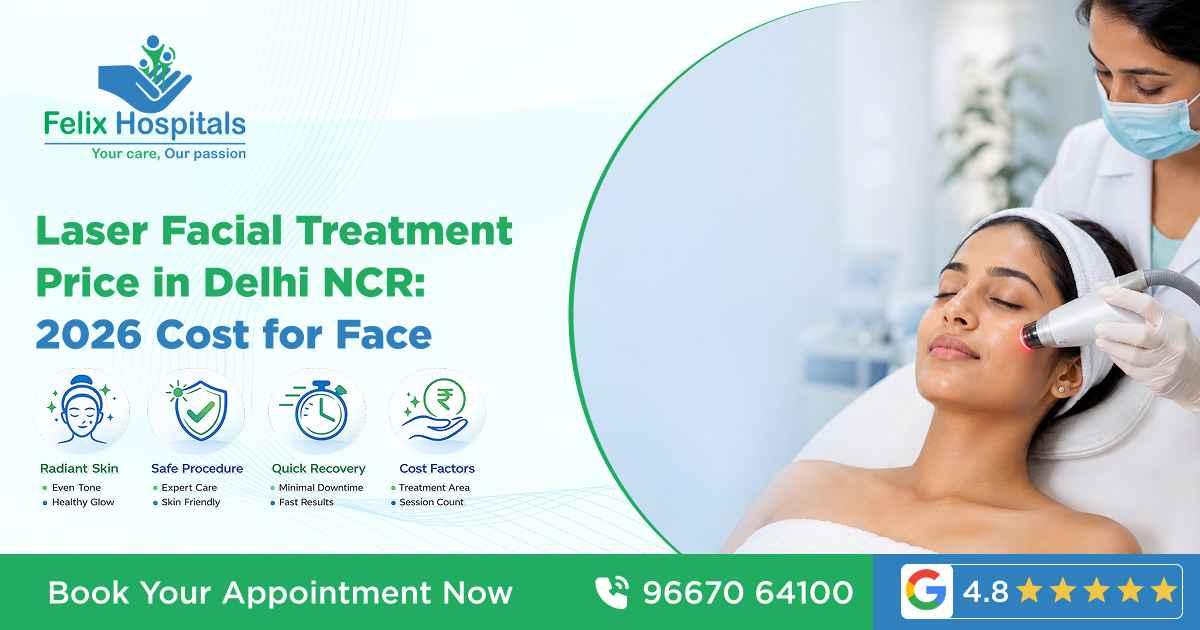
Walk into any dermatology clinic in Delhi NCR today and laser treatment comes up in almost every skin consultation. Acne scars, uneven texture, pigmentation, fine lines, dullness that nothing topical has shifted the answer increasingly involves a laser. And for good reason. The results are documented, the technology has matured significantly, and India now has access to the same clinical-grade equipment used in London and Seoul.
A laser facial treatment costs ₹4,000 at one place and ₹30,000 at another. Both call it the same thing. Neither explains what's actually different. And somewhere between those two numbers is a decision that affects your face which is not somewhere you want to be guessing.
At Felix Hospital's dermatology department, laser treatments are among the most frequently discussed procedures at consultation. What patients want most before the procedure, before the pricing is a straight answer about what they're actually paying for and what results are realistic.
Most skincare products work on the epidermis, the outermost skin layer. Serums, creams, even most chemical peels stay in this zone. Results are real but limited by how deep the product reaches.
Laser treatment reaches the dermis, the structural layer beneath. This is where collagen and elastin live, where scars are anchored, where the architecture of the skin either holds up or doesn't.
The laser creates controlled, precise injury in this layer. The body responds by activating its wound healing process producing new collagen, remodelling existing fibres, generating fresh skin cells. The result isn't just surface brightness. It's structural improvement in the skin itself.
This is why laser treatment produces results that creams genuinely cannot not because the creams are bad, but because they don't reach where the problem lives.
Understanding this distinction saves a lot of confusion when comparing treatment options and prices.
Ablative lasers remove the outermost skin layer while heating the dermis beneath: The surface is physically cleared and the deeper layer is stimulated simultaneously. Results are more dramatic but downtime is longer, three to seven days of redness, swelling, and skin peeling. CO2 and Erbium YAG are the main ablative lasers.
Non-ablative lasers leave the surface intact and work entirely below it: No visible injury, no peeling, minimal downtime often zero. Results per session are more modest than ablative treatment but accumulate significantly over a course of sessions. Q-switched Nd: YAG, pulsed dye laser, and IPL fall broadly into this category.
Neither is universally better: Deep acne scars and surgical scars respond better to ablative treatment. Pigmentation, tanning, and mild texture concerns often respond well to non-ablative approaches with no downtime at all. A dermatologist should recommend the right laser for your specific concern, not the most expensive option or the one the clinic happens to have.
By Laser Type Per Session
Laser Technology | Average Cost Per Session (India) | Best For | Downtime |
Fractional CO2 Laser | ₹8,500 – ₹18,000 | Deep acne scars, surgical scars, resurfacing | 5 – 7 days |
Erbium YAG Laser | ₹7,000 – ₹15,000 | Fine lines, surface texture, mild scars | 3 – 5 days |
MNRF (Microneedling RF / Morpheus8) | ₹12,000 – ₹25,000 | Skin tightening, deep scars, pores | 2 – 3 days |
Q-Switched Nd:YAG | ₹5,000 – ₹10,000 | Pigmentation, tanning, laser toning | Zero |
IPL / Photofacial | ₹4,000 – ₹8,000 | Sun damage, redness, mild uneven tone | Zero |
Pulsed Dye Laser | ₹8,000 – ₹20,000 | Redness, vascular concerns, fresh scars | Minimal |
Combination Protocol | ₹15,000 – ₹35,000 | Complex or multiple concerns | Varies |
By Skin Concern Per Session
Skin Concern | Minimum Per Session | Maximum Per Session |
Fine lines | ₹7,000 | ₹25,000 |
Wrinkles | ₹10,000 | ₹40,000 |
Acne scars | ₹5,000 | ₹35,000 |
Dark spots / pigmentation | ₹5,000 | ₹18,000 |
Sun damage / tanning | ₹4,000 | ₹12,000 |
Uneven skin texture | ₹6,000 | ₹20,000 |
Skin tightening | ₹12,000 | ₹35,000 |
Full face rejuvenation | ₹15,000 | ₹40,000 |
The wide ranges within each concern reflect laser type, clinic setting, and individual skin complexity, not arbitrary pricing decisions.
Area | Fractional CO2 | Q-Switched Laser | Full Face Rejuvenation | MNRF |
Noida / Greater Noida | ₹8,000 – ₹15,000 | ₹5,000 – ₹10,000 | ₹12,000 – ₹25,000 | ₹12,000 – ₹22,000 |
South Delhi (Saket, GK) | ₹10,000 – ₹20,000 | ₹6,000 – ₹12,000 | ₹15,000 – ₹30,000 | ₹15,000 – ₹28,000 |
Gurgaon (Cyber Hub area) | ₹12,000 – ₹22,000 | ₹7,000 – ₹15,000 | ₹18,000 – ₹35,000 | ₹18,000 – ₹35,000 |
West / North Delhi | ₹7,000 – ₹15,000 | ₹5,000 – ₹10,000 | ₹10,000 – ₹22,000 | ₹10,000 – ₹20,000 |
Ghaziabad | ₹6,000 – ₹12,000 | ₹4,000 – ₹8,000 | ₹8,000 – ₹18,000 | ₹9,000 – ₹18,000 |
Faridabad | ₹6,000 – ₹13,000 | ₹4,000 – ₹9,000 | ₹8,000 – ₹20,000 | ₹9,000 – ₹18,000 |
Noida offers genuinely competitive pricing relative to the rest of NCR; the technology available at reputable hospital-based dermatology departments in Noida is the same clinical-grade equipment used in South Delhi and Gurgaon. The cost difference is largely overhead and postcode, not capability.
At Felix Hospital, laser treatments are performed under dermatologist supervision using clinical-grade technology. Call +91 9667064100 for current 2026 pricing and package availability.
This is the question that matters most when comparing quotes. A ₹4,000 session and a ₹18,000 session are not the same procedure wearing different price tags. Here's what's actually different.
Medical-grade FDA-approved laser systems Lumenis, Alma, Candela, Fotona cost significantly more to acquire and maintain than unbranded alternatives. The difference in precision is significant. Clinical-grade systems deliver controlled energy at exact wavelengths with integrated cooling that protects the epidermis while treating the dermis. Non-branded machines common at budget salons and some standalone skin clinics create inconsistent energy delivery that causes hot spots, burns, and post-inflammatory hyperpigmentation.
The equipment cost shows up in the session price. A clinic offering fractional CO2 for ₹2,500 either doesn't have a genuine fractional CO2 machine or is cutting corners elsewhere. Neither is safe.
A laser is a medical device. The wavelength, fluence, pulse duration, and spot size all need to be calibrated to your specific skin type, concern, and Fitzpatrick classification. For Indian skin predominantly Fitzpatrick III to V this calibration is particularly important because darker skin has more epidermal melanin that can absorb laser energy and cause burns or hyperpigmentation if settings aren't adjusted correctly.
A board-certified dermatologist makes these calibrations based on clinical assessment. A technician follows a preset protocol. The outcome difference is not subtle.
A hospital-based dermatology department maintains sterile protocols, clinical-grade cooling and post-procedure management, and the ability to handle complications on-site. Complications are rare with properly administered laser treatment but when they occur, having a qualified clinical team immediately available is the difference between a managed outcome and a problem.
Many skin concerns respond better to combination approaches fractional CO2 followed by PRP for accelerated healing, or alternating Q-switched and fractional sessions for complex pigmentation. Combination protocols cost more per session but often produce better results in fewer total sessions, making them more cost-effective over a full treatment course.
A focused treatment for forehead lines costs less than a full face resurfacing session. Neck and décolletage added to a face treatment increases total cost. The quoted price should always specify the treatment area clearly.
This is where a lot of clinics over-promise. Here's the honest clinical picture.
Mild pigmentation, tanning, general glow improvement: Two to four Q-switched or IPL sessions typically produces significant improvement. These are zero-downtime treatments that can be done monthly.
Surface texture, fine lines, early skin ageing: Three to four fractional or Erbium sessions spaced four to six weeks apart produces meaningful collagen remodelling and texture improvement.
Moderate acne scars: Four to six fractional CO2 sessions is the clinical standard for 50 to 70 percent improvement. Results continue improving for three to six months after the final session as collagen remodelling completes.
Deep, pitted, or icepick acne scars: Six or more sessions, often with combination protocols including subcision, PRP, or dermal filler for specific scar types. Complete elimination is not realistic.
Skin tightening (MNRF/Morpheus8): Three to four sessions spaced six to eight weeks apart for visible tightening.
Maintenance annually: Any dermatologist quoting a specific session count without examining your skin in person is giving you a number, not a clinical recommendation. The consultation is where this gets determined honestly.
Indian skin predominantly falls in Fitzpatrick types III to V. The higher melanin content in darker skin means there's more competition for the laser's energy; the epidermal melanin absorbs some of the same wavelengths intended to target deeper structures. If laser parameters aren't adjusted for this, the result is post-inflammatory hyperpigmentation darkening of the treated area which is more cosmetically problematic than the original concern.
This is not a reason to avoid laser treatment. It's a reason to choose an operator who treats Indian skin regularly and knows how to calibrate correctly. Specific techniques, longer pulse durations, lower fluence, appropriate cooling, skin type-specific wavelength selection make laser treatment safe and effective for Fitzpatrick III to V patients. These are standard practice at experienced dermatology departments.
At Felix Hospital, our dermatology team regularly treats South Asian skin types and applies appropriate protocols for each Fitzpatrick classification. The consultation includes skin type assessment before any laser parameters are recommended.
After session one: Improved surface glow, slightly smoother texture, reduced surface pigmentation for Q-switched treatments. For ablative treatments, initial results are visible after healing around day seven to ten.
After sessions two to three: Noticeable reduction in acne scars, visible flattening, reduced depth, improved colour match with surrounding skin. Significant pigmentation reduction. Skin visibly firmer from collagen response.
After sessions four to six: Comprehensive improvement. Deep scars levelled significantly. Pigmentation largely resolved. Skin texture and tone substantially closer to undamaged skin. Fine lines are noticeably reduced.
Three to six months after final session: Collagen remodelling continues after the course ends. Many patients see their best results at this point not immediately after treatment.
What laser cannot do: stop ongoing aging, prevent new sun damage from forming, or completely erase very deep scars. The goal is significant, lasting improvement not perfection.
How you prepare and care for your skin after laser treatment directly affects how many sessions you need. Better-prepared skin heals faster, responds more efficiently, and requires fewer total sessions to reach the target outcome.
Before treatment: Avoid sun exposure to the treatment area for two weeks. Stop retinoids, AHAs, and vitamin C serums three to five days before the session. Stay well hydrated water intake matters for healing speed. Inform the dermatologist of all medications, particularly any that increase photosensitivity.
After treatment: Keep the area moisturised with a gentle, fragrance-free product. Do not pick, scratch, or attempt to peel healing skin this causes scarring. Avoid direct sun exposure for two weeks. SPF 50 every morning without exception laser-treated skin is more vulnerable to UV damage and new pigmentation. Avoid heat hot showers, saunas, steam rooms for 48 to 72 hours post-session. No active skincare ingredients for one week after ablative treatment.
The post-care period is where results are protected or lost. Patients who follow the protocol consistently require fewer corrective sessions.
Treatment | Effectiveness | Downtime | Cost Range (NCR) | Reaches Dermis |
Regular facial / cleanup | Low | None | ₹500 – ₹3,000 | No |
Chemical peel (superficial) | Mild to moderate | 3 – 5 days | ₹2,000 – ₹8,000 | Partially |
Microneedling | Moderate | 2 – 3 days | ₹5,000 – ₹15,000 | Yes |
HydraFacial | Moderate (surface) | None | ₹3,000 – ₹8,000 | No |
Q-Switched Laser | Good for pigmentation | None | ₹5,000 – ₹12,000 | Yes |
Fractional CO2 Laser | High | 5 – 7 days | ₹8,000 – ₹20,000 | Yes |
MNRF / Morpheus8 | High for tightening | 2 – 3 days | ₹12,000 – ₹25,000 | Yes |
PRP combined with laser | Very high | 3 – 5 days | ₹15,000 – ₹35,000 | Yes |
Laser sits at the higher end of both cost and effectiveness and is often the most cost-efficient choice over a full treatment course because it produces more improvement per session than alternatives requiring more sessions to achieve similar results.
Confirm the laser equipment brand Ask specifically which laser system is being used, brand name, model. Lumenis, Alma, Candela, Fotona, Cynosure are reputable manufacturers with documented clinical performance. If the clinic can't or won't name the equipment, that tells you something.
Confirm a dermatologist is performing the treatment Not supervising performing: The calibration of laser parameters to your skin type should be done by the qualified clinician, not delegated to a technician after a brief consult.
Expect a proper skin assessment before any quote: A treatment plan and session count given without examining your skin is marketing, not medicine. The consultation should include skin type assessment, concern evaluation, and a realistic discussion of expected outcomes before any pricing conversation.
Ask what the quoted price includes: Does it include numbing cream? Post-procedure cooling treatment? Follow-up review? SPF or post-care kit? Get this in writing before agreeing to treatment.
Look for a hospital-based or clinical setting: A hospital dermatology department maintains standard sterilisation protocols, emergency capability, qualified staff that standalone beauty clinics and medi-spas often don't. For a procedure with genuine medical complexity, this infrastructure is meaningful.
For treatments requiring multiple sessions, which is most of them, package pricing produces better value than paying per session.
Sessions | Approximate Package Saving |
3 sessions | 15 – 20% below individual session rate |
6 sessions | 20 – 30% below individual session rate |
Laser facial treatment in India in 2026 is accessible, effective, and when done correctly one of the most reliable ways to address skin concerns that nothing topical has resolved. The technology is mature. The clinical evidence is consistent. The outcomes, for patients who go through a proper course with appropriate post-care, are real and lasting.
The price variation across Delhi NCR is not noise. It reflects genuine differences in equipment quality, operator expertise, clinical protocols, and safety infrastructure. The gap between a ₹3,000 laser session and a ₹15,000 one isn't a gap between expensive and affordable. It's a gap between different procedures with different outcomes and different risk profiles.
At Felix Hospital,, laser facial treatments are performed by our dermatologist using clinical-grade technology with a proper skin assessment before any treatment recommendation, transparent pricing, and protocols specifically calibrated for South Asian skin. Whether you're addressing acne scars, pigmentation, uneven texture, or early skin ageing, the consultation starts with an honest picture of what your skin needs and what results are achievable.
Call +91 9667064100 to book a laser consultation or enquire about current 2026 pricing and package options.
Dr. Tarun Gupta is an experienced Dermatologist with 17+ years of expertise in treating skin, hair, and nail conditions, along with advanced cosmetic dermatology procedures.
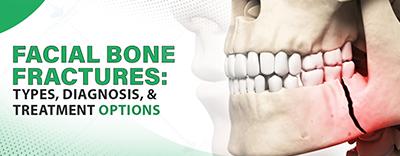
Facial Bone Fractures: Types, Diagnosis, and Treatment Options" provides a comprehensive overview of facial bone injuries, including common types such as nasal, jaw, and cheekbone fractures.

Know the HydraFacial treatment cost, inclusions, and benefits in this quick price guide.
Find the updated list of ECHS empanelled hospitals in Meerut for ex-servicemen and their dependents. Explore cashless treatment facilities, referral processes, and trusted healthcare providers in 2026.
DGEHS empanelled hospitals in Delhi 2026 provide cashless treatment for eligible government employees and pensioners under the Delhi Government health scheme.

If you are a central government employee or pensioner living in Ghaziabad and you have been paying out of pocket for specialist consultations, there is a good chance you did not know Felix Hospital was an option.
Felix Hospital in Gamma-1, Greater Noida is fully empanelled under the Central Government Health Scheme. From most parts of Ghaziabad Indirapuram, Vaishali, Kaushambi, Crossings Republik Felix Hospital is 30 to 45 minutes away via NH-9. That is often comparable to reaching a large CGHS hospital in central Delhi, without the city traffic.
CGHS Helpdesk at Felix Hospital: +91 9667064100
If the procedure is within CGHS approved rates, it is 100% cashless for entitled beneficiaries and their dependents. No deposit. No balance billing for covered procedures.
Specialty | Procedures Covered Under CGHS |
Cardiology and Cardiac Surgery | Angiography, angioplasty, bypass surgery (CABG), valve replacement, pacemaker, ICD implantation, heart failure management |
Orthopaedics and Joint Replacement | Knee replacement, hip replacement, spine surgery, fracture fixation, bone infection, revision joint surgery |
Neurology and Neurosurgery | Stroke management, brain surgery, spinal cord conditions, epilepsy, neurological investigations |
Oncology | Cancer diagnosis, chemotherapy, radiation therapy, surgical oncology, haematological cancers |
Gynaecology and Obstetrics | Normal delivery, C-section, hysterectomy, fibroid surgery, Level III NICU available |
Urology | Laser kidney stone treatment (zero-cut), prostate surgery, urinary tract procedures, dialysis |
General and Laparoscopic Surgery | Gallbladder removal, hernia repair, appendectomy, bariatric surgery, colorectal procedures |
Paediatrics | Paediatric surgical and medical conditions |
ENT and Ophthalmology | Cataract surgery, ear surgery, tonsillectomy, septoplasty, glaucoma procedures |
Pulmonology | Respiratory conditions, COPD, bronchoscopy, sleep apnoea |
Nephrology and Dialysis | Chronic kidney disease, haemodialysis, 24/7 dialysis unit |
Gastroenterology | Endoscopy, colonoscopy, liver conditions, digestive disorders |
Rheumatology | Arthritis, autoimmune joint conditions |
Endocrinology | Diabetes, thyroid disorders, hormonal conditions |
Physical Medicine and Rehabilitation | Physiotherapy, occupational therapy, post-surgical rehabilitation |
Psychiatry | Mental health consultation and management |
Dermatology | Skin conditions and dermatological procedures |
Call +91 9667064100 to confirm whether your specific procedure is covered under CGHS rates before your visit.
Ghaziabad has its own hospitals. What it does not have in abundance is a CGHS empanelled private tertiary care facility with a 24/7 cath lab, robotic surgery, and a Level III NICU available cashless for central government beneficiaries.
The 24/7 digital cath lab at Felix Hospital operates without slot restrictions. For CGHS beneficiaries in Kaushambi, Vaishali, or Indirapuram areas with a dense retired central government servant population a cardiac emergency via NH-9 reaches interventional cardiology capability in approximately 30 to 35 minutes.
We regularly see patients from Ghaziabad's residential sectors presenting in our cardiology OPD with chest discomfort they had been managing with antacids for weeks. Many turn out to have significant coronary artery disease on angiography. The CGHS card covers the angiography, the angioplasty if required, and the post-procedure management. The patient pays nothing for any of it.
Covered under CGHS: angiography, angioplasty with stenting, CABG, valve replacement and repair, pacemaker implantation, ICD implantation, and heart failure management. Pre-authorization for planned cardiac procedures is handled entirely by the Felix CGHS desk; no separate CGHS office visits are required.
Ghaziabad's central government pensioner population includes many who retired a decade ago and are now managing knee or hip degeneration that has been worsening steadily. Painkillers work for a while. Physiotherapy helps for a while. But when the pain is limiting daily function when climbing stairs in a Vaishali apartment or walking to the Indirapuram market becomes a problem, joint replacement becomes the practical answer.
At Felix Hospital, knee replacement, hip replacement, partial joint replacement, and revision surgery are all performed under CGHS package rates. No balance billing. The robotic-assisted surgery wing delivers precision outcomes with faster recovery. In-house physiotherapy begins the same day as surgery. For Ghaziabad patients who had been told joint replacement means three months of difficult recovery, the reality at Felix Hospital is often significantly better.
Most Ghaziabad CGHS beneficiaries who have used the reimbursement route know exactly what it involves. Pay the bill first, sometimes two to four lakhs for a joint replacement or cardiac procedure. Collect every receipt, every prescription, every discharge summary. File the claim. Wait. Follow up. Wait again. Sometimes receive a partial reimbursement weeks or months later with deductions that were never explained beforehand.
Factor | Reimbursement Route | Cashless at Felix Hospital |
Upfront payment | Required, often substantial | Zero |
Paperwork burden | Bills, forms, submissions, follow-ups | Handled entirely by Felix CGHS desk |
Waiting period | Weeks to months | Settled directly with CGHS |
Rate risk | Excess above CGHS rate not reimbursed | CGHS rate charged directly |
Risk of shortfall | High | None for covered procedures |
Stress during hospitalisation | High | Managed by hospital team |
The Felix Hospital CGHS desk processes pre-authorisations, manages documentation, and settles directly with CGHS. The family focuses on the patient.
Room entitlement under CGHS depends on the beneficiary's pay level or pension grade.
Beneficiary Category | Room Entitlement |
Group A Officers (Pay Level 13 and above) | Private Room |
Group B Officers (Pay Level 9 to 12) | Semi-Private Room |
Group C and below (Pay Level 1 to 8) | General Ward |
Pensioners | Equivalent to serving status at last pay drawn |
If a higher room category is chosen beyond entitlement, only the difference in room charges is payable by the beneficiary (and most CGHS patients from Ghaziabad find the semi-private rooms at Felix Hospital comfortable and well-equipped for a planned admission). All clinical charges remain at CGHS approved rates regardless of room choice.
For planned treatment: Visit your allocated CGHS Wellness Centre for most Ghaziabad residents, Sector 37 or Sector 56 in Noida are the closest options. The Medical Officer conducts an initial assessment and issues a referral letter to Felix Hospital specifying the department and nature of care required.
Bring the referral letter, CGHS card, and Aadhaar card to the Felix Hospital CGHS helpdesk at Gamma-1, Greater Noida. The hospital team manages registration, pre-authorisation submission, and admission from this point. You do not follow up with any CGHS office separately.
For emergencies: Do not look for the referral letter when someone is critically ill. Drive directly to Felix Hospital's emergency department via NH-9. CGHS guidelines permit direct emergency admission at any empanelled hospital without prior referral. Treatment begins immediately. Retrospective authorisation is submitted by the hospital after stabilisation.
Tell the emergency team you are a CGHS beneficiary when you arrive.
CGHS rules are explicit: emergency admission at any empanelled hospital requires no prior referral and no pre-authorisation. Felix Hospital's emergency team treats first. The CGHS desk handles retrospective documentation after stabilisation. From Indirapuram or Crossings Republik, Felix Hospital is 25 to 35 minutes via NH-9 faster than reaching most central Delhi hospitals from eastern Ghaziabad during morning hours.
For central government employees and pensioners in Ghaziabad, Felix Hospital offers something the reimbursement route never could: treatment without upfront financial exposure, at a NABH-accredited private facility, in a location that does not require entering Delhi.
From Crossings Republik which sits literally on the Ghaziabad-Greater Noida border Felix Hospital is under 25 minutes. From Indirapuram and Vaishali, allow 30 to 35 minutes via NH-9. From Kaushambi and the NH-9 corridor, 35 to 40 minutes. For a Ghaziabad resident who has been driving to central Delhi for CGHS consultations, that is a meaningful upgrade in both time and convenience.
Ghaziabad's central government pensioner population is concentrated in specific residential corridors in Indirapuram's apartment belt along Ahinsa Khand and Nyay Khand, the Vaishali and Vasundhara sectors, and the newer Crossings Republik area close to the Greater Noida border.
Felix Hospital sits at the logical terminus of the NH-9 corridor from all of these areas. The drive from Indirapuram's Shipra Sun City area to Gamma-1 runs approximately 32 to 38 minutes on a normal traffic day comparable to the time it takes to reach Saket or Rohini from the same starting point, and without the bottleneck at the Delhi-Noida toll.
Area | Key Landmarks | Approx. Time from Felix |
Indirapuram, Ahinsa Khand, Nyay Khand | Shipra Mall, Indirapuram Habitat Centre | 32 to 38 mins |
Vaishali and Vasundhara | Vaishali Metro, Sector 4 market | 35 to 40 mins |
Kaushambi | Kaushambi Metro, NH-9 corridor | 35 to 40 mins |
Crossings Republik | Crossings Republik Mall, GT Road junction | 20 to 25 mins |
Lal Kuan, Mohan Nagar | Mohan Nagar bus stand, NH-9 | 30 to 35 mins |
Ghaziabad city centre, Raj Nagar | Raj Nagar District Centre | 45 to 55 mins |
Greater Noida Central | Nearest to Felix | 10 to 15 mins |
Noida Extension, Gaur City | Gaur City Mall | 20 to 25 mins |
Central government employees and pensioners in Ghaziabad have spent careers in service. The healthcare entitlement they earned should not require navigating Delhi traffic to use.
Felix Hospital is on the NH-9 corridor from Ghaziabad 25 to 40 minutes depending on where you are starting from. Fully empanelled under CGHS. Tertiary care equipped. And a CGHS desk that processes cases every day, so when your family needs it, the process is already familiar to the team handling it.
+91 9667064100, CGHS Helpdesk, Pre-Authorisation Queries, and 24-hour Emergency Felix Hospital, Gamma-1, Greater Noida. CGHS Empanelled serving Ghaziabad, Indirapuram, Vaishali, Kaushambi, Crossings Republik, and the broader NCR belt.
Dr. Ravi Sharma is a senior physician with 42+ years of experience, known for compassionate and comprehensive patient care in Noida.
CGHS empanelled hospitals in Noida offer cashless treatment and advanced healthcare services for central government employees, pensioners, and their dependents
The ECHS panel in Noida consists of multiple empanelled private and specialty hospitals where Ex-Servicemen Contributory Health Scheme (ECHS)
Find the updated list of ECHS empanelled hospitals in Meerut for ex-servicemen and their dependents. Explore cashless treatment facilities, referral processes, and trusted healthcare providers in 2026.
DGEHS empanelled hospitals in Delhi 2026 provide cashless treatment for eligible government employees and pensioners under the Delhi Government health scheme.
If your CGHS card has been sitting in your wallet while you have been paying out of pocket for specialist consultations, this page is going to frustrate you in a useful way. Because the hospital you needed has been in Greater Noida this whole time.
Felix Hospital in Gamma-1, Greater Noida is fully empanelled under the Central Government Health Scheme. For central government employees and pensioners living across Greater Noida sectors, Knowledge Park, Noida Extension, Dadri, and the surrounding district, this means the full weight of CGHS cashless coverage is available without a drive to Delhi, without a waiting list that stretches three weeks, and without navigating a government hospital that sees three hundred patients before noon.
Helpdesk at Felix Hospital: +91 9667064100
If the procedure is within CGHS approved rates, it is 100% cashless for entitled beneficiaries and their dependents. No deposit. No balance billing for covered procedures.
Specialty | Procedures Covered Under CGHS |
Cardiology and Cardiac Surgery | Angiography, angioplasty, bypass surgery (CABG), valve replacement, pacemaker, ICD implantation, heart failure management |
Orthopaedics and Joint Replacement | Knee replacement, hip replacement, spine surgery, fracture fixation, bone infection, revision joint surgery |
Neurology and Neurosurgery | Stroke management, brain surgery, spinal cord conditions, epilepsy, neurological investigations |
Oncology | Cancer diagnosis, chemotherapy, radiation therapy, surgical oncology, haematological cancers |
Gynaecology and Obstetrics | Normal delivery, C-section, hysterectomy, fibroid surgery, Level III NICU available |
Urology | Laser kidney stone treatment (zero-cut), prostate surgery, urinary tract procedures, dialysis |
General and Laparoscopic Surgery | Gallbladder removal, hernia repair, appendectomy, bariatric surgery, colorectal procedures |
Paediatrics | Paediatric surgical and medical conditions |
ENT and Ophthalmology | Cataract surgery, ear surgery, tonsillectomy, septoplasty, glaucoma procedures |
Pulmonology | Respiratory conditions, COPD, bronchoscopy, sleep apnoea |
Nephrology and Dialysis | Chronic kidney disease, haemodialysis, 24/7 dialysis unit |
Gastroenterology | Endoscopy, colonoscopy, liver conditions, digestive disorders |
Rheumatology | Arthritis, autoimmune joint conditions |
Endocrinology | Diabetes, thyroid disorders, hormonal conditions |
Physical Medicine and Rehabilitation | Physiotherapy, occupational therapy, post-surgical rehabilitation |
Psychiatry | Mental health consultation and management |
Dermatology | Skin conditions and dermatological procedures |
Call +91 9667064100 to confirm whether your specific procedure is covered under CGHS rates before your visit. The helpdesk checks on the spot.
Central government employees and pensioners in Greater Noida do not need to accept a lower standard of care because they are using a government health scheme. At Felix Hospital, CGHS patients use the same facilities as every other patient.
24/7 Digital Cath Lab: Cardiac emergencies at 2 AM in the Omicron sector reach a functioning catheterisation lab in under 15 minutes. No waiting for a morning slot
Minimal Invasive Surgery:Smaller incisions, less pain, quicker recovery, and faster return to everyday activities.
Level III NICU: For newborns requiring intensive neonatal care immediately after delivery one of the few facilities in Gautam Buddha Nagar with this capability
Zero-Cut Laser Technology: Kidney stone treatment without incision most patients discharged within 24 hours
Advanced Diagnostics On-Site: MRI, CT scan, digital X-ray, ultrasound, endoscopy no referral to an outside lab for any standard investigation
Laminar Airflow Operation Theatres: Infection-controlled surgical environment
NABH Accreditation: Standards externally audited, not self-declared
The 24/7 digital cath lab at Felix Hospital is one of the few in the Greater Noida and Noida region that operates without slot restrictions. For CGHS beneficiaries living in Alpha, Beta, Gamma, or Knowledge Park sectors, a cardiac emergency reaches a functioning interventional cardiology facility in under 15 minutes.
In our cardiology OPD, we see central government employees, many of them in sedentary desk roles for decades presenting with chest pain they had been attributing to acidity or stress. A significant proportion have significant coronary artery disease on angiography. The CGHS card covers the angiography, the angioplasty if needed, and the follow-up management. The patient pays nothing for any of it.
Covered under CGHS: angiography, angioplasty with stenting, CABG, valve replacement and repair, pacemaker implantation, ICD implantation, and heart failure management. Pre-authorisation for planned cardiac procedures is handled entirely by the Felix CGHS desk.
Greater Noida's central government pensioner population includes many who retired in their late 50s and are now in their 60s and 70s with knee or hip degeneration that has been worsening for years. Many have been managing with painkillers and physiotherapy, unaware that joint replacement under CGHS at a NABH-accredited facility with robotic-assisted surgery is available in the same district they live in.
At Felix Hospital, total knee replacement, total hip replacement, partial joint replacement, and revision joint replacement are all performed under CGHS package rates. No balance billing. No implant surcharges beyond entitled limits. The robotic-assisted surgery wing maps the procedure to the patient's anatomy before the first incision. In-house physiotherapy begins the same day as surgery. A patient who arrived with a walking stick has, in more cases than we can count, left without one.
CGHS Wellness Centres serve as the first point of contact for beneficiaries OPD consultations, routine medicines, and referral letters for specialist care at empanelled hospitals like Felix Hospital.
CGHS Wellness Centre | Location | Serves |
CGHS Wellness Centre Sector 12 | Sector 12, Noida | Central and west Noida sectors |
CGHS Wellness Centre Sector 37 | Sector 37, Noida | Mid-Noida and expressway sectors |
CGHS Wellness Centre Sector 56 | Sector 56, Noida | East Noida sectors |
CGHS Wellness Centre Sector 82 | Sector 82, Noida | Expressway and Greater Noida border |
For Greater Noida residents, the Sector 37 and Sector 82 wellness centres are the most practical starting points for referrals to Felix Hospital. The drive from Sector 37 to Felix Hospital runs approximately 20 minutes via the Noida-Greater Noida Expressway.
For the most current dispensary list and catchment allocations, visit cghs.gov.in or call your allocated wellness centre directly. Allocations are updated periodically.
Most CGHS beneficiaries know the reimbursement process. File the bills, attach the referral, submit to the office, wait. Sometimes the wait is six weeks. Sometimes it is six months. Sometimes the bill comes back with deductions because a particular item was not in the approved schedule and nobody told you before the procedure.
Factor | Reimbursement Route | Cashless at Felix Hospital |
Upfront payment | Required, often substantial | Zero |
Paperwork burden | Bills, forms, submissions, follow-ups | Handled entirely by Felix CGHS desk |
Waiting period | Weeks to months | Settled directly with CGHS |
Rate risk | Excess above CGHS rate not reimbursed | CGHS rate charged directly |
Risk of shortfall | High | None for covered procedures |
Stress during hospitalization | High | Managed by hospital team |
The Felix Hospital CGHS desk processes pre-authorizations, manages documentation, and settles directly with CGHS. The patient and family focus on the clinical side.
Room entitlement under CGHS depends on the beneficiary's pay level or pension grade.
Beneficiary Category | Room Entitlement |
Group A Officers (Pay Level 13 and above) | Private Room |
Group B Officers (Pay Level 9 to 12) | Semi-Private Room |
Group C and below (Pay Level 1 to 8) | General Ward |
Pensioners | Equivalent to serving status at last pay drawn |
If a higher room category is chosen beyond entitlement, only the difference in room charges is payable by the beneficiary (and most CGHS patients find the semi-private rooms at Felix Hospital comfortable and well-maintained for a planned admission). All clinical charges surgery, medicines during admission, investigations remain at CGHS approved rates regardless of room choice.
For planned treatment: Visit your allocated CGHS Wellness Centre. The Medical Officer conducts an initial assessment and, where specialist or hospital care is required, issues a referral letter to Felix Hospital specifying the department and nature of care needed.
Bring the referral letter, CGHS card, and Aadhaar card to the Felix Hospital CGHS helpdesk at Gamma-1. From this point, the hospital team manages registration, pre-authorization submission, and admission. You do not follow up with any CGHS office separately.
For emergencies: Do not look for the referral letter when someone is critically ill. Walk directly into the Felix Hospital emergency department. CGHS guidelines permit direct emergency admission at any empanelled hospital without prior referral. Treatment begins immediately. Retrospective authorisation is submitted by the hospital after the patient is stabilised.
Life-Threatening Emergencies Heart attack: Stroke. Respiratory failure. Major trauma.
Don't wait. Don't look for the referral letter. Just get here.
CGHS rules are clear: emergency admission at any empanelled hospital requires no prior referral and no pre-authorisation. The clinical team at Felix Hospital treats first. The CGHS desk handles retrospective documentation after stabilisation. For CGHS beneficiaries in Alpha sector, Knowledge Park, or anywhere in Gautam Buddha Nagar Felix Hospital is under 20 minutes away for most of the district. Use that time getting here.
For central government employees and pensioners across Greater Noida, Felix Hospital removes the most common barrier to using CGHS benefits, the belief that quality private care under CGHS means a trip to Delhi.
It does not. Not anymore. Not for residents of this district.
Felix Hospital is NABH accredited, tertiary care equipped, and fully empanelled under CGHS in Gamma-1, accessible from every sector in Greater Noida without leaving the district. CGHS beneficiaries receive the same doctors, the same operation theatres, and the same post-operative care as every other patient. No separate ward. No lower-priority queue.
Central government employees settled in Greater Noida span a wide geography: the bungalow sectors of Alpha and Beta, the apartment corridors of Knowledge Park, the newer sectors along the expressway toward Noida Extension. Felix Hospital sits centrally within this spread.
From Alpha sector near Pari Chowk 10 to 15 minutes. From Knowledge Park areas under 15 minutes. From Omicron and Pi sectors 15 to 20 minutes. From Noida Extension and Gaur City stretch 20 to 25 minutes. For a planned knee replacement or cardiac review, no central government employee in Greater Noida needs to drive to Delhi.
Zero waiting lists for most elective procedures. Same-day specialist consultations. A dedicated CGHS administrative team that speaks the language of the scheme.
Area | Key Landmarks | Approx. Time from Felix |
Alpha and Beta sectors | Pari Chowk, Alpha Commercial Belt | 10 to 15 mins |
Knowledge Park 1, 2, 3, 5 | Knowledge Park Metro, Sharda Hospital Road | 10 to 15 mins |
Gamma and Delta sectors | Gamma-1 market, Delta roundabout | 5 to 10 mins |
Omicron and Pi sectors | Omicron 1 Market, Pi commercial belt | 15 to 20 mins |
Zeta and Eta sectors | Zeta market, Eta residential belt | 15 to 20 mins |
Noida Extension, Gaur City | Gaur City Mall, Crossings Republik | 20 to 25 mins |
Dadri and Surajpur | Dadri Bus Stand, Surajpur Chowk | 20 to 30 mins |
Noida Expressway, Sector 100 to 137 | Advant Navis Business Park, Sector 137 Metro | 20 to 25 mins |
Jewar and Rabupura belt | Jewar Chowk, Yamuna Expressway | 35 to 45 mins |
For emergencies, the Felix Hospital ambulance operates 24 hours and dispatches immediately on a single call.
Central government employees and pensioners in Greater Noida have spent careers building this country. The healthcare entitlement they earned should not require a commute to Delhi to use.
Felix Hospital is in the same district. Fully empanelled under CGHS. Equipped across every major specialty. And the CGHS desk processes cases every single day so when your family needs it, the process is already familiar to the team handling it.
+91 9667064100, CGHS Helpdesk, Pre-Authorisation Queries, and 24-hour Emergency Felix Hospital, Gamma-1, Greater Noida. CGHS Empanelled serving Greater Noida, Noida Extension, Dadri, Jewar, and Gautam Buddha Nagar district.
Dr. Ravi Sharma is a senior physician with 42+ years of experience, known for compassionate and comprehensive patient care in Noida.
CGHS empanelled hospitals in Noida offer cashless treatment and advanced healthcare services for central government employees, pensioners, and their dependents
The ECHS panel in Noida consists of multiple empanelled private and specialty hospitals where Ex-Servicemen Contributory Health Scheme (ECHS)
Find the updated list of ECHS empanelled hospitals in Meerut for ex-servicemen and their dependents. Explore cashless treatment facilities, referral processes, and trusted healthcare providers in 2026.
DGEHS empanelled hospitals in Delhi 2026 provide cashless treatment for eligible government employees and pensioners under the Delhi Government health scheme.
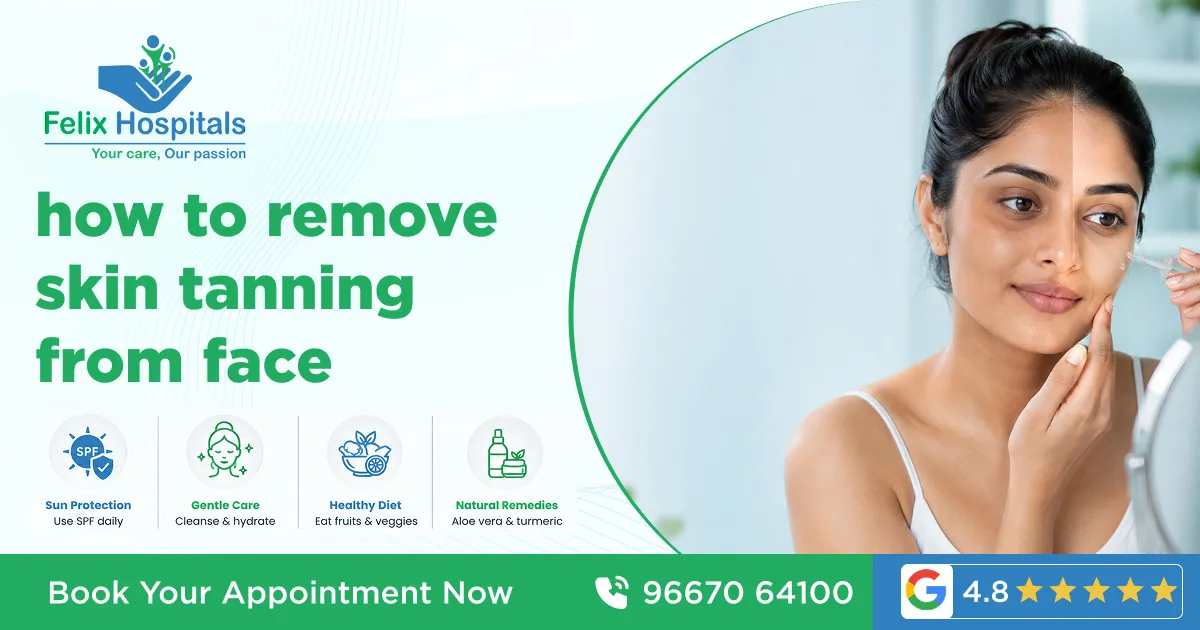
There's a particular kind of frustration that comes with sun tan on the face. You were outside for a few hours, maybe a wedding, a cricket match, a day of running errands across Noida in peak summer and now there's a visible difference between your face and your neck. Your forehead and nose are darker. There's a line at your jawline. Your natural skin tone feels like it's somewhere underneath all of it, waiting to come back.
The good news is that most sun tan is genuinely reversible. Unlike the deeper pigmentation changes that come from melasma or post-inflammatory hyperpigmentation, a straightforward sun tan sits primarily in the outermost layers of the skin which means consistent, targeted treatment brings your natural tone back faster than most people expect.
The less good news is that most of what gets recommended online for tan removal from lemon juice to fairness creams to elaborate ten-step routines ranges from ineffective to actively damaging. The ingredients that work are simpler than the marketing suggests.
When UV radiation from sunlight hits the skin, specialised cells called melanocytes respond by producing more melanin, the pigment responsible for skin colour. This is a protective response. Melanin absorbs UV radiation and disperses it as heat, protecting the DNA in deeper skin cells from damage.
The key fact for treatment purposes: most surface tanning is in the epidermis, the outermost skin layer. The epidermis renews itself every 28 to 40 days. Tanned cells are shed and replaced with cells from below that haven't been UV-exposed. This is why tans fade naturally over time and why treatments that accelerate cell turnover work so well for tan removal.
What makes some tans stubborn: repeated UV exposure keeps stimulating melanin production faster than the skin can shed tanned cells. Tans that have been layered over weeks or months, or that have triggered deeper pigmentation changes, take longer to treat and may need clinical intervention.
If there's one thing that underpins every effective tan removal approach, it's this. Tanned cells are on the surface. Getting them off faster than the natural 28-40 day cycle is how you remove tan. Every effective tan removal ingredient either exfoliates directly or accelerates the skin's own cell turnover.
Physical exfoliation scrubs remove dead cells mechanically. Chemical exfoliation AHAs, BHAs, enzyme-based products dissolves the bonds holding dead cells together and clears them more evenly. Both work. Chemical exfoliation is generally gentler and more consistent in results.
Home-based exfoliation two to three times a week is the baseline for any tan removal routine.
This combination has been used in Indian skincare for generations and the chemistry behind it holds up. Besan exfoliates mechanically while absorbing excess oil. Curd contains lactic acid, a natural AHA that gently dissolves dead cell bonds, improves cell turnover, and has a mild brightening effect over time.
How to use: Mix two tablespoons of besan with enough fresh curd to form a spreadable paste. Add a pinch of turmeric if you like. Apply to face, let it dry partially for about 15 minutes then rub off gently with wet fingers using circular motions. Rinse with cool water. Use two to three times a week.
What to expect: Noticeably smoother, brighter texture within one to two weeks. Gradual tan reduction over four to six weeks of consistent use.
Underestimated and consistently effective. Raw potato contains catecholase, an enzyme with documented tyrosinase-inhibiting activity tyrosinase being the enzyme that drives melanin production. Regular use on tanned skin slows ongoing melanin synthesis and gradually lightens existing pigmentation.
It's particularly effective on the nose, forehead, and cheekbones, the areas that catch the most direct sun.
How to use: Grate a raw potato and squeeze out the juice. Apply directly to tanned areas with a cotton pad. Leave for 20 minutes, rinse with cool water. Use it daily.
What to expect: Gradual lightening of tanned areas over three to five weeks. More effective on recent tans than on established, layered pigmentation.
Tomatoes contain lycopene, a powerful antioxidant alongside natural acids that gently exfoliate and brighten. Lycopene has documented photoprotective properties, meaning it helps neutralize some of the UV-induced damage that drives pigmentation. Honey adds moisture and soothes post-sun inflammation.
This combination is particularly good for skin that's been repeatedly sun-exposed because it addresses both the existing tan and some of the inflammatory damage underneath it.
How to use: Blend half a tomato into a smooth paste, mix with one teaspoon of raw honey. Apply to face, leave for 20 minutes, rinse. Use three to four times a week.
What to expect: Reduced redness and surface brightness improvement within one to two weeks. Tan reduction visible over four to six weeks.
Curcumin in turmeric inhibits tyrosinase and has anti-inflammatory properties that reduce post-sun skin stress. Milk's lactic acid content improves cell turnover. Together they work at two levels slowing melanin production and accelerating shedding of already-tanned cells.
How to use: Mix half a teaspoon of raw turmeric with enough cold raw milk to form a paste. Apply to face, leave for 15 to 20 minutes, rinse thoroughly. Use two to three times a week.
What to expect: Reduced surface tan over four to six weeks. Works gradually don't expect dramatic overnight change.
Fresh aloe vera gel contains aloe in a compound with documented melanin-inhibiting properties alongside deep hydrating polysaccharides. Sun-damaged skin is often dehydrated skin, and dehydration makes tanning and uneven tone look significantly worse. Restoring the moisture barrier helps the skin's natural renewal process work more efficiently.
How to use: Apply fresh gel from a cut aloe leaf directly to tanned skin. Leave for 30 minutes or use it as an overnight treatment. Use it daily.
What to expect: Improved hydration and soothing of sun-stressed skin within days. Gradual reduction in tan depth over four to six weeks with consistent use.
Dried orange peel powder contains vitamin C in a form that penetrates the skin more effectively than fresh orange juice. It's more concentrated and less acidic. Vitamin C inhibits melanin synthesis through tyrosinase inhibition and gradually fades existing pigmentation with consistent use. Rose water soothes and balances.
How to use: Mix one tablespoon of dried orange peel powder with rose water to form a paste. Apply to face, leave for 15 minutes, rinse. Use twice a week.
What to expect: Gradual brightening and tan reduction over four to six weeks.
Simple, immediate, and underrated for freshly tanned skin. Cold milk applied directly after sun exposure does two things: the cold constricts blood vessels and reduces the inflammatory response that deepens tanning, and the lactic acid begins gentle surface exfoliation immediately. Applied within a few hours of sun exposure, it genuinely reduces how deeply a tan sets.
How to use: Soak a clean cloth in cold raw milk. Apply as a compress to tanned areas for 15 to 20 minutes. Rinse with cool water. Most useful immediately after sun exposure or the following morning.
Doing individual remedies occasionally produces slow results. Combining them in a structured weekly routine produces visible improvement in two to three weeks.
Morning (daily): Wash face with a gentle cleanser. Apply aloe vera gel as a light layer, leave on, don't rinse. Sunscreen SPF 50 before going out. Always.
Evening (daily): Cleanse thoroughly to remove pollution and sunscreen. Apply potato juice on tanned areas with a cotton pad. Leave 20 minutes, rinse.
Tuesday and Friday: Besan and curd scrub. Gentle circular motion, two minutes, rinse with cool water.
Wednesday: Turmeric and milk paste. 15 to 20 minutes, rinse well.
Saturday: Tomato and honey mask, followed by aloe vera overnight treatment.
Throughout the week: Two liters of water minimum daily. Sleep adequately skin renewal is significantly faster during sleep. Eat antioxidant-rich foods tomatoes, amla, and citrus which support melanin regulation from the inside.
The internet recommends several tan removal remedies that cause more harm than they fix. Worth knowing before you damage your skin pursuing a shortcut.
Lemon juice directly on skin The most commonly recommended, most consistently damaging. The citric acid concentration in raw lemon juice is far higher than any skincare formulation. Applied directly to the face and followed by sun exposure which is exactly when people use it it causes phototoxic reactions, chemical burns, and paradoxically worsens pigmentation. The brightening effect is real but the damage is not worth it. Formulated vitamin C products work without the risk.
Bleaching creams containing mercury or hydroquinone without medical supervision Over-the-counter bleaching creams in India sometimes contain mercury, a neurotoxin or high concentrations of hydroquinone. Both cause long-term damage with regular use. Hydroquinone in formulations above 2% should only be used under dermatologist supervision for specific periods. Mercury-containing products should not be used at all.
Baking soda is highly alkaline, disrupts skin's natural pH, damages the acid mantle, and worsens sensitivity and uneven tone. Despite persistent recommendations online, it is not useful for any skin concern.
Tomato juice alone as a daily toner Tomato in a mask is fine. As a daily leave-on toner the acidity can irritate and sensitive skin over time, particularly in summer when skin is already stressed.
Sun tan doesn't distribute evenly. Different areas of the face get different amounts of UV exposure and need slightly different approaches.
Nose and forehead the T-zone tan These areas protrude and get the most direct sun. Tan here is usually the deepest. Potato juice daily on these specific areas, combined with consistent SPF application, targets this effectively.
Under-eye area The skin here is thinner and more sensitive than the rest of the face. Avoid abrasive scrubs in this area. Cold milk compresses and aloe vera are gentle enough for daily under-eye use.
Neck and jawline the tan line The visible demarcation between the face and neck is one of the most common complaints. Extend all tan removal treatments to the neck. Don't treat the face and stop at the jawline. The tan line won't close that way.
Cheekbones High-exposure area that responds well to antioxidant treatments tomato and honey, orange peel powder.
This depends on how the tan got there and how long it's been there.
Recent tan (1 to 3 weeks old): Consistent home treatment produces visible improvement in two to three weeks. The tan is primarily in the upper epidermis and responds quickly to exfoliation and brightening ingredients.
Layered, older tan (months of cumulative exposure): Four to eight weeks of consistent treatment for meaningful improvement. Some of the pigmentation may have shifted deeper into the dermis and will respond more slowly.
Tan combined with hyperpigmentation: If the tanning has triggered underlying melanin production beyond the surface which happens with repeated, heavy sun exposure home remedies will improve the appearance but may not fully resolve it. Clinical treatment may be needed.
Some tanning and pigmentation doesn't respond adequately to home care. Knowing when to step up to clinical treatment saves weeks of ineffective effort.
Chemical Peels Superficial to medium-depth peels glycolic acid, lactic acid, salicylic acid accelerate cell turnover significantly beyond what home exfoliation achieves. A series of three to six peels spaced two to four weeks apart produces visible tan reduction and skin brightening. Particularly effective for layered, accumulated tan. Cost at reputable dermatology clinics in Noida: ₹2,000 to ₹8,000 per session depending on peel depth and type.
Laser Toning / Q-Switched Nd: YAG Laser Targets melanin in the skin without damaging the surface. Breaks down excess melanin deposits that contribute to tan and uneven tone. Multiple sessions required typically four to eight. Effective for stubborn tan that hasn't responded to other treatments. Cost in Delhi NCR: ₹5,000 to ₹15,000 per session.
Vitamin C Infusion/Glutathione IV Intravenous and topical vitamin C and glutathione treatments reduce melanin synthesis systemically. Popular in dermatology clinics across India. Results vary not as consistently documented as topical or laser approaches but some patients respond well. Should only be administered by qualified medical professionals.
Prescription Topicals Dermatologist-prescribed formulations containing kojic acid, azelaic acid, tranexamic acid, or supervised-concentration hydroquinone work significantly faster than over-the-counter alternatives. If your tan is combined with underlying pigmentation, a prescription topical is often the most efficient first step.
You can do every remedy consistently, use the right ingredients, follow the weekly routine and undo all of it in a single afternoon without sun protection.
Every tan removal treatment works by reducing existing melanin and preventing new production. Sun exposure actively drives new melanin production. If you're treating tan in the evening and getting re-tanned during the day without SPF, you're running on a treadmill.
SPF 50, broad spectrum, applied every morning, reapplied every two hours if you're outdoors this is not optional for tan removal to work. It's the foundation that every other remedy builds on.
For daily city use in Noida and Delhi where UV index is high eight to nine months of the year, SPF 50 PA+++ is the minimum recommendation. Apply it as the last step before leaving the house. Every day. Including overcast days UV penetrates cloud cover.
Most sun tan on the face is reversible with consistent, targeted treatment. The ingredients that work besan, curd, aloe vera, potato juice, turmeric, orange peel are accessible, affordable, and genuinely effective when used consistently as part of a structured routine. The timeline is weeks, not days. And SPF is the non-negotiable foundation that makes everything else work.
When tanning is deeper, layered over months, or combined with underlying pigmentation that doesn't respond to home care, clinical treatment at a dermatology department produces results that home remedies can't match. The right approach depends on what you're actually dealing with.
At Felix Hospital our dermatology team assesses tan and pigmentation properly before recommending treatment whether that's an optimized home routine, a course of chemical peels, laser toning, or a prescription topical. The consultation starts with an honest picture of what your skin needs, not a package designed around what we want to sell you.
Call +91 9667064100 to book a dermatologist consultation
Dr. Tarun Gupta is an experienced Dermatologist with 17+ years of expertise in treating skin, hair, and nail conditions, along with advanced cosmetic dermatology procedures.
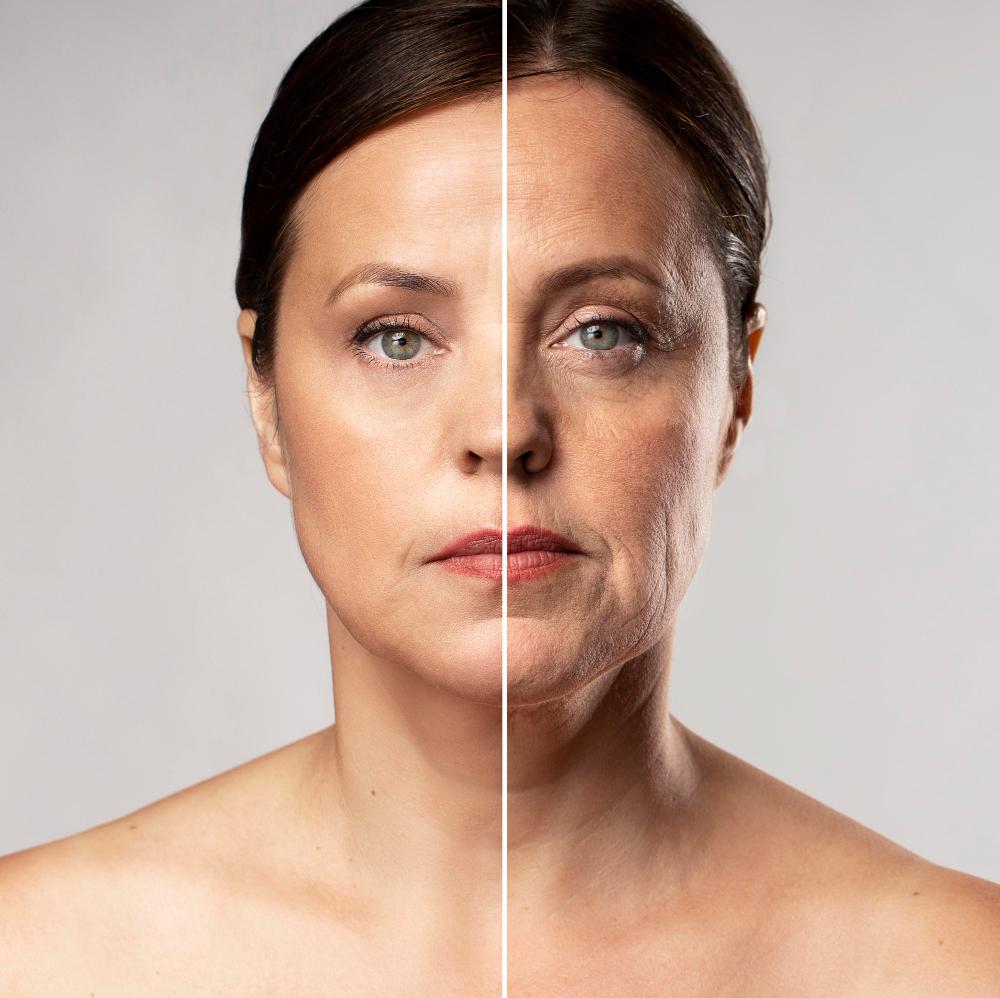
Certain skin disorders aren’t preventable, including genetic conditions and some skin problems due to other illnesses.
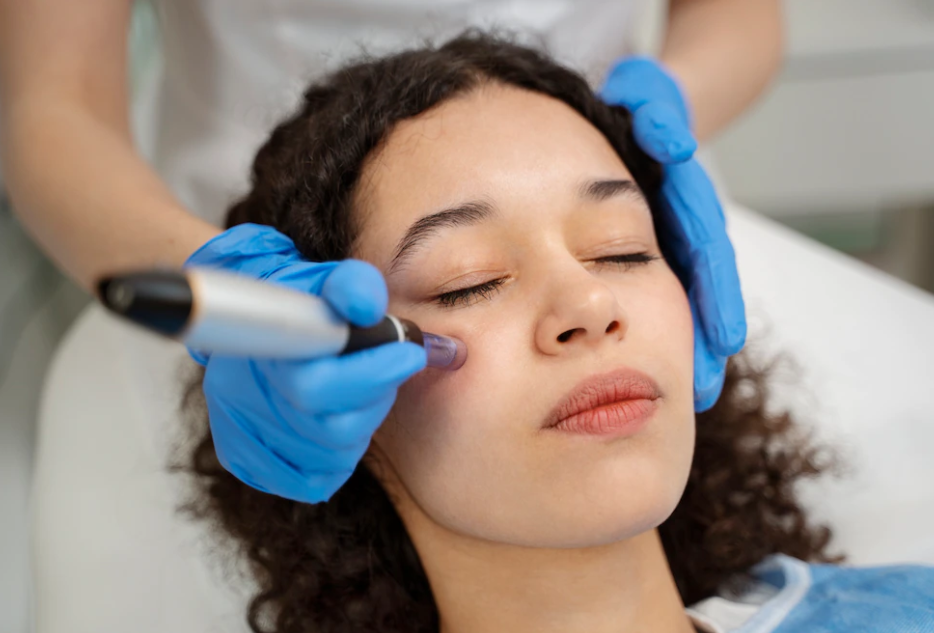
If your answer is yes, then, here are 6 easy steps to keep your skin look young and glowing.
It’s essential to note that the cost of skin pigmentation disorder treatment in Noida can differ based on the type of treatment required and the healthcare facility's resources.
In severe cases, surgery may be required to drain the blocked sinus.
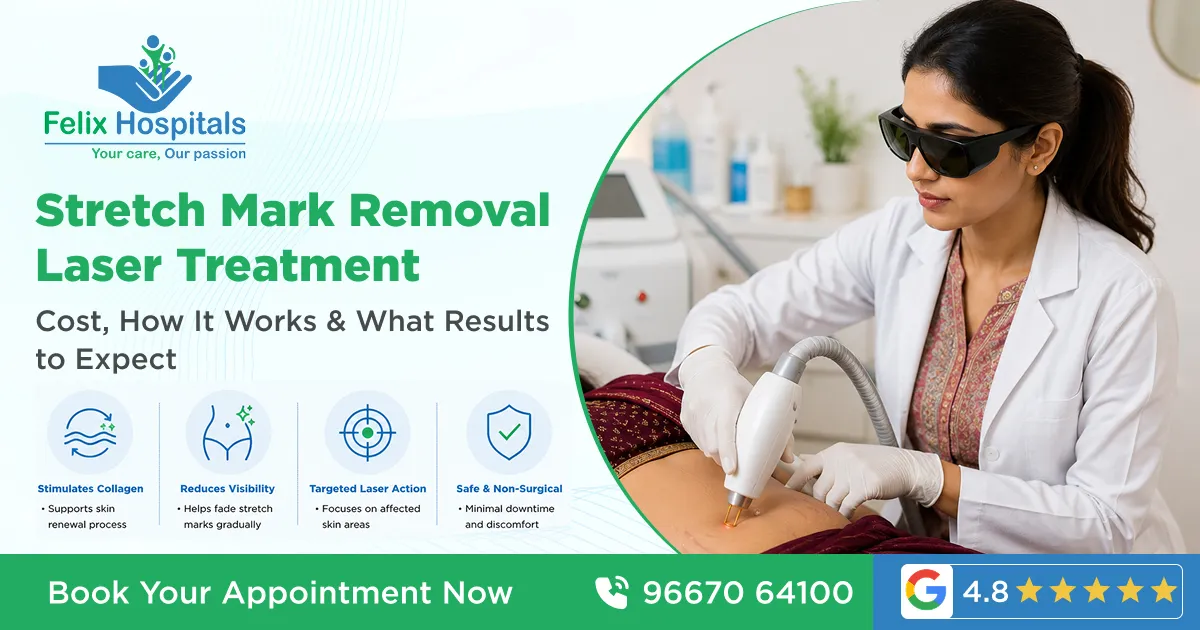
Stretch marks are one of those skin concerns that sit in an uncomfortable middle ground. They're not a medical problem. They're not dangerous. But for a lot of people, women post-pregnancy, anyone who's gone through rapid weight changes they're a genuine source of self-consciousness that doesn't respond to creams, oils, or anything else the pharmacy sells.
The internet is full of products claiming to remove stretch marks. Most of them don't. Laser treatment is different; it's the closest thing to an evidence-based solution for stretch mark reduction that currently exists. But it comes with its own set of questions that most clinic websites don't answer honestly.
How much does it actually cost? How many sessions do you need? What results are realistic? And what's the difference between the ₹3,000 package at a beauty studio and the ₹15,000 session at a dermatology clinic? This blog covers all of them.
Before getting into treatment, it helps to understand what you're treating because the biology of stretch marks directly determines which treatments work and which don't.
Stretch marks are mainly striate in clinical terminology form when skin is stretched faster than it can adapt. The dermis, the middle layer of skin responsible for structural integrity, tears internally. Collagen and elastin fibers rupture. The skin's surface remains intact but the underlying structure is damaged which is why stretch marks appear as indented, discolored streaks rather than surface-level marks.
This is also why creams don't work. A moisturizer or oil sits on the epidermis, the outermost layer. The damage is in the dermis, one layer below. No topical ingredient penetrates deeply enough to repair torn collagen fibers. Keeping skin moisturized can reduce the appearance of new stretch marks slightly and may help prevent new ones from forming, but it cannot reverse existing structural damage.
Laser treatment works because it reaches the dermis. That's the fundamental difference.
Stretch marks go through two distinct phases, and the treatment approach differs significantly between them.
Red or purple stretch marks: New stretch marks are red, pink, or purple. This coloration comes from the blood vessels visible through the damaged dermis the mark is still active, still inflamed, still changing. This phase lasts weeks to months depending on the individual.
This is the best time to treat: The tissue is still responding, collagen synthesis is active, and laser treatment at this stage produces significantly better results than the same treatment applied later. Vascular lasers that target the red colouration are particularly effective here.
White or silver stretch marks: Older stretch marks fade to white or silver as the blood vessels contract and the damaged area becomes essentially scar tissue. The skin here is atrophic thinner, with less cellular activity.
Treatment is still possible and produces real improvement, but requires more sessions and produces more modest results than treatment during the red phase.
Several laser technologies are used for stretch marks, and they work through different mechanisms. Understanding the difference helps you have a more informed conversation with your dermatologist and helps you understand why one laser isn't always better than another.
Fractional CO2 Laser The most commonly used laser for stretch mark treatment. Creates thousands of microscopic injury columns in the skin controlled damage that triggers the body's wound healing response. Collagen production increases, the dermis remodels, and the stretch marks texture and appearance improve progressively as new collagen fills in.
Fractional CO2 is particularly effective for older, white stretch marks where the tissue needs aggressive stimulation to respond. It requires downtime redness and mild swelling for three to seven days post-treatment. Results are significant but require patience. Full results are visible three to six months after a course of treatment.
Nd:YAG Laser Penetrates deeply into the dermis and stimulates collagen remodelling without the surface damage of CO2. Less downtime than fractional CO2 but also typically less dramatic results per session. Often used in combination with other lasers or for patients who can't take the downtime of CO2 treatment.
Pulsed Dye Laser (PDL) Specifically targets the vascular component of red, new stretch marks. The laser's wavelength is absorbed by haemoglobin in the blood vessels, reducing the redness significantly and triggering early collagen remodelling. Highly effective for fresh stretch marks. Less useful for mature white ones where the vascular component is gone.
Fractional Erbium Laser Similar mechanism to fractional CO2 but gentler. Less downtime, suitable for more sensitive skin types or areas. Produces good results but typically requires more sessions than CO2 to achieve equivalent improvement.
Which laser is right for you? Depends on the age of your stretch marks, their location, your skin type, and how much downtime you can manage. A dermatologist should assess all of these before recommending a laser, not a one-size approach applied to every patient.
Laser stretch mark treatment is priced per session, and the total cost depends on the area being treated, the laser type used, and the number of sessions required.
Laser Type | Price Per Session (India) |
Fractional CO2 Laser | ₹8,000 – ₹25,000 |
Nd:YAG Laser | ₹6,000 – ₹18,000 |
Pulsed Dye Laser (PDL) | ₹8,000 – ₹20,000 |
Fractional Erbium Laser | ₹7,000 – ₹20,000 |
Combination Laser Protocol | ₹12,000 – ₹35,000 |
Body Area | Approximate Cost Per Session |
Abdomen (small area) | ₹8,000 – ₹20,000 |
Abdomen (full / post-pregnancy) | ₹15,000 – ₹40,000 |
Thighs (one side) | ₹8,000 – ₹18,000 |
Thighs (both sides) | ₹14,000 – ₹32,000 |
Hips / buttocks | ₹10,000 – ₹25,000 |
Arms / underarms | ₹6,000 – ₹15,000 |
Breasts | ₹8,000 – ₹20,000 |
Lower back | ₹8,000 – ₹18,000 |
Most dermatologists recommend three to six sessions for meaningful results. Clinics offering packages price these at 15 to 25 percent less than individual session rates.
Sessions | Approximate Package Cost |
3 sessions (small area) | ₹18,000 – ₹45,000 |
3 sessions (large area) | ₹30,000 – ₹80,000 |
6 sessions (small area) | ₹30,000 – ₹80,000 |
6 sessions (large area) | ₹55,000 – ₹1,50,000 |
Area | Approximate Cost Per Session |
Noida / Greater Noida | ₹8,000 – ₹25,000 |
South Delhi (Saket, GK, Vasant Kunj) | ₹15,000 – ₹50,000 |
West / North Delhi | ₹7,000 – ₹22,000 |
Gurgaon | ₹12,000 – ₹40,000 |
Ghaziabad | ₹6,000 – ₹18,000 |
Faridabad | ₹6,000 – ₹20,000 |
South Delhi and Gurgaon premiums reflect location overhead and, at the better clinics, more experienced laser operators. The laser technology itself can be identical across price points the operator's skill and the clinical protocol determine the outcome more than postcode.
At Felix Hospital, Sector 137, Noida, laser stretch mark treatment is performed under dermatologist supervision with clinical-grade equipment at transparent pricing. Call +91 9667064100 for current session rates and package pricing.
Area size The single biggest variable. A small cluster of stretch marks on the upper arm costs a fraction of a full abdominal treatment post-pregnancy. Larger areas require more laser passes, more time, and more energy delivery all of which affect price.
The number of sessions needed Old white stretch marks require more sessions than fresh red ones. Deep, wide marks require more sessions than fine, superficial ones. A realistic session count is established at the consultation and any dermatologist who gives you a precise number before seeing the area in person is guessing.
Laser type and combination protocols A single Nd: YAG session costs less than a fractional CO2 session. A combination protocol using two laser types in the same session costs more than either alone but often produces better results in fewer total sessions. Total cost depends on which approach your skin and marks actually need.
Dermatologist expertise and clinic setting A hospital-based dermatology department with a qualified laser specialist charges differently from a beauty clinic with a laser machine and a technician. The gap in outcome can be significant. Laser treatment for stretch marks requires precise energy settings calibrated to your skin type; incorrect settings cause burns, hyperpigmentation, or insufficient results.
How many sessions you need actually depends on the marks
Fresh red stretch marks: Two to four sessions of pulsed dye laser or fractional treatment typically produces significant improvement 50 to 70 percent reduction in redness and texture improvement.
Old white stretch marks: Three to six sessions of fractional CO2 or combination protocol is the clinical standard for meaningful improvement. Expecting dramatic change from a single session is unrealistic and any clinic promising it is over-selling.
Large areas post-pregnancy: Six or more sessions may be needed for comprehensive treatment of extensive abdominal stretch marks. Results are real and often significant, but this is a course of treatment, not a single procedure.
Sessions are typically spaced four to six weeks apart to allow tissue healing and collagen remodelling between treatments.
Laser treatment for stretch marks produces real, documented improvement. In clinical studies, fractional CO2 laser consistently shows 50 to 75 percent improvement in stretch mark appearance after a course of treatment. Texture smooths out, depth reduces, colour normalises. Most patients are genuinely satisfied with the outcome.
What laser treatment does not do is erase stretch marks completely. The skin's structure has been fundamentally altered; the goal of treatment is significant reduction, not elimination. If a clinic is promising complete removal, they're telling you what you want to hear, not what the evidence supports.
After treatment, most patients describe the marks as significantly less noticeable, reduced in depth, smoother in texture, closer to surrounding skin tone. They're still there on very close inspection. From normal social distance, most are not visible.
Results continue improving for three to six months after the final session as collagen remodelling continues. The improvement is lasting unlike topical treatments that lose effect when you stop using them, laser-stimulated collagen remodelling is structural and durable.
Before treatment: Avoid sun exposure to the treatment area for two weeks prior. Stop retinoids or any prescription topical on the area one week before. Stay well hydrated. Inform your dermatologist of any medications, skin conditions, or recent procedures. Avoid waxing or chemical hair removal on the area in the week before.
After treatment: Expect redness and mild swelling for two to seven days depending on laser type and intensity. Keep the area moisturised with a gentle, fragrance-free product. Avoid sun exposure completely for two weeks and use SPF 50 on the area if it will be exposed to sun. Avoid hot showers, saunas, and intense exercise for 48 hours post-treatment. Do not pick or scratch the treated area.
The post-care period is where results are made or lost. Laser creates controlled injury and how the skin heals determines the final outcome.
This is a question that deserves a direct answer because South Asian skin has specific considerations with laser treatment.
Indian skin typically falls in Fitzpatrick types III to V. Darker skin has more melanin, which means lasers targeting the skin's deeper layers can also inadvertently heat melanin in the epidermis causing post-inflammatory hyperpigmentation (PIH) if parameters aren't adjusted correctly.
In the hands of an experienced laser dermatologist who regularly treats Indian skin, this risk is well managed. Lower fluence settings, appropriate cooling, test patches before full treatment, and correct wavelength selection for the skin type make laser treatment safe and effective for most Indian patients.
In the hands of someone without this specific experience, PIH is a real risk and it can be more cosmetically troubling than the original stretch marks.
This is one of the strongest arguments for choosing a hospital-based dermatology department with demonstrated experience treating South Asian skin over a generic laser clinic or beauty studio offering discounted sessions.
Treatment | Effectiveness | Downtime | Cost | Suitable for Old Marks |
Topical creams / oils | Minimal | None | Low | No |
Microneedling | Moderate | 2–3 days | ₹5,000 – ₹15,000/session | Yes |
Chemical peels | Mild to moderate | 3–5 days | ₹3,000 – ₹10,000/session | Partially |
Fractional CO2 Laser | High | 3–7 days | ₹8,000 – ₹25,000/session | Yes |
PRP (Platelet Rich Plasma) | Moderate | Minimal | ₹8,000 – ₹20,000/session | Yes |
Combination (laser + PRP) | Very high | 3–7 days | ₹15,000 – ₹40,000/session | Yes |
Surgery (tummy tuck) | High (removes skin) | Weeks | ₹80,000 – ₹3,00,000 | Yes |
Microneedling is worth noting as an alternative or complement to laser; it uses fine needles to create controlled micro-injuries that stimulate collagen, reaching the dermis without laser energy. It's gentler on darker skin types and costs less per session. Results are more modest than fractional CO2 but the risk profile is lower. Many dermatologists use microneedling and laser in alternating sessions for comprehensive treatment.
(PRP) platelet rich plasma involves drawing a small amount of the patient's blood, processing it to concentrate growth factors, and injecting or applying it to the treatment area. Combined with a laser, it accelerates healing and enhances collagen response. Increasingly used as part of combination protocols for difficult or extensive stretch marks.
Most adults with stretch marks are suitable candidates, with the best outcomes in:
Patients with fresh red stretch marks the earlier treatment starts, the better the result. Patients with localised stretch marks on a specific area rather than extensive body coverage. Patients with realistic expectations about significant reduction rather than complete removal. Patients who can commit to the full recommended course of sessions and the post-care protocol.
Treatment may need to be modified or postponed for patients who are pregnant or breastfeeding, have active skin infections or inflammatory conditions in the treatment area, have a history of keloid scarring, are on photosensitising medications, or have had recent significant sun exposure to the area.
Laser treatment is the most effective non-surgical option currently available for stretch mark reduction. The evidence is consistent, the results are real, and for patients who go through a proper course of treatment with appropriate post-care, the improvement is meaningful and lasting.
The price variation across Delhi NCR reflects genuine differences in laser technology, operator experience, clinical protocols, and the ability to safely manage Indian skin types. The ₹3,000 session and the ₹20,000 session are not the same treatment wearing the same name.
At Felix Hospital, Sector 137, Noida, laser stretch mark treatment is performed under dermatologist supervision using clinical-grade technology with protocols specifically calibrated for South Asian skin. Every patient starts with a consultation that assesses the marks, determines the right laser approach, and gives a realistic, honest picture of what results to expect and how many sessions to plan for.
Call +91 9667064100 to book a consultation
Dr. Tarun Gupta is an experienced Dermatologist with 17+ years of expertise in treating skin, hair, and nail conditions, along with advanced cosmetic dermatology procedures.
Certain skin disorders aren’t preventable, including genetic conditions and some skin problems due to other illnesses.
If your answer is yes, then, here are 6 easy steps to keep your skin look young and glowing.

"Skin whitening" is largely a marketing term. What people actually want and what's genuinely achievable at home is brighter, clearer, more even-toned skin that looks healthy and alive. The difference matters because chasing "whiteness" sets you up for disappointment and, in some cases, real harm. Chasing glow, clarity, and evenness? That's entirely doable, including with ingredients sitting in your kitchen right now.
This blog covers both the home remedies that genuinely work for improving skin radiance and tone, and the honest context around what they can and can't do. Because the internet is full of "7 days glowing skin challenge" content that sets unrealistic expectations, and you deserve better than that.
Before getting into remedies, it helps to understand what you're actually treating. Dull, uneven, lacklustre skin usually comes from one or more of these:
Dead skin cell buildup: Skin renews itself every 28 to 40 days. When dead cells accumulate on the surface faster than they shed which happens more in dry climates, during winter, or with age the skin looks flat and grey.
Dehydration: Not dryness dehydration. Dry skin lacks oil. Dehydrated skin lacks water. You can have oily, dehydrated skin. When skin cells are water-depleted, they reflect light poorly and look dull regardless of how much moisturiser you apply on top.
Hyperpigmentation and uneven tone: Sun exposure, hormonal changes, post-acne marks, and inflammation all trigger melanin production unevenly. The result is patches, spots, and an overall uneven tone that reads as dullness even when individual skin texture is fine.
Pollution and oxidative stress: In cities like Noida and Delhi, this is significant. Particulate matter from air pollution deposits on skin, clogs pores, generates free radicals, and accelerates the breakdown of collagen all of which affect how skin looks day to day.
Poor circulation: Skin colour and glow are partly determined by blood flow. Lack of sleep, stress, and sedentary habits all reduce circulation to the face visibly.
Home remedies address some of these. Others require clinical treatment. Knowing which is which saves you time, money, and skin.
Turmeric has been used in Indian skincare for centuries, and modern dermatology has caught up with why. Curcumin, the active compound in turmeric, has documented anti-inflammatory and mild skin-brightening properties. It inhibits tyrosinase, the enzyme involved in melanin production. Raw turmeric contains higher curcumin concentration than the processed powder.
Honey is a humectant that draws moisture into the skin and has antimicrobial properties that make it useful for acne-prone skin.
How to use: Mix a small amount of raw turmeric paste with one teaspoon of raw honey. Apply to clean skin, leave for 15 minutes, and rinse thoroughly. Use two to three times a week.
What to expect: Reduced redness, more even tone over four to six weeks of consistent use. Not an overnight result, a gradual one.
Caution: Turmeric stains. Use an old towel. And yes, your skin may look slightly yellow immediately after this washes off.
Besan is one of the most underrated skincare ingredients available. It gently exfoliates dead skin cells mechanically while absorbing excess oil which is why it's been a staple of Indian skincare traditions long before "double cleansing" became a trend. Rose water has mild astringent properties and soothes inflammation.
Together they address two of the main causes of dullness: dead cell buildup and excess sebum without stripping the skin.
How to use: Mix two tablespoons of besan with enough rose water to form a paste. Add a pinch of turmeric if you like. Apply to face, let it dry slightly, then rub off gently with wet fingers in circular motions. Rinse. Use once or twice a week.
What to expect: Noticeably smoother texture within two weeks. Improved glow over four to six weeks as dead cell buildup consistently clears.
The difference between fresh aloe vera and packaged aloe vera gel is significant. Fresh gel from a leaf contains aloesin a compound with documented tyrosinase-inhibiting activity alongside mucopolysaccharides that hydrate the skin deeply. Most packaged gels have these compounds degraded or removed through processing and preservatives.
If you have an aloe plant at home, this is genuinely one of the most effective single-ingredient skin treatments available. If you don't, it's worth getting one.
How to use: Cut a leaf, squeeze out the clear gel, apply directly to clean skin. Leave for 20 to 30 minutes or overnight as a sleeping mask. Use daily if your skin tolerates it.
What to expect: Improved hydration and reduced redness within days. Gradual improvement in pigmentation and tone over four to eight weeks.
This sounds unusual enough that people skip it. They shouldn't. Raw potato contains catecholase, an enzyme that has skin-lightening properties and is particularly effective on dark circles, sun spots, and post-inflammatory hyperpigmentation.
It won't dramatically lighten your overall skin tone. Nothing applied topically will do that significantly but for targeted dark patches, it's genuinely more effective than most people expect.
How to use: Grate a raw potato and squeeze out the juice. Apply with a cotton pad to affected areas. Leave for 15 to 20 minutes, rinse. Daily use is fine.
What to expect: Gradual lightening of dark spots and patches over four to eight weeks. More effective on fresh marks than old, established ones.
Milk contains lactic acid, a natural alpha hydroxy acid that exfoliates gently and improves skin texture and tone over time. It also has moisturising properties from its fat and protein content. Saffron contains crocin and safranal, compounds with documented skin-brightening and antioxidant activity.
This combination has been in Indian skincare traditions for generations and the chemistry behind it holds up.
How to use: Soak a few saffron strands in two tablespoons of raw milk for 30 minutes. Apply to face with a cotton pad, leave for 20 minutes, rinse with cool water. Use three to four times a week.
What to expect: Improved hydration and mild brightening effect within two to three weeks. Cumulative improvement in skin tone with consistent use.
Sandalwood chandan has been documented in Ayurvedic texts and increasingly in modern research for its anti-inflammatory, antimicrobial, and mild skin-brightening properties. It contains alpha-santalol, which inhibits melanin synthesis and reduces hyperpigmentation over time.
Real sandalwood powder is what you want here, not synthetic fragrance products sold as sandalwood. The cost is higher but the active compounds are entirely different.
How to use: Mix sandalwood powder with rose water or raw milk to form a paste. Apply to clean skin, leave until dry, rinse. Use two to three times a week.
What to expect: Reduced oiliness and congestion quickly. Improvement in tone and brightness over four to six weeks.
This costs nothing and works immediately. Rubbing ice wrapped in a thin cloth across the face in the morning reduces puffiness, tightens pores temporarily, stimulates circulation, and gives an immediate glow that lasts several hours. It's a genuine technique used by makeup artists before events and by dermatologists recommending morning skincare prep.
It doesn't fix pigmentation or texture long-term. But for daily radiance and a fresh appearance, it's the fastest result available from any home remedy.
How to use: Wrap two or three ice cubes in a clean muslin cloth. Glide across the face for two to three minutes, paying attention to under-eye area, cheekbones, and jawline. Do this before your morning routine.
What to expect: Immediate visible glow and reduced puffiness within minutes. Pores appear smaller temporarily. Makeup applies more smoothly after.
Green tea contains epigallocatechin gallate EGCG, one of the most potent topical antioxidants available from a natural source. Applied to skin, it neutralises free radicals from pollution and UV exposure, reduces inflammation, and over time helps prevent the oxidative damage that accelerates dullness and uneven tone.
For those living in high-pollution areas like Noida and Delhi, the antioxidant protection from green tea is more relevant than it would be elsewhere.
How to use: Brew strong green tea, allow to cool completely, pour into a clean spray bottle or apply with a cotton pad after cleansing. Leave on, don't rinse. Use morning and evening.
What to expect: Reduced redness and irritation within days. Gradual improvement in skin clarity and tone over four to six weeks.
Search this phrase and you'll find before-and-after photos suggesting dramatic transformation in a week. Here's what's actually achievable in seven days with consistent home care and what isn't.
What can change in 7 days: Improved hydration visible within 48 to 72 hours of consistent moisturizing and increased water intake. Reduced puffiness and dullness from ice facials and green tea. Clearer surface texture from one or two exfoliation sessions with besan. Reduced inflammation and redness from aloe vera and turmeric.
What cannot change in 7 days: Established hyperpigmentation. Melasma. Deep acne scars. Significant uneven tone from sun damage. These are weeks-to-months corrections at best and some require clinical treatment.
A realistic seven-day plan:
Day 1–2: Ice facial every morning, green tea toner twice daily, aloe vera overnight mask.
Day 3: Besan and rose water scrub, followed by saffron milk treatment.
Day 4–5: Turmeric and honey mask, green tea toner, aloe vera overnight.
Day 6: Potato juice on dark spots, sandalwood mask.
Day 7: Full routine ice facial in the morning, besan scrub, aloe vera overnight.
Saffron milk, potato juice, and turmeric honey mask used consistently over four to six weeks. Combined with daily SPF.
Besan scrub twice weekly, aloe vera overnight mask, ice facial daily, green tea toner.
Potato juice daily on affected areas, sandalwood paste three times weekly, vitamin C from topical sources like tomato or amla which can be added to any of the base preparations above.
Besan is your primary tool. Multani mitti (fuller's earth) mixed with rose water is also highly effective for absorbing sebum and deep-cleaning pores without stripping.
Raw milk and saffron, honey as a standalone mask, aloe vera. Focus on hydration before attempting any brightening dehydrated skin won't respond well to brightening treatments until the moisture barrier is restored.
Some skin concerns respond genuinely well to consistent home care. Others have an underlying cause that no kitchen ingredient addresses. Knowing the difference saves months of ineffective effort.
See a dermatologist if you have:
Melasma the butterfly pattern of pigmentation across the cheeks and forehead that's driven by hormonal changes. Home remedies slow it. They don't treat it. Clinical options including topical prescription agents, chemical peels, and laser therapy produce significantly better results.
Persistent acne leading to marks won't clear faster than the active acne keeps producing them. The acne needs to be treated first.
Pigmentation that hasn't improved after eight to twelve weeks of consistent home care. At that point you're dealing with something that sits deeper in the skin than topical home remedies reach.
Sudden changes in skin tone or texture. These warrant a clinical assessment to rule out underlying conditions before beginning any treatment.
For a dermatologist consultation, call +91 9667064100.
These aren't glamorous. They're also more impactful on skin appearance than any mask or scrub:
Water intake: Dehydrated skin looks dull regardless of what you put on it. Two to three litres daily is a baseline.
Sleep: Skin repair and collagen synthesis happen predominantly during sleep. Chronic sleep deprivation is visible on the face within days pale, dull, puffy. Eight hours is not a beauty myth.
Sun protection: Every brightening effort home remedy or clinical is partially or fully reversed by consistent unprotected sun exposure. SPF 30 minimum, daily, regardless of whether you're going outside or sitting near a window. UV penetrates glass.
Diet: Antioxidant-rich foods tomatoes, amla, citrus, leafy greens, nuts support skin health from within in ways that topical application can't fully replicate. Processed foods high in refined sugar accelerate glycation, which visibly dulls and yellows skin over time.
Stress management: Cortisol from chronic stress triggers inflammation, increases oil production, impairs skin barrier function, and accelerates aging. Not a skincare problem solvable with a face mask.
The internet also surfaces home remedy suggestions that cause more damage than benefit. Worth knowing what to leave in the kitchen:
Lemon juice directly on skin: Citric acid at that concentration causes photosensitivity and can cause chemical burns in sunlight. The brightening effect is real but the damage risk is higher than the benefit.
Baking soda: Highly alkaline, disrupts skin's natural pH, damages the acid mantle. Causes irritation and worsens sensitive and acne-prone skin despite its persistent recommendation online.
Toothpaste on pimples: Causes contact dermatitis. Ineffective.
Undiluted essential oils: Potent irritants at undiluted concentration. Always require a carrier oil and patch testing.
Apple cider vinegar: Too acidic for most skin types at any practical concentration. Causes irritation and barrier disruption.
Homemade remedies for glowing skin work within their limits. Besan exfoliates, turmeric brightens, aloe vera hydrates, green tea protects. Consistent use of the right ingredients for your skin type produces real, visible improvement over four to eight weeks.
What they don't do is reverse significant pigmentation, treat hormonal melasma, or address active acne producing ongoing marks. For those concerned, the gap between home care and clinical treatment is meaningful and bridging it is not about abandoning natural skincare, it's about using the right tool for the actual problem.
At Felix Hospital's dermatology department our team works with patients across the full spectrum from basic skincare guidance and home routine optimisation to prescription treatments and clinical procedures for concerns that need more than a kitchen remedy. Whatever your skin is dealing with, the consultation starts with an honest assessment of what it actually needs.
Call +91 9667064100 to book a dermatologist consultation
Dr. Tarun Gupta is an experienced Dermatologist with 17+ years of expertise in treating skin, hair, and nail conditions, along with advanced cosmetic dermatology procedures.
Certain skin disorders aren’t preventable, including genetic conditions and some skin problems due to other illnesses.
If your answer is yes, then, here are 6 easy steps to keep your skin look young and glowing.
It’s essential to note that the cost of skin pigmentation disorder treatment in Noida can differ based on the type of treatment required and the healthcare facility's resources.
In severe cases, surgery may be required to drain the blocked sinus.
If you search for "lip filler cost in Delhi NCR," you’ll see numbers ranging from ₹3,000 to ₹45,000. It’s frustrating. No one explains why there is a 10x price difference, and clinics rarely tell you what’s actually in the syringe.
At Felix Hospital’s we have seen many patients who went for the ₹3,000 "budget" package and ended up with lumps, migration, or worse. The truth is that while lip fillers are common, they are a medical procedure, not a salon service.
This blog breaks down what you’re actually paying for, the city-wide price differences, and the safety risks that most Instagram ads ignore.
Lip fillers are injectable treatments that add volume, shape, or definition to the lips using hyaluronic acid, a substance that occurs naturally in the body and has a strong safety record in aesthetic medicine. The filler is injected in small, precise amounts into specific lip structures depending on what's being addressed: overall volume, border definition, cupid's bow shape, vertical lip lines, or the ratio between upper and lower lip.
Hyaluronic acid attracts and holds water, which is what creates the fullness. It also integrates with surrounding tissue rather than sitting as a foreign body, which is why well-placed filler looks and feels natural rather than artificial.
The procedure takes 30 to 45 minutes. Results are immediate. There's minimal downtime, some swelling and bruising for two to five days, then the final result settles over two weeks.
A topical numbing cream is applied first and left for 15 to 20 minutes. Most quality fillers also contain lidocaine, an anaesthetic, mixed into the product itself which significantly reduces discomfort during injection.
The injector then uses a fine needle or cannula to place small amounts of filler at specific points in the lip. The technique where exactly the filler goes, how deep, in what quantity determines the entire result. This is not a procedure where product alone determines outcome. Two injectors using the same 1ml syringe of the same filler can produce completely different results based on technique alone.
After injection, the injector gently moulds the filler into position. The lips will look slightly overfilled immediately after due to swelling. This is normal and settles within a week. The final result is visible at around day 14.
Lip filler in India is almost always priced per syringe or per ml of product, not per session as a flat fee. Understanding this is important before you compare any two quotes.
Filler Brand | Price Per ml / Syringe (India) |
Juvederm (Allergan) | ₹18,000 – ₹35,000 |
Restylane (Galderma) | ₹15,000 – ₹28,000 |
Belotero (Merz) | ₹14,000 – ₹25,000 |
Teosyal | ₹12,000 – ₹22,000 |
Generic / unbranded HA fillers | ₹3,000 – ₹8,000 |
That last row is where most of the alarming prices come from. Generic hyaluronic acid fillers exist, they are dramatically cheaper, and they are not the same product as Juvederm or Restylane in terms of manufacturing standards, particle size, cross-linking technology, longevity, or safety profile.
A clinic offering lip fillers for ₹3,000 to ₹5,000 is almost certainly using unbranded or grey-market products. This is not a value option. It is a different product with a different risk profile.
Area | Approximate Cost Per Session |
Noida / Greater Noida | ₹12,000 – ₹28,000 |
South Delhi (Saket, GK, Vasant Kunj) | ₹20,000 – ₹45,000 |
West / North Delhi | ₹10,000 – ₹22,000 |
Gurgaon | ₹15,000 – ₹40,000 |
Ghaziabad | ₹8,000 – ₹18,000 |
Faridabad | ₹8,000 – ₹20,000 |
These figures assume a standard 1ml session with a reputable branded filler administered by a qualified dermatologist. South Delhi and Gurgaon premiums reflect both location and, in genuinely good clinics, more experienced injectors with premium products.
This is the most significant cost driver. Juvederm Volbella and Restylane Kysse both specifically formulated for lip tissue cost significantly more than generic hyaluronic acid products. The difference isn't just branding. It's particle size, cross-linking density, longevity, how naturally the product integrates with lip tissue, and the clinical safety data behind it.
Branded fillers have years of post-market safety surveillance. Generic alternatives often don't. For a procedure that involves injecting product into highly vascular, mobile tissue, the product's provenance matters in ways that are easy to dismiss until something goes wrong.
Most first-time patients start with 0.5ml to 1ml. Patients wanting more significant volume may require 1.5ml to 2ml. Since pricing is per ml, this directly affects total cost. An injector recommending more than 1ml for a first treatment should explain why and if the reasoning is about your aesthetic goals rather than their revenue, that's a good sign.
A dermatologist with formal training in facial anatomy and injectable techniques is not the same as a beauty therapist who has completed a weekend filler course. The lips are highly vascular; the labial arteries run through them and vascular complications from filler, while rare, are serious and require immediate clinical management. This is not a procedure where the injector's qualification is a bureaucratic detail.
A hospital-based dermatology department maintains sterile injection protocols, cold storage for products, and the clinical infrastructure to manage complications. A beauty studio or home-service provider does not.
The consultation before lip filler is where your lip anatomy is assessed, your expectations are discussed, and contraindications are screened. It's also where an honest injector tells you if what you're asking for isn't achievable or isn't right for your face. If a clinic is booking you straight into treatment with no prior assessment, that's a problem regardless of the price.
This is the question patients most often ask, and the answer depends on what you're trying to achieve.
0.5ml suits patients who want very subtle enhancement, a small amount of definition, a slight increase in volume, or a lip flip effect with filler. Good for first-timers who are unsure how they'll respond or what they want.
1ml is the standard starting point for most patients. Produces visible but natural-looking results. Enough to add meaningful volume, define the border, and address the cupid's bow without looking overdone.
1.5ml – 2ml for patients wanting more significant volume or those who've had filler before and want to build on an existing result. Requires more experience from the injector to avoid an unnatural appearance.
Goal | Typical Filler Required | Approximate Cost (Noida) |
Subtle definition only | 0.5ml | ₹8,000 – ₹15,000 |
Standard volume + shape | 1ml | ₹14,000 – ₹28,000 |
Significant volume increase | 1.5ml – 2ml | ₹22,000 – ₹50,000 |
Lip line correction (smoker's lines) | 0.5ml – 1ml | ₹10,000 – ₹25,000 |
Asymmetry correction | 0.5ml – 1ml | ₹10,000 – ₹25,000 |
Immediately after treatment, the lips will look swollen more than the intended final result. This is normal and settles over five to seven days. Bruising is common and fades within a week. The final result is visible at around day 14.
Done well, lip filler looks like your lips, but better fuller, more defined, more symmetrical. Done poorly or overdone, it looks exactly like what people imagine when they think of "bad lip filler." The overfilled, shelf-like appearance that became a cultural reference point is the result of too much product placed incorrectly, not an inevitable outcome of the procedure.
Results from a standard 1ml session with quality filler last six to twelve months depending on product brand, your metabolism, and how active your lip movement is.
Patients sometimes ask whether over-the-counter alternatives are worth trying before committing to filler.
Topical lip plumpers work by causing mild irritation or using hyaluronic acid on the surface; the effect is temporary, minimal, and entirely superficial. They're fine for a night out. They don't compare to injectable filler in terms of result or duration.
Lip liner overdrawing is a makeup technique, not a treatment. It creates an illusion of a larger lip but doesn't change the lip itself.
Lip filler is the only non-surgical option that actually changes the lip's volume and shape in a lasting way. The comparison is more useful as a frame for what you're trying to achieve if you want something subtle for an occasion, a plumper might do. If you want a result that's visible without makeup and lasts the better part of a year, filler is a different category of solution.
Lip filler is broadly safe for most adults, but there are genuine contraindications and situations requiring caution:
Pregnancy and breastfeeding avoid: Active cold sore or herpes labialis outbreak postpone treatment and inform your dermatologist, as the procedure can trigger a flare. Active skin infection at or near the injection site waits until resolved. Blood-thinning medications aspirin, warfarin, certain supplements including fish oil and vitamin E increase bruising risk significantly. Autoimmune conditions affecting skin or connective tissue requires dermatologist assessment. Known allergy to lidocaine or hyaluronic acid is rare but relevant.
Patients with a history of severe allergic reactions or anaphylaxis should have an extended consultation before any injectable procedure.
This is the conversation most clinics skip because it's uncomfortable. Vascular occlusion where filler inadvertently enters or compresses a blood vessel is the most serious complication associated with lip filler. It is rare. It is also a medical emergency when it occurs.
Symptoms include severe pain immediately after injection, white blanching of the skin, and rapid tissue changes. Treated promptly with hyaluronidase, an enzyme that dissolves hyaluronic acid filler, it resolves without permanent damage. Treated late or not at all, it can cause tissue necrosis.
This is why the injector's qualification and the clinical setting are not optional considerations. A dermatologist in a hospital setting recognizes this complication immediately and has hyaluronidase on hand.
Yes, which is one of its advantages over permanent fillers. Hyaluronidase dissolves hyaluronic acid filler quickly and effectively. Patients who are unhappy with their result, who want to start fresh, or who have developed a complication can have the filler reversed.
Dissolution typically takes one to two sessions. The lips return to their pre-filler state within a few days. Some patients dissolve existing filler before starting again with a different technique or a different injector.
The dissolvability of HA filler is a genuine safety advantage; it means a poor result is not permanent. This is not true of all filler types, which is another reason hyaluronic acid remains the standard recommendation.
Confirm the doctor’s qualification.
Lip filler should be administered by a dermatologist, plastic surgeon, or trained cosmetic physician not an aesthetician or beauty therapist. Ask directly. Don't assume from the clinic's appearance.
Ask which brand of filler is being used.
Juvederm, Restylane, Belotero, Teosyal all are legitimate options. Ask to see the packaging. Any hesitation or evasion here is meaningful.
Get a unit count and brand confirmation before agreeing.
You should know exactly how many ml of which product is being used and the per-ml cost before treatment starts.
Ask whether hyaluronidase is stocked on-site.
A clinic that stocks dissolution enzymes is a clinic prepared for complications. One that doesn't is not.
Expect a consultation before treatment.
Lip anatomy assessment, expectation discussion, medical history review these happen before the needle comes out.
Not during or after.
Be suspicious of very low prices.
Below ₹8,000 for a lip filler session in Delhi NCR almost certainly means unbranded product, unqualified injector, or both. The product alone costs more than this at wholesale for reputable brands.
Lip filler done well is one of the more consistently satisfying cosmetic procedures available with immediate results, reversible if needed, and when done by someone who understands lip anatomy, genuinely natural-looking.
The price range you see across Delhi NCR reflects real differences in product quality, injector qualification, and clinical standards. The gap between ₹3,000 and ₹25,000 for "the same procedure" is not a gap between expensive and affordable. It's a gap between different procedures wearing the same name.
At Felix Hospital, Sector 137, Noida, lip filler is administered by our dermatologist using authenticated branded products with a proper pre-treatment consultation, transparent pricing, and clinical infrastructure that includes dissolution capability on-site. Whether you're considering lip filler for the first time or looking for a more reliable experience than you've had elsewhere, we'll give you an honest assessment of what's achievable and what's right for your face.
Call +91 9667064100 to book a consultation
Dr. Tarun Gupta is an experienced Dermatologist with 17+ years of expertise in treating skin, hair, and nail conditions, along with advanced cosmetic dermatology procedures.
Certain skin disorders aren’t preventable, including genetic conditions and some skin problems due to other illnesses.
If your answer is yes, then, here are 6 easy steps to keep your skin look young and glowing.
It’s essential to note that the cost of skin pigmentation disorder treatment in Noida can differ based on the type of treatment required and the healthcare facility's resources.
In severe cases, surgery may be required to drain the blocked sinus.
One clinic says ₹600 per unit. Another says ₹2,000. Someone’s offering “full face Botox” cheaper than a weekend brunch, while another clinic quotes a number that makes you close the tab immediately. And after twenty minutes of searching, most people still don’t know what Botox should actually cost, what’s normal, what’s suspiciously cheap, or whether they’re about to overpay for the exact same thing.
At Felix Hospital we’ve had this conversation with hundreds of patients. Some come in after a bad experience at a discount clinic. Some are scared they’ll look unnatural. Some just want to know why the pricing is all over the place and whether cheaper Botox is actually safe.
So instead of vague numbers and confusing package deals, here's what you need to know about Botox costs in Delhi NCR, why prices vary so much, and what you should actually pay attention to before getting it done.
Botox is the brand name for botulinum toxin type A a purified protein that temporarily relaxes the muscles responsible for expression lines. When injected in small, precise amounts into targeted facial muscles, it reduces the repeated contractions that create wrinkles over time.
It does not freeze your face. It does not fill anything. It does not change your bone structure. What it does when done correctly, by someone who understands facial anatomy is soften the lines that form when you frown, squint, raise your eyebrows, or smile. The face still moves. It just moves with less visible wear.
This distinction matters because a lot of the fear around Botox comes from badly done work, overfilled foreheads, dropped brows, the expressionless look that became shorthand for "too much Botox." That's not what correctly administered botox looks like. That's what happens when someone injects too much, or in the wrong places, or both.
Botox works by blocking the nerve signal that tells a muscle to contract. The injection itself takes minutes. The effect sets in gradually over three to seven days and reaches its peak around two weeks after treatment.
The muscles relax. The skin above them smooths out. Lines that were carved in by years of repeated movement become noticeably softer and in some cases, with consistent treatment over time, they fade significantly even when the botox wears off.
The effect lasts three to six months, depending on the area treated, the dose used, and individual factors like metabolism and muscle strength. After that, the muscle activity gradually returns and the lines come back which is why most people who see good results continue with maintenance sessions.
Botox in India is priced in two ways per unit or per area. Understanding this is essential before you compare any two clinics.
Per unit pricing means you pay for exactly how much product is used. This is the more transparent model.
Per area pricing means you pay a flat fee for a treated zone forehead, frown lines, crow's feet regardless of how many units are used. This can work in your favor or against you depending on how much product actually goes in.
Botox Brand | Price Per Unit (India) |
Botox (Allergan) | ₹350 – ₹600 per unit |
Dysport | ₹150 – ₹300 per unit |
Xeomin | ₹300 – ₹500 per unit |
Nuceiva | ₹350 – ₹550 per unit |
Allergan's Botox remains the most widely used and clinically documented brand. Dysport requires more units to achieve the same effect; it's not cheaper just because the per-unit price is lower.
Treatment Area | Approximate Units Needed | Approx. Cost (Allergan Botox) |
Forehead lines | 10 – 20 units | ₹3,500 – ₹12,000 |
Frown lines (glabella) | 15 – 25 units | ₹5,250 – ₹15,000 |
Crow's feet (both sides) | 10 – 24 units | ₹3,500 – ₹14,400 |
Brow lift | 4 – 8 units | ₹1,400 – ₹4,800 |
Bunny lines (nose) | 4 – 8 units | ₹1,400 – ₹4,800 |
Lip flip | 4 – 6 units | ₹1,400 – ₹3,600 |
Jawline slimming (masseter) | 40 – 60 units | ₹14,000 – ₹36,000 |
Neck bands (platysma) | 25 – 50 units | ₹8,750 – ₹30,000 |
Hyperhidrosis (underarms) | 50 – 100 units | ₹17,500 – ₹60,000 |
The unit ranges vary because people's muscle mass and movement patterns differ.
Area | Approximate Cost Per Session |
Noida / Greater Noida | ₹8,000 – ₹25,000 |
South Delhi (Saket, GK, Vasant Kunj) | ₹15,000 – ₹60,000 |
West / North Delhi | ₹6,000 – ₹20,000 |
Gurgaon | ₹10,000 – ₹40,000 |
Ghaziabad | ₹5,000 – ₹15,000 |
Faridabad | ₹5,000 – ₹18,000 |
These are full-session estimates, not per-unit figures. A "session" here means a standard two to three area treatment forehead, frown lines, crow's feet which is what most first-time patients get.
Here's why the same treatment can cost ₹6,000 at one clinic and ₹35,000 at another and when each price is and isn't justified.
A trained dermatologist or plastic surgeon with a deep understanding of facial anatomy produces fundamentally different results from a technician following a protocol. Botox injected in the wrong plane, wrong location, or wrong amount causes the complications you've seen: dropped brows, asymmetry, the frozen look.
Authentic Allergan Botox is imported, cold-chain managed, and expensive. Counterfeit or diluted botulinum toxin products exist in the Indian market; they're cheaper to acquire and completely undetectable by the patient. A clinic charging ₹150 per unit for "Botox" when the authentic product costs ₹350–₹600 per unit at the supply level is telling you something important about what's actually in the vial.
Two clinics can both quote ₹400 per unit and produce very different results if one uses 40 units and the other uses 15. Always ask for a unit count alongside the per-unit price and be wary of any injector who can't or won't tell you how much product they're planning to use.
A hospital-based dermatology department maintains cold storage, sterile injection protocols, and the ability to manage any adverse reaction on-site. A beauty studio or medi-spa may not. For a procedure that involves injecting a neurotoxin into your face, clinical standards aren't just for aesthetics , they're actual safety infrastructure.
Any reputable clinic charges for or includes a meaningful consultation, facial assessment, medical history, discussion of expectations, contraindication screening. If you're being booked straight into a Botox appointment with no prior assessment, that should concern you.
Forehead lines Horizontal lines across the forehead caused by repeated brow elevation. One of the most commonly treated areas. Usually 10–20 units. Risk of brow drop if over-treated or injected too low which is why placement matters more than quantity.
Frown lines (glabella / 11 lines) The vertical lines between the eyebrows. These respond very well to botox and tend to show dramatic improvement. Usually 15–25 units. This area is often the highest priority for patients bothered by looking angry or tired at rest.
Crow's feet Lines radiating from the outer corners of the eyes. Botox here typically gives very natural results because the muscle treated (orbicularis oculi) is large and responds predictably. Usually 10–24 units across both sides.
Brow lift Small amounts of botox placed strategically around the brow can create a subtle lift typically 2–4mm without surgery. Works best for mild brow descent and requires a precise understanding of brow mechanics.
Lip flip A small dose along the upper lip border relaxes the muscle slightly, causing the lip to roll outward and appear fuller. Not a filler it adds no volume. But for patients who want a subtle change without adding products, it works well.
Jawline slimming (masseter reduction) One of the more significant uses of botox is injecting the masseter muscles to reduce their bulk over several sessions, creating a softer, slimmer jawline. Requires higher doses (40–60 units) and multiple sessions. Particularly popular among patients who grind their teeth, where it also reduces jaw pain.
Hyperhidrosis (excessive sweating) Botox injected into the underarms, palms, or soles blocks the nerve signals to sweat glands. Dramatically effective for excessive sweating results last six to twelve months, significantly longer than facial botox.
"Is there a package price or do I pay per unit?"
Both models exist. Per-unit pricing is more transparent. Area-based packages can be good value if the unit count is clearly specified. Ask before you agree to anything.
"How much would a full face botox cost?"
There's no universal "full face" treatment; it depends on which areas you're addressing and how much product your muscles need. A realistic estimate for forehead, frown lines, and crow's feet together using Allergan Botox in Noida: ₹12,000 – ₹30,000 depending on units used and clinic setting.
"What's the minimum I should expect to pay for genuine botox?"
In Delhi NCR, anything below ₹350 per unit for Allergan Botox should raise questions about product authenticity. For Dysport, below ₹120–₹150 per unit is suspicious. These aren't arbitrary thresholds; they reflect the actual supply cost of authentic products.
"Can I get botox touched up if the result isn't even?"
Yes, and any reputable clinic should include a two-week review in the treatment. Botox takes up to 14 days to fully settle. Minor asymmetries are sometimes corrected at no additional cost at this review appointment.
The effect starts showing around day three to five. By day fourteen, you're seeing the full result.
What changes: the lines soften. The face looks more rested. In the frown line area particularly, patients often comment that they no longer look annoyed or tired when their face is at rest which for many people has a real psychological impact beyond just aesthetics.
What doesn't change: your bone structure, the volume of your face, deep static lines that are present even when your face is completely still. Botox relaxes muscles. It doesn't fill anything in. For deep static lines, filler or resurfacing is typically a separate conversation.
Results last three to six months: First-time patients often find their results last on the shorter end of that range as treatment continues over time, many people find they need slightly less product to maintain the same effect.
Botox is very safe when properly administered, but there are genuine contraindications:
Pregnancy and breastfeeding are avoided entirely. Neuromuscular conditions like myasthenia gravis or Lambert-Eaton syndrome botox can worsen these. Active skin infection at the injection site treatment should be postponed. Current use of certain antibiotics, particularly aminoglycosides, can potentiate the effect unpredictably. Known allergy to botulinum toxin or human albumin.
This is why the consultation before your first session isn't optional. At Felix Hospital, the dermatologist reviews your medical history before any botox treatment not as a formality, but because some of these contraindications aren't obvious to patients.
Confirm the doctors qualification Your botox should be administered by a qualified dermatologist, plastic surgeon, or trained cosmetic physician not a beauty therapist or technician. In India this distinction isn't always obvious from a clinic's marketing. Ask directly.
Ask about the brands being used Allergan, Dysport, Xeomin, Nuceiva all are legitimate. Ask which brand, ask to see the vial, ask about cold-chain storage. A clinic confident in their product answers these questions easily.
Get a unit count before you agree to treatment The quote should include the number of units planned, not just the per-unit price or area price. You can't evaluate value or compare clinics without this number.
Look for a two-week review Reputable clinics schedule a follow-up at two weeks to assess the result and correct any unevenness. If this isn't offered, it's a gap in their care protocol.
Be cautious of significantly discounted packages "Full face botox for ₹5,000" in a market where the product alone costs more than that is mathematically suspicious. Discounting exists, but there's a floor below which the numbers don't add up honestly.
Botox is one of the most studied, most performed cosmetic procedures in the world. When the product is authentic, the injector is skilled, and the treatment is tailored to your facial anatomy it works consistently and safely.
The price variation across Delhi NCR reflects real differences in all of these things. The ₹600 per unit clinic and the ₹1,800 per unit clinic are not selling the same thing, even if both call it Botox.
At Felix Hospital in our Centre for skin care we administer botox in a fully clinical setting, genuine product, dermatologist-led injection, pre-treatment consultation, and a two-week review built into every first session. Whether you're considering botox for the first time or looking for a more reliable option than wherever you went before, we'll give you an honest assessment of what treatment makes sense for your face and your budget.
Call +91 9667064100 to book a consultation
Dr. Tarun Gupta is an experienced Dermatologist with 17+ years of expertise in treating skin, hair, and nail conditions, along with advanced cosmetic dermatology procedures.
Certain skin disorders aren’t preventable, including genetic conditions and some skin problems due to other illnesses.
If your answer is yes, then, here are 6 easy steps to keep your skin look young and glowing.
Every few months, a new COVID variant name surfaces online and the cycle is familiar by now headlines about mutations, social media panic, conflicting advice, and a general sense that nobody quite knows what to do. The Cicada variant, officially BA.3.2, is currently going through that cycle.
At Felix Hospital, our General Medicine team has been fielding questions about it for a long time. So here is the honest, clinical answer without the alarm and without the dismissiveness.
BA.3.2 was first identified in South Africa in November 2024. The name "Cicada" is not arbitrary. Like the insects, the variant has a pattern of disappearing and then reemerging months later. Scientists think that for two years, BA.3 infected a single person who didn't have enough immune function to completely fight off evolving silently inside one host before re-emerging with significantly more mutations than its predecessor.
BA.3.2 has over 50 mutations in its spike protein compared to its immediate ancestor, and more than 70 mutations when compared to the original Wuhan strain. That number sounds alarming. It requires context.
Mutations in SARS-CoV-2 are not inherently dangerous; they are the normal result of a virus replicating inside a human body over time. What matters is what those mutations do: do they make the virus spread faster? Cause more severe disease? Slip past existing vaccine-induced immunity? On all three questions, the current answer for BA.3.2 is: possibly some immune escape, but no evidence of increased severity.
WHO classified BA.3.2 a Variant Under Monitoring on 5 December 2025 one of five Omicron subvariants that currently has this status. That classification means it is being watched carefully, not that it has been found to be dangerous.
As of today, no major outbreak has been linked to BA.3.2 in India. Indian health authorities are tracking it, not managing a crisis.
This is where the Cicada variant is most straightforward: BA.3.2 does not appear to cause new or unusual symptoms. The symptoms are similar to earlier Omicron variants.
In our OPD, patients presenting with COVID in 2026 typically describe a combination of the following fever, sore throat, fatigue, dry cough, body aches, headache, and in some cases nasal congestion. Loss of taste and smell, which was a hallmark of the original Omicron waves, appears less consistently now.
These symptoms are often indistinguishable from the symptoms of influenza and respiratory syncytial virus, which are still circulating. "Unfortunately, there is not really a distinct trait between these respiratory illnesses," according to Dr. Greeta Sood, an epidemiologist at Johns Hopkins Bayview Medical Center. Testing is crucial to get diagnosed and treated properly.
This is a point we emphasise to every patient who walks in with a respiratory illness: the symptoms alone cannot tell you whether you have COVID, flu, or RSV. Treatment decisions particularly around antivirals for high-risk patients depend on knowing which one it is. A test is not optional.
BA.3.2 spreads the same way every COVID variant has spread since 2020 through respiratory droplets and aerosols in close contact, and through touching contaminated surfaces and then touching the face.
Early data suggests the BA.3.2 "Cicada" variant may spread easily from person to person, similar to other recent Omicron subvariants.
As of early February 2026, BA.3.2 was detected in nasal swabs from travellers, airplane wastewater samples, clinical samples from patients, and wastewater samples from 25 U.S. states. As of April 13, 2026, BA.3.2 has been detected in at least 33 countries.
For Noida specifically, the risk transmission points are predictable: crowded metro coaches on the Aqua Line during rush hour, shared office spaces with poor ventilation in Sector 62 and Sector 125 buildings, and high-density residential societies where common areas gyms, lifts, and corridors act as the same kind of fomite environments we discussed during peak COVID years.
The virus hasn't changed its routes. Neither should your precautions.
Early evidence suggests this Omicron offshoot is not currently driving large waves of infection or more severe disease. Overall, available evidence suggests that BA.3.2 poses low additional public health risk compared with other circulating Omicron descendant lineages.
It has spread internationally and been detected in multiple countries, but mostly at low or moderate levels, rather than driving large global waves. This suggests it is not currently outcompeting dominant subvariants.
The honest clinical position in May 2026 is this: BA.3.2 is worth monitoring because of its unusual mutation profile and its potential for some immune escape. It is not worth panic because it has not demonstrated the ability to cause more severe illness. Those are two different things, and conflating them in either direction produces bad decisions.
The risk stratification for BA.3.2 is essentially the same as it has been throughout the pandemic. The patients in our OPD who need the most careful management are those who are above 60 years of age, immunocompromised including those on chemotherapy, long-term steroids, or with poorly controlled diabetes have chronic lung disease, cardiac conditions, or chronic kidney disease, or are in the early or late stages of pregnancy.
A heavily mutated variant of the virus appears to be affecting primarily children, scientists say, though it's not causing more severe disease in kids or in adults. The pattern of children being affected more than older adults is an unusual characteristic of BA.3.2 that researchers are still studying. Parents should be watchful, but the clinical data so far does not indicate that children are at risk of severe outcomes.
One group that tends to underestimate their risk in Noida: working professionals in their thirties and forties with uncontrolled hypertension or borderline diabetes who consider themselves "basically healthy." Metabolic comorbidities significantly raise the risk of a complicated COVID course, even with Omicron-descendant variants.
There is no Cicada-specific vaccine or treatment protocol. What works is what has always worked.
Ventilation over everything else: The single most effective structural change you can make is improving air circulation in indoor spaces. Keep windows open. In office meeting rooms in Sector 142 where eight people are sitting for an hour, that's not a small thing. Poorly ventilated, crowded indoor spaces are where COVID has always transmitted most efficiently.
Masking in specific situations : You do not need to mask outdoors or in well-ventilated private spaces. You should consider masking in crowded, enclosed settings the metro, hospital waiting areas, crowded markets particularly if you are in a higher-risk category or live with someone who is.
Hand hygiene still relevant : The virus reaches your respiratory system when you touch a contaminated surface and then touch your face. Twenty seconds of soap and water remains as relevant for COVID as it is for every other respiratory illness circulating right now.
Vaccination : Current COVID vaccines targeting the JN.1 lineage still offer protection against severe disease from BA.3.2, though they may be less effective at preventing infection. Health experts strongly recommend staying vaccinated as vaccines continue to protect against hospitalization and serious illness. If you have not had a booster in over a year, that conversation is worth having with your physician particularly if you are in a higher-risk group.
Antivirals for high-risk patients : Antiviral drugs like Paxlovid remain effective against the Cicada variant. These medicines work best when taken early after a positive test, particularly for people at high risk of severe disease. This means testing early matters not waiting three days into symptoms to confirm what you already suspect.
Test if you have fever, sore throat, cough, or body aches especially if you have been in a crowded setting, have travelled recently, or are in contact with a confirmed case. Don't wait for symptoms to worsen before testing. The window for antiviral treatment is narrow.
Come to us immediately don't manage at home if your fever exceeds 39°C and is not responding to paracetamol after 48 hours, if you are experiencing shortness of breath at rest or with minimal activity, if you have chest tightness or persistent chest pain, if you are confused or unusually drowsy, or if you are in a high-risk category and your symptoms are worsening after day three rather than improving.
Self-medicating with leftover antibiotics which we addressed in the context of other infections applies equally here. Antibiotics do not treat viral infections. They do not treat COVID. They do contribute to antibiotic resistance in your gut flora and in the community. If you are testing positive and you are not in a high-risk category, the treatment is rest, hydration, and monitoring. If you are high-risk, come in.
Our General Medicine team has been managing COVID presentations through every variant wave since 2020. We understand the local patterns what's circulating in Noida right now alongside BA.3.2 (influenza A is still active, RSV is still active), how to differentiate clinically, and when watchful waiting is appropriate versus when antiviral treatment should begin.
We have rapid testing available, an NABL-accredited lab for confirmatory PCR, and senior physicians who will give you a straight answer rather than a generic protocol.
If you are sick, or if someone in your household is in a high-risk category and has symptoms don't wait to see if it gets better on its own. Come in early, when the options are still open.
📞 +91 9667064100 📍 Felix Hospital, Sector 137, Noida
Same-day consultations available for respiratory and fever presentations.
Dr. Ravi Sharma is a senior physician with 42+ years of experience, known for compassionate and comprehensive patient care in Noida.
For those experiencing such symptoms, seeking care from the best hospital for pulmonology treatment in Noida ensures you receive timely and expert diagnosis and treatment.

Felix Hospital in Noida is esteemed as a leading institution for general medicine, particularly renowned for its excellence in treating cold and cough

Winter viral fever is common in children during cold months. Early care from the best pediatrician in Noida helps ensure fast and safe recovery.

Looking for the best physician for viral fever treatment in Noida

Subscribe to our
© Copyright 2026. All Rights Reserved by Felix Healthcare Private Limited
Design and development by :


 +(91)9667064100
 Emergency : +(91)9667064100